
Surface modification of polyurethane biomaterials by ammonia plasma: bacterial adhesion and cellular response

Q3 Materials Science
JCIS open Pub Date : 2026-04-01 Epub Date: 2026-02-13 DOI:10.1016/j.jciso.2026.100173
Kamil Drożdż , Paulina Chytrosz-Wróbel , Divya Kumar , Andrzej Kotarba , Monika Brzychczy-Włoch
{"title":"Surface modification of polyurethane biomaterials by ammonia plasma: bacterial adhesion and cellular response","authors":"Kamil Drożdż ,&nbsp;Paulina Chytrosz-Wróbel ,&nbsp;Divya Kumar ,&nbsp;Andrzej Kotarba ,&nbsp;Monika Brzychczy-Włoch","doi":"10.1016/j.jciso.2026.100173","DOIUrl":null,"url":null,"abstract":"<div><div>Polyurethanes (PUs) are versatile polymers widely used in biomedical applications due to their tunable properties. However, PU-based medical devices are susceptible to bacterial contamination, necessitating surface modifications to improve biocompatibility and reduce colonization. This study introduced amine groups (–NH<sub>2</sub>) onto PU surfaces using low-temperature ammonia plasma and evaluated effects on bacterial adhesion and biocompatibility. X-ray photoelectron spectroscopy (XPS), contact angle measurements, atomic force microscopy (AFM), fluorescence microscopy, and biocompatibility assays were employed. Ammonia plasma effectively introduced amine groups, confirmed by XPS. The contact angle decreased markedly (from 101.5° to 36.3°), accompanied by a pronounced increase in surface free energy (from 27.3 to 64.6 mJ/m<sup>2</sup>), indicating enhanced hydrophilicity, while AFM analysis revealed no significant changes in surface roughness (RMS). Bacterial adhesion increased for <em>P. aeruginosa</em> DSM 22644, <em>S. aureus</em> DSM 4910, and <em>S. epidermidis</em> DSM 28319, but was unaffected for <em>E. coli</em> DSM 18039. Biocompatibility tests with A549 cells showed improved adhesion, morphology, and cytoskeletal organization, with elevated focal adhesion kinase (FAK) expression. Ammonia plasma thus enhances PU biocompatibility while influencing bacterial adhesion.</div></div>","PeriodicalId":73541,"journal":{"name":"JCIS open","volume":"21 ","pages":"Article 100173"},"PeriodicalIF":0.0000,"publicationDate":"2026-04-01","publicationTypes":"Journal Article","fieldsOfStudy":null,"isOpenAccess":false,"openAccessPdf":"","citationCount":"0","resultStr":null,"platform":"Semanticscholar","paperid":null,"PeriodicalName":"JCIS open","FirstCategoryId":"1085","ListUrlMain":"https://www.sciencedirect.com/science/article/pii/S2666934X26000048","RegionNum":0,"RegionCategory":null,"ArticlePicture":[],"TitleCN":null,"AbstractTextCN":null,"PMCID":null,"EPubDate":"2026/2/13 0:00:00","PubModel":"Epub","JCR":"Q3","JCRName":"Materials Science","Score":null,"Total":0}
引用次数: 0

Abstract

Polyurethanes (PUs) are versatile polymers widely used in biomedical applications due to their tunable properties. However, PU-based medical devices are susceptible to bacterial contamination, necessitating surface modifications to improve biocompatibility and reduce colonization. This study introduced amine groups (–NH2) onto PU surfaces using low-temperature ammonia plasma and evaluated effects on bacterial adhesion and biocompatibility. X-ray photoelectron spectroscopy (XPS), contact angle measurements, atomic force microscopy (AFM), fluorescence microscopy, and biocompatibility assays were employed. Ammonia plasma effectively introduced amine groups, confirmed by XPS. The contact angle decreased markedly (from 101.5° to 36.3°), accompanied by a pronounced increase in surface free energy (from 27.3 to 64.6 mJ/m2), indicating enhanced hydrophilicity, while AFM analysis revealed no significant changes in surface roughness (RMS). Bacterial adhesion increased for P. aeruginosa DSM 22644, S. aureus DSM 4910, and S. epidermidis DSM 28319, but was unaffected for E. coli DSM 18039. Biocompatibility tests with A549 cells showed improved adhesion, morphology, and cytoskeletal organization, with elevated focal adhesion kinase (FAK) expression. Ammonia plasma thus enhances PU biocompatibility while influencing bacterial adhesion.
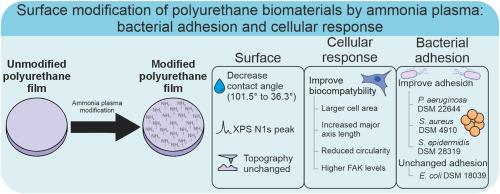
Abstract Image

氨等离子体对聚氨酯生物材料表面的改性:细菌粘附和细胞反应
聚氨酯(pu)是一种多用途聚合物,由于其可调节的特性而广泛用于生物医学应用。然而,基于pu的医疗器械容易受到细菌污染,因此需要进行表面修饰以提高生物相容性并减少定植。本研究利用低温氨血浆将氨基(-NH2)引入PU表面,并评价其对细菌粘附和生物相容性的影响。采用x射线光电子能谱(XPS)、接触角测量、原子力显微镜(AFM)、荧光显微镜和生物相容性测定。氨气血浆有效引入胺基,经XPS证实。接触角明显减小(从101.5°到36.3°),表面自由能明显增加(从27.3到64.6 mJ/m2),表明亲水性增强,而AFM分析显示表面粗糙度(RMS)没有显著变化。铜绿假单胞菌DSM 22644、金黄色葡萄球菌DSM 4910和表皮葡萄球菌DSM 28319的细菌粘附性增加,而大肠杆菌DSM 18039的细菌粘附性不受影响。A549细胞的生物相容性测试显示,细胞黏附性、形态学和细胞骨架组织得到改善,局灶黏附激酶(FAK)表达升高。氨水血浆因此增强PU的生物相容性,同时影响细菌粘附。
本文章由计算机程序翻译,如有差异,请以英文原文为准。
求助全文
约1分钟内获得全文 求助全文
来源期刊
JCIS open
JCIS open Physical and Theoretical Chemistry, Colloid and Surface Chemistry, Surfaces, Coatings and Films
CiteScore
4.10
自引率
0.00%
发文量
0
审稿时长
36 days

×
引用
GB/T 7714-2015
复制
MLA
复制
APA
复制
导出至
BibTeX EndNote RefMan NoteFirst NoteExpress
×
提示
您的信息不完整,为了账户安全,请先补充。
现在去补充
×
提示
您因"违规操作"
具体请查看互助需知
我知道了
×
提示
确定
请完成安全验证×
copy
已复制链接
快去分享给好友吧!
我知道了
右上角分享
点击右上角分享
0
联系我们:info@booksci.cn Book学术提供免费学术资源搜索服务,方便国内外学者检索中英文文献。致力于提供最便捷和优质的服务体验。 Copyright © 2023 布克学术 All rights reserved.
京ICP备2023020795号-1
ghs 京公网安备 11010802042870号
Book学术文献互助
Book学术文献互助群
群 号:604180095
Book学术官方微信
小红书


