
One-step encapsulation of CsPbBr3 nanocrystals with customized polyethylene glycol for single-molecule localization microscopy imaging of cellular microstructures
IF 4.3
3区 材料科学
Q2 MATERIALS SCIENCE, MULTIDISCIPLINARY
引用次数: 0
Abstract
All-inorganic perovskite nanocrystals have emerged as highly effective fluorophores for single molecule localization microscopy (SMLM) imaging due to their remarkable blinking behavior, high photoluminescence quantum yields, and facile synthesis methods. However, the development of all-inorganic perovskite nanocrystals with targeting imaging properties has been limited by their insufficient stability, which presents challenges for their application in the SMLM imaging of cellular microstructures. Herein, a straightforward approach is demonstrated by conjugating cesium lead bromide perovskite nanocrystals (CsPbBr3 NCs) with streptavidin (SA) using ester-functionalized carboxyl polyethylene glycol (COOH-PEG-NHS) to achieve a core-shell composite of SA-modified CsPbBr3 NCs (CsPbBr3@SA) as an immunofluorescence nanoprobe for SMLM imaging of cellular microstructures. The COOH-PEG-NHS served as a bridging agent that initially reacted with the amine groups of the SA and subsequently integrated with CsPbBr3 NCs in a single-step process to minimize the impact of the biological modification process on the optical properties of the CsPbBr3@SA nanoprobe. The obtained CsPbBr3@SA exhibits a significant fluorescence characteristic along with the frequent blinking phenomena. Moreover, SMLM imaging of CsPbBr3@SA demonstrated a localization precision of approximately 3 nm and an elevenfold enhancement in spatial resolution. Furthermore, CsPbBr3@SA was utilized to label the nuclear lamina of the nuclear envelope via immunofluorescence technique. The improved spatial resolution suggests that CsPbBr3@SA is capable of facilitating SMLM imaging of the nuclear lamina. This innovative biological modification method presents significant potential for improving the biological application of all-inorganic perovskite nanocrystals in SMLM.
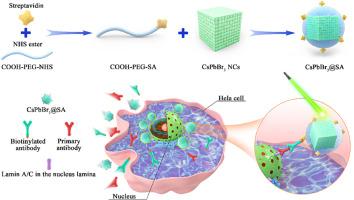
用定制的聚乙二醇一步封装CsPbBr3纳米晶体,用于细胞微观结构的单分子定位显微镜成像
全无机钙钛矿纳米晶体由于其卓越的闪烁行为、高光致发光量子产率和简便的合成方法,已成为单分子定位显微镜(SMLM)成像中高效的荧光团。然而,具有靶向成像特性的全无机钙钛矿纳米晶体的发展受到其稳定性不足的限制,这给其在细胞微结构的SMLM成像中的应用带来了挑战。本文展示了一种简单的方法,即使用酯功能化的羧基聚乙二醇(COOH-PEG-NHS)将铯-溴化铅钙钛矿纳米晶体(CsPbBr3纳米晶体)与链亲和素(SA)偶联,以获得SA修饰的CsPbBr3纳米晶体(CsPbBr3@SA)的核-壳复合材料,作为细胞微结构SMLM成像的免疫荧光纳米探针。COOH-PEG-NHS作为桥接剂,最初与SA的胺基反应,随后与CsPbBr3 NCs在单步过程中整合,以最大限度地减少生物修饰过程对CsPbBr3@SA纳米探针光学性能的影响。所得CsPbBr3@SA具有明显的荧光特性,并伴有频繁的闪烁现象。此外,CsPbBr3@SA的SMLM成像显示定位精度约为3 nm,空间分辨率提高了11倍。此外,利用CsPbBr3@SA通过免疫荧光技术标记核膜的核层。提高的空间分辨率表明CsPbBr3@SA能够促进核层的SMLM成像。这种创新的生物修饰方法为提高全无机钙钛矿纳米晶体在SMLM中的生物应用提供了巨大的潜力。
本文章由计算机程序翻译,如有差异,请以英文原文为准。
求助全文
约1分钟内获得全文
求助全文
来源期刊
Optical Materials
工程技术-材料科学:综合
CiteScore
6.60
自引率
12.80%
发文量
1265
审稿时长
38 days
期刊介绍:
Optical Materials has an open access mirror journal Optical Materials: X, sharing the same aims and scope, editorial team, submission system and rigorous peer review.
The purpose of Optical Materials is to provide a means of communication and technology transfer between researchers who are interested in materials for potential device applications. The journal publishes original papers and review articles on the design, synthesis, characterisation and applications of optical materials.
OPTICAL MATERIALS focuses on:
• Optical Properties of Material Systems;
• The Materials Aspects of Optical Phenomena;
• The Materials Aspects of Devices and Applications.
Authors can submit separate research elements describing their data to Data in Brief and methods to Methods X.
 求助内容:
求助内容: 应助结果提醒方式:

 京公网安备 11010802042870号


