
Electrorheology of methacrylic acid functionalized titania nanotubes in silicone oil
IF 3.9
3区 工程技术
Q2 ENGINEERING, CHEMICAL
Chemical Engineering Research & Design
Pub Date : 2026-03-01
Epub Date: 2026-02-11
DOI:10.1016/j.cherd.2026.02.006
引用次数: 0
Abstract
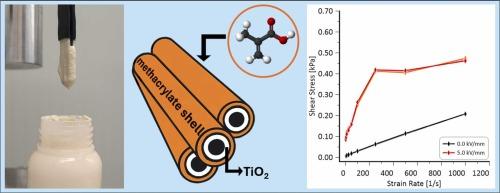
Titanium oxide (TiO2) nanotubes functionalized with a shell of methacrylic acid were synthesized and applied to prepare electrorheological (ER) suspensions in this study. Performance was compared with the bare TiO2 nanotubes and simple spherical commercial nanoparticles. ER performance was evaluated under electric field from 0 to 5 kV/mm using shear and yield stress measurements. The organic shell provided electrical insulation minimizing joule effect during operation and preventing overheating, rendering it more suitable for real life technological applications, while also improving the suspension stability. This came at the cost of some of the ER effect intensity which is directly influenced by the conductivity. The high aspect ratio of the tubes still led to a net performance enhancement compared to the commercial control. From this comparison, a 3.5-fold increase of the rheological response to the field was obtained just from the explored morphology. These findings demonstrate that methacrylic acid functionalization enables safer and more stable ER fluids while preserving superior performance compared to spherical nanoparticles.
甲基丙烯酸功能化二氧化钛纳米管在硅油中的电流变特性
本文合成了以甲基丙烯酸为壳层的氧化钛(TiO2)纳米管,并将其用于制备电流变混悬液。将其性能与裸TiO2纳米管和简单的球形商业纳米颗粒进行了比较。在0 ~ 5 kV/mm的电场下,通过剪切和屈服应力测量来评估ER性能。有机外壳提供电绝缘,最大限度地减少了操作过程中的焦耳效应,防止过热,使其更适合现实生活中的技术应用,同时也提高了悬挂稳定性。这是以一些直接受电导率影响的ER效应强度为代价的。与商业控制相比,高长宽比管仍然导致净性能增强。从这个比较中,仅从探索的形态中就获得了3.5倍的磁场流变响应。这些发现表明,与球形纳米颗粒相比,甲基丙烯酸功能化可以使内质网流体更安全、更稳定,同时保持优越的性能。
本文章由计算机程序翻译,如有差异,请以英文原文为准。
求助全文
约1分钟内获得全文
求助全文
来源期刊
Chemical Engineering Research & Design
工程技术-工程:化工
CiteScore
6.10
自引率
7.70%
发文量
623
审稿时长
42 days
期刊介绍:
ChERD aims to be the principal international journal for publication of high quality, original papers in chemical engineering.
Papers showing how research results can be used in chemical engineering design, and accounts of experimental or theoretical research work bringing new perspectives to established principles, highlighting unsolved problems or indicating directions for future research, are particularly welcome. Contributions that deal with new developments in plant or processes and that can be given quantitative expression are encouraged. The journal is especially interested in papers that extend the boundaries of traditional chemical engineering.
 求助内容:
求助内容: 应助结果提醒方式:

 京公网安备 11010802042870号


