
Dissolution of semicrystalline polyethylene: Contributions of decrystallization and disentanglement to kinetics revealed by integrated experiments and modelling
IF 6.6
2区 工程技术
Q1 ENGINEERING, MECHANICAL
International Journal of Heat and Mass Transfer
Pub Date : 2026-06-01
Epub Date: 2026-02-12
DOI:10.1016/j.ijheatmasstransfer.2026.128478
引用次数: 0
Abstract
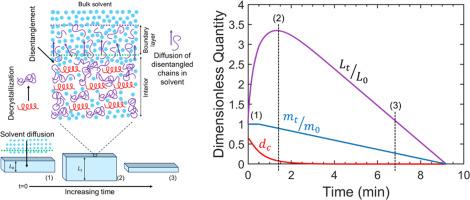
Increased use of plastics and corresponding generation of plastic waste leads to growing pressure for recycling technologies that are both economically viable and environmentally sound. For plastic films, widely used in packaging and comprising mostly polyolefins, mechanical recycling is not practical, hence the interest in chemical recycling. Dissolution/precipitation recycling can recover polyolefins for re-use, with energy needs and emissions much lower than pyrolysis. The dissolution of polyolefins is key to this recycling process, however, the underlying phenomena which govern the dissolution of semicrystalline polymers are little studied. To address this gap in knowledge, the swelling and dissolution kinetics of high-density polyethylene (HDPE) films are investigated here. Experiments are designed to obtain the time evolution of HDPE dissolved mass and degree of crystallinity. A mathematical model is developed to describe the swelling and dissolution of semicrystalline HDPE based on the transport phenomena and thermodynamics governing the process. Experimental data are used to validate the model and to obtain values for the two key fitted parameters, decrystallization constant and disentanglement rate. The detailed information provided by the model, spatial and temporal composition and solvent diffusion, reveals the molecular mechanism of HDPE dissolution. A parametric analysis is performed using the validated model to simulate dissolution phenomena at varying conditions, including initial degree of crystallinity and film thickness. These insights on polyethylene dissolution facilitate the design of more energy efficient and environment-friendly dissolution-precipitation recycling processes. The model can be extended to probe the dissolution of other semicrystalline polymers.
半结晶聚乙烯的溶解:通过综合实验和模型揭示的脱晶和解缠对动力学的贡献
塑料使用的增加和相应的塑料废物的产生导致对经济上可行且无害环境的回收技术的压力越来越大。对于广泛用于包装且主要由聚烯烃组成的塑料薄膜,机械回收是不实际的,因此对化学回收感兴趣。溶解/沉淀回收法可以回收聚烯烃进行再利用,其能源需求和排放量远低于热解法。聚烯烃的溶解是这一回收过程的关键,然而,控制半晶聚合物溶解的潜在现象很少被研究。为了解决这方面的知识差距,本文研究了高密度聚乙烯(HDPE)薄膜的膨胀和溶解动力学。通过实验得到了HDPE的溶解质量和结晶度随时间的变化规律。基于输运现象和热力学,建立了描述半结晶HDPE溶胀和溶解过程的数学模型。利用实验数据对模型进行了验证,并得到了解晶常数和解缠率这两个关键拟合参数的值。模型提供的详细信息,时空组成和溶剂扩散,揭示了HDPE溶解的分子机制。利用验证的模型进行参数分析,模拟不同条件下的溶解现象,包括初始结晶度和薄膜厚度。这些关于聚乙烯溶解的见解有助于设计更节能、更环保的溶解沉淀回收工艺。该模型可推广到其他半晶聚合物的溶解。
本文章由计算机程序翻译,如有差异,请以英文原文为准。
求助全文
约1分钟内获得全文
求助全文
来源期刊
CiteScore
10.30
自引率
13.50%
发文量
1319
审稿时长
41 days
期刊介绍:
International Journal of Heat and Mass Transfer is the vehicle for the exchange of basic ideas in heat and mass transfer between research workers and engineers throughout the world. It focuses on both analytical and experimental research, with an emphasis on contributions which increase the basic understanding of transfer processes and their application to engineering problems.
Topics include:
-New methods of measuring and/or correlating transport-property data
-Energy engineering
-Environmental applications of heat and/or mass transfer
 求助内容:
求助内容: 应助结果提醒方式:

 京公网安备 11010802042870号


