
Modified bi-Gaussian models to describe chromatographic peaks as a function of peak-shape parameters

IF 3.2
Journal of chromatography open Pub Date : 2026-05-01 Epub Date: 2026-02-21 DOI:10.1016/j.jcoa.2026.100317
J.J. Baeza-Baeza, L.J. Baeza-Ballesteros, J.R. Torres-Lapasió, M.C. García-Alvarez-Coque
{"title":"Modified bi-Gaussian models to describe chromatographic peaks as a function of peak-shape parameters","authors":"J.J. Baeza-Baeza,&nbsp;L.J. Baeza-Ballesteros,&nbsp;J.R. Torres-Lapasió,&nbsp;M.C. García-Alvarez-Coque","doi":"10.1016/j.jcoa.2026.100317","DOIUrl":null,"url":null,"abstract":"<div><div>The modelling and prediction of chromatographic peak profiles have been extensively studied, with foundational contributions such as Grushka's bi-Gaussian model. In this work, this approach is extended to two modified Gaussian models: The Linear Modified Gaussian (LMG) and the Parabolic Variance Modified Gaussian (PVMG). These models enhance the traditional Gaussian framework by allowing the peak variance to change according to parabolic trends, thereby capturing deviations from ideal Gaussian peak shapes. This added flexibility enables a more accurate representation of a wide range of chromatographic peak shapes with varying degrees of asymmetry. The proposed modified bi-Gaussian models (BLMG and BVMG with six and seven parameters) use peak-shape parameters that can be expressed as functions of retention time. This makes them well suited for predicting peak shape and chromatographic resolution, which are key factors in optimising the separation of complex analyte mixtures. The BVMG model with seven parameters yields fitting errors below 1 % for most peaks and below 2 % for the peaks of all assayed probe compounds, comparable to the more sophisticated Parabolic Lorentzian Modified Gaussian (PLMG) model, while relying only on peak-shape parameters (retention time, peak height at the peak maximum, and half-widths measured at 60 and 10 % of peak height). The performance of the models is validated through the fitting and prediction of chromatographic peaks for compounds eluted using two columns with distinct retention mechanisms: Zorbax C18 and Hypercarb porous graphitic carbon columns.</div></div>","PeriodicalId":93576,"journal":{"name":"Journal of chromatography open","volume":"9 ","pages":"Article 100317"},"PeriodicalIF":3.2000,"publicationDate":"2026-05-01","publicationTypes":"Journal Article","fieldsOfStudy":null,"isOpenAccess":false,"openAccessPdf":"","citationCount":"0","resultStr":null,"platform":"Semanticscholar","paperid":null,"PeriodicalName":"Journal of chromatography open","FirstCategoryId":"1085","ListUrlMain":"https://www.sciencedirect.com/science/article/pii/S2772391726000125","RegionNum":0,"RegionCategory":null,"ArticlePicture":[],"TitleCN":null,"AbstractTextCN":null,"PMCID":null,"EPubDate":"2026/2/21 0:00:00","PubModel":"Epub","JCR":"","JCRName":"","Score":null,"Total":0}
引用次数: 0

Abstract

The modelling and prediction of chromatographic peak profiles have been extensively studied, with foundational contributions such as Grushka's bi-Gaussian model. In this work, this approach is extended to two modified Gaussian models: The Linear Modified Gaussian (LMG) and the Parabolic Variance Modified Gaussian (PVMG). These models enhance the traditional Gaussian framework by allowing the peak variance to change according to parabolic trends, thereby capturing deviations from ideal Gaussian peak shapes. This added flexibility enables a more accurate representation of a wide range of chromatographic peak shapes with varying degrees of asymmetry. The proposed modified bi-Gaussian models (BLMG and BVMG with six and seven parameters) use peak-shape parameters that can be expressed as functions of retention time. This makes them well suited for predicting peak shape and chromatographic resolution, which are key factors in optimising the separation of complex analyte mixtures. The BVMG model with seven parameters yields fitting errors below 1 % for most peaks and below 2 % for the peaks of all assayed probe compounds, comparable to the more sophisticated Parabolic Lorentzian Modified Gaussian (PLMG) model, while relying only on peak-shape parameters (retention time, peak height at the peak maximum, and half-widths measured at 60 and 10 % of peak height). The performance of the models is validated through the fitting and prediction of chromatographic peaks for compounds eluted using two columns with distinct retention mechanisms: Zorbax C18 and Hypercarb porous graphitic carbon columns.
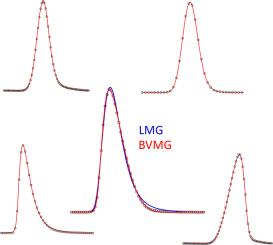
Abstract Image

改进双高斯模型,将色谱峰描述为峰形参数的函数
色谱峰分布的建模和预测已经得到了广泛的研究,其中包括Grushka的双高斯模型。在这项工作中,该方法扩展到两种修正高斯模型:线性修正高斯(LMG)和抛物方差修正高斯(PVMG)。这些模型通过允许峰值方差根据抛物线趋势变化来增强传统高斯框架,从而捕获与理想高斯峰值形状的偏差。这种增加的灵活性可以更准确地表示具有不同程度不对称的各种色谱峰形状。所提出的改进双高斯模型(BLMG和BVMG分别有6个和7个参数)使用的峰形参数可以表示为保留时间的函数。这使得它们非常适合预测峰形和色谱分辨率,这是优化复杂分析混合物分离的关键因素。具有7个参数的BVMG模型对大多数峰的拟合误差小于1%,对所有被测探针化合物的峰的拟合误差小于2%,与更复杂的抛物洛伦兹修正高斯(PLMG)模型相当,而仅依赖于峰形参数(保留时间、峰高峰值时的峰高以及峰高60%和10%时测量的半宽度)。通过对Zorbax C18和Hypercarb多孔石墨碳柱两种保留机制不同的色谱柱洗脱的化合物的色谱峰进行拟合和预测,验证了模型的性能。
本文章由计算机程序翻译,如有差异,请以英文原文为准。
求助全文
约1分钟内获得全文 求助全文
来源期刊
Journal of chromatography open
Journal of chromatography open Analytical Chemistry
CiteScore
2.50
自引率
0.00%
发文量
0
审稿时长
50 days

×
引用
GB/T 7714-2015
复制
MLA
复制
APA
复制
导出至
BibTeX EndNote RefMan NoteFirst NoteExpress
×
提示
您的信息不完整,为了账户安全,请先补充。
现在去补充
×
提示
您因"违规操作"
具体请查看互助需知
我知道了
×
提示
确定
请完成安全验证×
copy
已复制链接
快去分享给好友吧!
我知道了
右上角分享
点击右上角分享
0
联系我们:info@booksci.cn Book学术提供免费学术资源搜索服务,方便国内外学者检索中英文文献。致力于提供最便捷和优质的服务体验。 Copyright © 2023 布克学术 All rights reserved.
京ICP备2023020795号-1
ghs 京公网安备 11010802042870号
Book学术文献互助
Book学术文献互助群
群 号:604180095
Book学术官方微信
小红书


