
Improving emulsification for pesticide control: The role of Phytolacca dodecandra leaf extract and tween 80
IF 3.2
Journal of chromatography open
Pub Date : 2026-05-01
Epub Date: 2026-02-15
DOI:10.1016/j.jcoa.2026.100313
引用次数: 0
Abstract
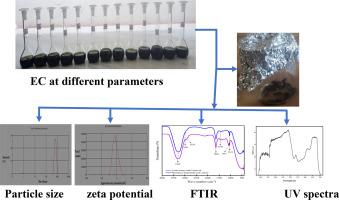
This study focuses on optimizing the emulsification process utilizing Phytolacca dodecandra leaf extract in combination with emulsifier (Tween 80) for household cockroach control. The main aim is to evaluate and enhance emulsion stability and efficiency through systematic experimentation. Employing the Box-Behnken Design (BBD) within response surface methodology (RSM), key EC variables including mixing time (20, 40, and 60 min), mixing temperature (25, 42.5, and 60 °C), and crude extract with emulsifier ratio (10:10, 15:15, and 20:20 wt/wt) were investigated to determine optimization for the response variables of pH and viscosity of EC. The EC optimization, characterization, and efficiency were investigated. The results were demonstrated significant interactions among variables, with optimal emulsification achieved at mixing time (40 min), mixing temperature (42.5 °C), crude extract to Tween 80 ratio (15:15 wt/wt) with a pH (7.678) and viscosity (5.768 cp). At this optimal point, the UV–Vis spectroscopy (230–400 nm) confirmed the presence of bioactive compounds responsible for emulsification. FTIR analysis identified functional groups involved in stabilization the emulsion. By using natural plant extracts like Phytolacca dodecandra and surfactants like Tween 80, the research advances the development of sustainable and eco-friendly emulsification systems. Bioassay testing on cockroaches showed that the prepared emulsion at optimal result was effective; within ten minutes of exposure, a mortality rate of 100 % was observed using 5 ml of the EC for 15 cockroaches for three replicants. Whereas, a positive control (mortien) and negative control (Tween 80), were laid with three replications. Mortality 100 % and 0 % of cockroaches was recorded after 24 h of exposure for both positive and negative control respectively. This method provides an efficient and safe way to control household cockroaches, lowering the need for dangerous chemical pesticides and fostering safer living conditions.
改善乳化液对农药防治的作用:十二植甲叶提取物和乳化剂的作用
本研究主要研究了利用十二胎甲叶提取物与乳化剂Tween 80联合用于灭蟑的乳化工艺优化。主要目的是通过系统的实验来评价和提高乳液的稳定性和效率。采用响应面法(RSM)中的Box-Behnken设计(BBD),研究了乳化剂配比(10:10、15:15和20:20 wt/wt)、混合时间(20、40和60 min)、混合温度(25、42.5和60℃)和粗提液(10:10、15:15和20:20 wt/wt)等关键乳化剂变量对乳化剂pH和粘度的影响。考察了EC的优化、表征和效率。结果表明,各变量之间存在显著的相互作用,在混合时间(40分钟)、混合温度(42.5°C)、粗提物与Tween 80的比例(15:15 wt/wt)、pH(7.678)和粘度(5.768 cp)的条件下达到最佳乳化效果。在这个最佳点,紫外可见光谱(230-400 nm)证实了负责乳化的生物活性化合物的存在。FTIR分析确定了稳定乳液的官能团。通过使用天然植物提取物如十二胎草和表面活性剂如Tween 80,该研究推动了可持续和环保乳化系统的发展。对蜚蠊进行生物测定试验表明,制备的最佳乳状液效果良好;在暴露10分钟内,使用5毫升EC对3个复制体的15只蟑螂进行处理,观察到死亡率为100%。阳性对照(mortien)和阴性对照(Tween 80)设3个重复。阳性对照和阴性对照暴露24 h后,蟑螂死亡率分别为100%和0%。这种方法为控制家庭蟑螂提供了一种有效和安全的方法,降低了对危险化学农药的需求,并创造了更安全的生活条件。
本文章由计算机程序翻译,如有差异,请以英文原文为准。
求助全文
约1分钟内获得全文
求助全文
来源期刊

Journal of chromatography open
Analytical Chemistry
CiteScore
2.50
自引率
0.00%
发文量
0
审稿时长
50 days
 求助内容:
求助内容: 应助结果提醒方式:

 京公网安备 11010802042870号


