
Hidden defects unveiled: Solvent-driven kinetic accessibility in anatase TiO2 pseudocapacitance

IF 5.6 3区 材料科学 Q1 ELECTROCHEMISTRY
Electrochimica Acta Pub Date : 2026-05-20 Epub Date: 2026-03-10 DOI:10.1016/j.electacta.2026.148647
K. Sakthiraj , B. Karthikeyan , M. Hema
{"title":"Hidden defects unveiled: Solvent-driven kinetic accessibility in anatase TiO2 pseudocapacitance","authors":"K. Sakthiraj ,&nbsp;B. Karthikeyan ,&nbsp;M. Hema","doi":"10.1016/j.electacta.2026.148647","DOIUrl":null,"url":null,"abstract":"<div><div>Organic solvent selection in anatase TiO₂ nanoparticle synthesis profoundly influences microstructure and electrochemical performance despite comparable intrinsic defect chemistry. Comprehensive multi-scale characterization of ethanol-, ethylene glycol-, and glycerol-assisted TiO₂ reveals that ethanol-derived monodispersed ∼10-15 nm low-strain nanoparticles with clean surfaces achieve superior galvanostatic capacitance (44.4 mF g⁻¹ at 0.2 mA g⁻¹), linear charge-discharge profiles, and minimal charge-transfer resistance (∼12 Ω), reflecting 9.4% defect utilization. In stark contrast, glycerol-assisted TiO₂—featuring ∼15-20 nm primary crystallites, 9 times higher lattice strain, and residual organic coatings (5.32 at% C)—exhibits excellent equilibrium capacitance (563 F g⁻¹ at 2 mV s⁻¹) but catastrophic practical failure (7.8 mF g⁻¹ at 0.2 mA g⁻¹), trapping 98.6% of Ti³⁺/oxygen vacancy sites due to 12 times elevated impedance (R<sub>ct</sub>∼150 Ω). Ethylene glycol occupies the performance intermediate. Cyclic voltammetry, galvanostatic charge-discharge, Randles-Sevcik, and electrochemical impedance spectroscopy establish a kinetic accessibility framework: solvent microstructure governs not defect quantity but practical electroactivity. This work provides rational design principles—ethanol TiO₂ for high-energy pseudocapacitors, glycerol TiO₂ for ultra-long cycle life (93% retention after 1000 cycles)—with broad implications for defect-engineered electrochemical energy storage.</div></div>","PeriodicalId":305,"journal":{"name":"Electrochimica Acta","volume":"559 ","pages":"Article 148647"},"PeriodicalIF":5.6000,"publicationDate":"2026-05-20","publicationTypes":"Journal Article","fieldsOfStudy":null,"isOpenAccess":false,"openAccessPdf":"","citationCount":"0","resultStr":null,"platform":"Semanticscholar","paperid":null,"PeriodicalName":"Electrochimica Acta","FirstCategoryId":"88","ListUrlMain":"https://www.sciencedirect.com/science/article/pii/S0013468626005396","RegionNum":3,"RegionCategory":"材料科学","ArticlePicture":[],"TitleCN":null,"AbstractTextCN":null,"PMCID":null,"EPubDate":"2026/3/10 0:00:00","PubModel":"Epub","JCR":"Q1","JCRName":"ELECTROCHEMISTRY","Score":null,"Total":0}
引用次数: 0

Abstract

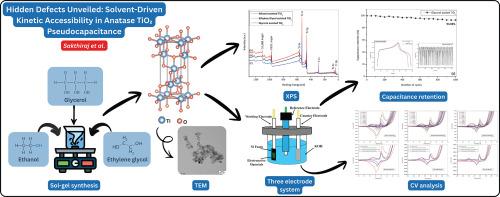
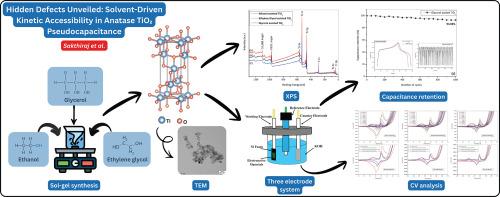
Organic solvent selection in anatase TiO₂ nanoparticle synthesis profoundly influences microstructure and electrochemical performance despite comparable intrinsic defect chemistry. Comprehensive multi-scale characterization of ethanol-, ethylene glycol-, and glycerol-assisted TiO₂ reveals that ethanol-derived monodispersed ∼10-15 nm low-strain nanoparticles with clean surfaces achieve superior galvanostatic capacitance (44.4 mF g⁻¹ at 0.2 mA g⁻¹), linear charge-discharge profiles, and minimal charge-transfer resistance (∼12 Ω), reflecting 9.4% defect utilization. In stark contrast, glycerol-assisted TiO₂—featuring ∼15-20 nm primary crystallites, 9 times higher lattice strain, and residual organic coatings (5.32 at% C)—exhibits excellent equilibrium capacitance (563 F g⁻¹ at 2 mV s⁻¹) but catastrophic practical failure (7.8 mF g⁻¹ at 0.2 mA g⁻¹), trapping 98.6% of Ti³⁺/oxygen vacancy sites due to 12 times elevated impedance (Rct∼150 Ω). Ethylene glycol occupies the performance intermediate. Cyclic voltammetry, galvanostatic charge-discharge, Randles-Sevcik, and electrochemical impedance spectroscopy establish a kinetic accessibility framework: solvent microstructure governs not defect quantity but practical electroactivity. This work provides rational design principles—ethanol TiO₂ for high-energy pseudocapacitors, glycerol TiO₂ for ultra-long cycle life (93% retention after 1000 cycles)—with broad implications for defect-engineered electrochemical energy storage.
Abstract Image

Abstract Image

揭露隐藏缺陷:锐钛矿TiO2赝电容中溶剂驱动的动力学可及性
在锐钛矿型纳米tio2合成中,有机溶剂的选择对纳米tio2的微观结构和电化学性能有着深远的影响。对乙醇、乙二醇和甘油辅助TiO 2的综合多尺度表征表明,乙醇衍生的单分散~ 10-15 nm低strain纳米颗粒具有清洁的表面,具有优越的恒流电容(44.4 mF g⁻¹at 0.2 mA g⁻¹)、线性充放电曲线和最小的电荷转移电阻(~ 12 Ω),反映了9.4%的缺陷利用。与此形成强烈对比的是,甘油-辅助TiO 2 -具有~ 15-20 nm的初生晶体,9倍高的晶格strain和残留的有机涂层(% C时5.32)-表现出良好的平衡电容(563 F g⁻¹在2 mV s时毒化),但灾难性的实际失败(7.8 mF g⁻¹在0.2 mA g⁻¹),由于12倍高的阻抗(Rct ~ 150 Ω), Ti³+ /氧空缺位点被捕获。乙二醇作为性能中间体。循环伏安法、恒流充放电、Randles-Sevcik和电化学阻抗谱建立了动力学可及性框架:溶剂微观结构决定的不是缺陷数量,而是实际的电活性。这项工作提供了合理的设计原则——乙醇TiO₂用于高能伪电容器,甘油TiO₂用于超长循环寿命(1000次循环后保持93%)——对缺陷工程电化学储能具有广泛的意义。
本文章由计算机程序翻译,如有差异,请以英文原文为准。
求助全文
约1分钟内获得全文 求助全文
来源期刊
Electrochimica Acta
Electrochimica Acta 工程技术-电化学
CiteScore
11.30
自引率
6.10%
发文量
1634
审稿时长
41 days
期刊介绍: Electrochimica Acta is an international journal. It is intended for the publication of both original work and reviews in the field of electrochemistry. Electrochemistry should be interpreted to mean any of the research fields covered by the Divisions of the International Society of Electrochemistry listed below, as well as emerging scientific domains covered by ISE New Topics Committee.

×
引用
GB/T 7714-2015
复制
MLA
复制
APA
复制
导出至
BibTeX EndNote RefMan NoteFirst NoteExpress
×
提示
您的信息不完整,为了账户安全,请先补充。
现在去补充
×
提示
您因"违规操作"
具体请查看互助需知
我知道了
×
提示
确定
请完成安全验证×
copy
已复制链接
快去分享给好友吧!
我知道了
右上角分享
点击右上角分享
0
联系我们:info@booksci.cn Book学术提供免费学术资源搜索服务,方便国内外学者检索中英文文献。致力于提供最便捷和优质的服务体验。 Copyright © 2023 布克学术 All rights reserved.
京ICP备2023020795号-1
ghs 京公网安备 11010802042870号
Book学术文献互助
Book学术文献互助群
群 号:604180095
Book学术官方微信
小红书


