{"title":"Kenny is the adaptor protein for ubiquitin-dependent mitophagy in <i>Drosophila melanogaster</i>.","authors":"Hubert Osei Acheampong, Ryan Insolera","doi":"10.1080/27694127.2026.2638025","DOIUrl":null,"url":null,"abstract":"<p><p>Mitophagy is the selective degradation program for damaged and unnecessary mitochondria to maintain cellular mitostasis and survival. Specific mutations in the mediators for the canonical ubiquitin (ub)-dependent mitophagy pathway have been identified with unique neurological diseases like Parkinson disease and ALS (amyotrophic lateral sclerosis), metabolic diseases, and cancer. Mammalian OPTN (optineurin) has been shown as a SAR (selective autophagy receptor) for ub-dependent mitophagy in vitro with direct connections of its mutations with glaucoma and ALS. Despite the in vitro demonstration of OPTN's role in mitophagy, the in vivo physiological characterization of OPTN's mitophagy function is largely unexplored. In our recent study, we provide in vivo evidence that the <i>Drosophila melanogaster</i> (Dm) protein, Kenny, directly mediates the sequestration of target mitochondria for the progression and completion of ub-dependent mitophagy. This result establishes Kenny as the Dm homolog of OPTN. Previously, Kenny had only been characterized for its role in innate immune activation and modulation. The conclusion from this study provides avenues for further understanding the in vivo signaling regulating Kenny's role in mitophagy and investigating homologous disease-relevant mutations of OPTN in Dm.</p>","PeriodicalId":72341,"journal":{"name":"Autophagy reports","volume":"5 1","pages":"2638025"},"PeriodicalIF":0.0000,"publicationDate":"2026-03-04","publicationTypes":"Journal Article","fieldsOfStudy":null,"isOpenAccess":false,"openAccessPdf":"https://www.ncbi.nlm.nih.gov/pmc/articles/PMC12962666/pdf/","citationCount":"0","resultStr":null,"platform":"Semanticscholar","paperid":null,"PeriodicalName":"Autophagy reports","FirstCategoryId":"1085","ListUrlMain":"https://doi.org/10.1080/27694127.2026.2638025","RegionNum":0,"RegionCategory":null,"ArticlePicture":[],"TitleCN":null,"AbstractTextCN":null,"PMCID":null,"EPubDate":"2026/1/1 0:00:00","PubModel":"eCollection","JCR":"","JCRName":"","Score":null,"Total":0}
引用次数: 0
Abstract
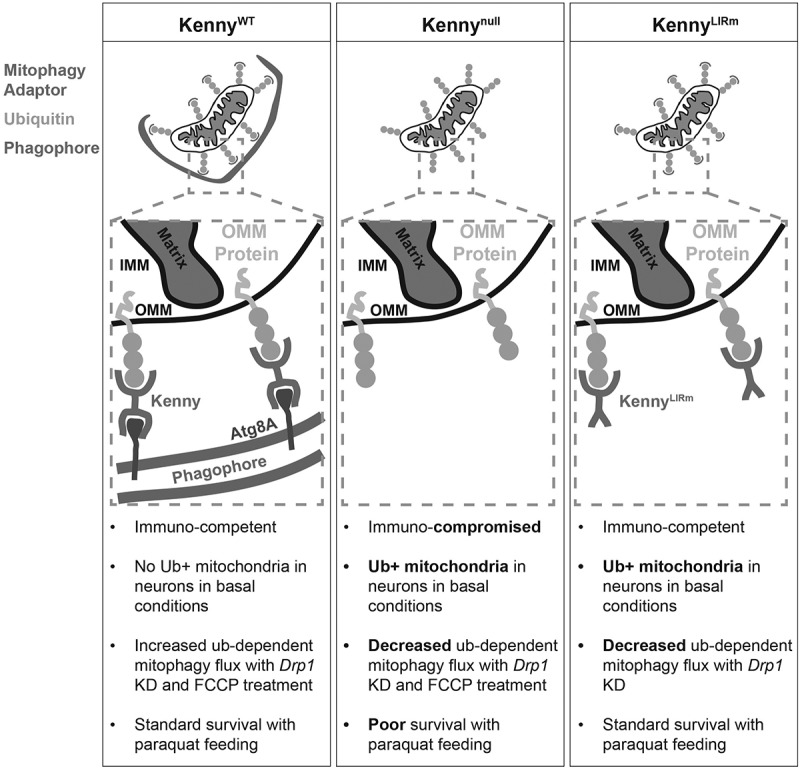
Mitophagy is the selective degradation program for damaged and unnecessary mitochondria to maintain cellular mitostasis and survival. Specific mutations in the mediators for the canonical ubiquitin (ub)-dependent mitophagy pathway have been identified with unique neurological diseases like Parkinson disease and ALS (amyotrophic lateral sclerosis), metabolic diseases, and cancer. Mammalian OPTN (optineurin) has been shown as a SAR (selective autophagy receptor) for ub-dependent mitophagy in vitro with direct connections of its mutations with glaucoma and ALS. Despite the in vitro demonstration of OPTN's role in mitophagy, the in vivo physiological characterization of OPTN's mitophagy function is largely unexplored. In our recent study, we provide in vivo evidence that the Drosophila melanogaster (Dm) protein, Kenny, directly mediates the sequestration of target mitochondria for the progression and completion of ub-dependent mitophagy. This result establishes Kenny as the Dm homolog of OPTN. Previously, Kenny had only been characterized for its role in innate immune activation and modulation. The conclusion from this study provides avenues for further understanding the in vivo signaling regulating Kenny's role in mitophagy and investigating homologous disease-relevant mutations of OPTN in Dm.



 求助内容:
求助内容: 应助结果提醒方式:

 京公网安备 11010802042870号


