Comparison of Clinical Performance of Preformed CAD/CAM Milled PMMA Crown and Stainless Steel Crown for Primary Molar Teeth Using Dental Operating Microscope.
A K Shanmugaavel, Priyanka Balakrishnan, Taslima Nandhini, Ranjith Akshay Seshari Iyer, Daya Srinivasan, Ar Senthil Eagappan
{"title":"Comparison of Clinical Performance of Preformed CAD/CAM Milled PMMA Crown and Stainless Steel Crown for Primary Molar Teeth Using Dental Operating Microscope.","authors":"A K Shanmugaavel, Priyanka Balakrishnan, Taslima Nandhini, Ranjith Akshay Seshari Iyer, Daya Srinivasan, Ar Senthil Eagappan","doi":"10.5005/jp-journals-10005-3400","DOIUrl":null,"url":null,"abstract":"<p><strong>Background: </strong>Full-coverage restorations are essential for the long-term preservation of extensively carious primary molars. While preformed stainless steel crowns (P-SSCs) are the gold standard due to their durability, esthetic concerns have led to the development of alternative options such as preformed 3D-milled polymethylmethacrylate (P-PMMA) crowns, which offer improved appearance and marginal adaptation.</p><p><strong>Aim: </strong>To compare the clinical efficiency of P-PMMA crowns and P-SSCs in restoring mandibular second primary molars over a 6-month period in terms of gingival health, occlusal wear, and crown failure/dislodgement.</p><p><strong>Materials and methods: </strong>A randomized controlled clinical trial was conducted on 34 children aged 4-8 years with bilateral carious mandibular second primary molars. Using a split-mouth design, one molar received a P-SSC and the contralateral molar received a P-PMMA crown. Clinical evaluations were performed at baseline, 3 months, and 6 months. Parameters assessed included gingival health (using modified gingival index), occlusal wear (visual-tactile assessment), and crown retention. Data were analyzed using paired <i>t</i>-tests and Chi-square tests (<i>p</i> < 0.05 considered significant).</p><p><strong>Results: </strong>Both crown types demonstrated satisfactory performance at 6 months. P-SSCs showed slightly higher retention rates, while P-PMMA crowns had better esthetic outcomes and comparable gingival health. No statistically significant differences were observed in occlusal wear between the groups.</p><p><strong>Conclusion: </strong>Preformed polymethylmethacrylate crowns are a clinically acceptable esthetic alternative to P-SSCs for mandibular second primary molars, showing comparable short-term performance with enhanced patient and parent satisfaction.</p><p><strong>How to cite this article: </strong>Shanmugaavel AK, Balakrishnan P, Nandhini T, <i>et al.</i> Comparison of Clinical Performance of Preformed CAD/CAM Milled PMMA Crown and Stainless Steel Crown for Primary Molar Teeth Using Dental Operating Microscope. Int J Clin Pediatr Dent 2026;19(2):139-144.</p>","PeriodicalId":36045,"journal":{"name":"International Journal of Clinical Pediatric Dentistry","volume":"19 2","pages":"139-144"},"PeriodicalIF":0.0000,"publicationDate":"2026-02-01","publicationTypes":"Journal Article","fieldsOfStudy":null,"isOpenAccess":false,"openAccessPdf":"https://www.ncbi.nlm.nih.gov/pmc/articles/PMC12960349/pdf/","citationCount":"0","resultStr":null,"platform":"Semanticscholar","paperid":null,"PeriodicalName":"International Journal of Clinical Pediatric Dentistry","FirstCategoryId":"1085","ListUrlMain":"https://doi.org/10.5005/jp-journals-10005-3400","RegionNum":0,"RegionCategory":null,"ArticlePicture":[],"TitleCN":null,"AbstractTextCN":null,"PMCID":null,"EPubDate":"2026/2/12 0:00:00","PubModel":"Epub","JCR":"Q3","JCRName":"Dentistry","Score":null,"Total":0}
引用次数: 0
Abstract
Background: Full-coverage restorations are essential for the long-term preservation of extensively carious primary molars. While preformed stainless steel crowns (P-SSCs) are the gold standard due to their durability, esthetic concerns have led to the development of alternative options such as preformed 3D-milled polymethylmethacrylate (P-PMMA) crowns, which offer improved appearance and marginal adaptation.
Aim: To compare the clinical efficiency of P-PMMA crowns and P-SSCs in restoring mandibular second primary molars over a 6-month period in terms of gingival health, occlusal wear, and crown failure/dislodgement.
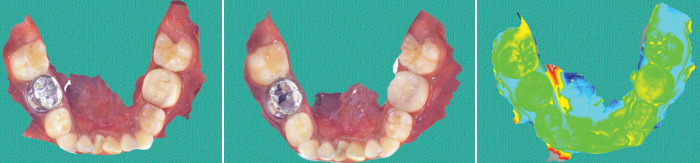
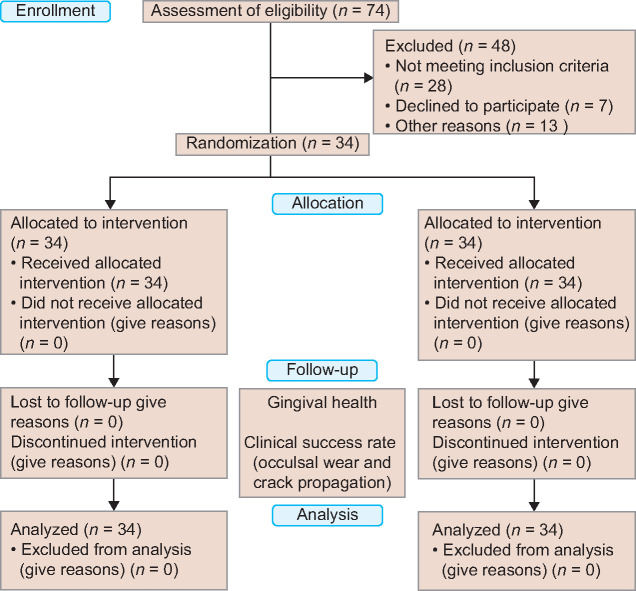
Materials and methods: A randomized controlled clinical trial was conducted on 34 children aged 4-8 years with bilateral carious mandibular second primary molars. Using a split-mouth design, one molar received a P-SSC and the contralateral molar received a P-PMMA crown. Clinical evaluations were performed at baseline, 3 months, and 6 months. Parameters assessed included gingival health (using modified gingival index), occlusal wear (visual-tactile assessment), and crown retention. Data were analyzed using paired t-tests and Chi-square tests (p < 0.05 considered significant).
Results: Both crown types demonstrated satisfactory performance at 6 months. P-SSCs showed slightly higher retention rates, while P-PMMA crowns had better esthetic outcomes and comparable gingival health. No statistically significant differences were observed in occlusal wear between the groups.
Conclusion: Preformed polymethylmethacrylate crowns are a clinically acceptable esthetic alternative to P-SSCs for mandibular second primary molars, showing comparable short-term performance with enhanced patient and parent satisfaction.
How to cite this article: Shanmugaavel AK, Balakrishnan P, Nandhini T, et al. Comparison of Clinical Performance of Preformed CAD/CAM Milled PMMA Crown and Stainless Steel Crown for Primary Molar Teeth Using Dental Operating Microscope. Int J Clin Pediatr Dent 2026;19(2):139-144.



 求助内容:
求助内容: 应助结果提醒方式:

 京公网安备 11010802042870号


