{"title":"Analysis of risk factors and establishment of a prediction model for latent autoimmune diabetes in adults.","authors":"Haiyan Yan, Jiarong Lv, Lingling Miao, Lei Shi","doi":"10.1177/20420188261423784","DOIUrl":null,"url":null,"abstract":"<p><strong>Background: </strong>Latent autoimmune diabetes in adults (LADA) is a form of diabetes that shares clinical features with type 2 diabetes mellitus (T2DM), often leading to misdiagnosis and delayed treatment. Early detection is critical to prevent the progression of the disease.</p><p><strong>Objectives: </strong>This study aims to analyze the risk factors of LADA and develop a predictive model to enhance early diagnosis.</p><p><strong>Design: </strong>A retrospective study was conducted on T2DM patients treated at our hospital between June 2019 and June 2024. The study focused on identifying risk factors for LADA and developing a predictive model.</p><p><strong>Data sources and methods: </strong>Clinical data of 728 patients (651 non-LADA, 77 LADA) were analyzed. LASSO regression was used for variable selection, followed by logistic regression to identify risk factors. The model's performance was assessed using the receiver operating characteristic curve and the Hosmer-Lemeshow test.</p><p><strong>Results: </strong>Significant differences were found between the non-LADA and LADA groups in terms of thyroid disease history, diabetic ketoacidosis, fasting plasma glucose (FPG), 2-hour postprandial glucose (2hPG), and glycated hemoglobin (HbA1c) levels (<i>p</i> < 0.05). Logistic regression identified thyroid disease history, FPG, 2hPG, and HbA1c as key risk factors for LADA. The model achieved an area under the curve of 0.907, with a sensitivity of 76.6% and specificity of 91.9%, indicating strong discrimination and robust calibration (<i>p</i> = 0.275).</p><p><strong>Conclusion: </strong>The predictive model based on thyroid disease history, FPG, 2hPG, and HbA1c demonstrates excellent predictive ability in our cohort for early identification of LADA, suggesting its potential to aid in timely intervention and improved patient outcomes.<i>Trial registration:</i> Not applicable.</p>","PeriodicalId":22998,"journal":{"name":"Therapeutic Advances in Endocrinology and Metabolism","volume":"17 ","pages":"20420188261423784"},"PeriodicalIF":4.6000,"publicationDate":"2026-03-06","publicationTypes":"Journal Article","fieldsOfStudy":null,"isOpenAccess":false,"openAccessPdf":"https://www.ncbi.nlm.nih.gov/pmc/articles/PMC12966588/pdf/","citationCount":"0","resultStr":null,"platform":"Semanticscholar","paperid":null,"PeriodicalName":"Therapeutic Advances in Endocrinology and Metabolism","FirstCategoryId":"3","ListUrlMain":"https://doi.org/10.1177/20420188261423784","RegionNum":3,"RegionCategory":"医学","ArticlePicture":[],"TitleCN":null,"AbstractTextCN":null,"PMCID":null,"EPubDate":"2026/1/1 0:00:00","PubModel":"eCollection","JCR":"Q2","JCRName":"ENDOCRINOLOGY & METABOLISM","Score":null,"Total":0}
引用次数: 0
Abstract
Background: Latent autoimmune diabetes in adults (LADA) is a form of diabetes that shares clinical features with type 2 diabetes mellitus (T2DM), often leading to misdiagnosis and delayed treatment. Early detection is critical to prevent the progression of the disease.
Objectives: This study aims to analyze the risk factors of LADA and develop a predictive model to enhance early diagnosis.
Design: A retrospective study was conducted on T2DM patients treated at our hospital between June 2019 and June 2024. The study focused on identifying risk factors for LADA and developing a predictive model.
Data sources and methods: Clinical data of 728 patients (651 non-LADA, 77 LADA) were analyzed. LASSO regression was used for variable selection, followed by logistic regression to identify risk factors. The model's performance was assessed using the receiver operating characteristic curve and the Hosmer-Lemeshow test.
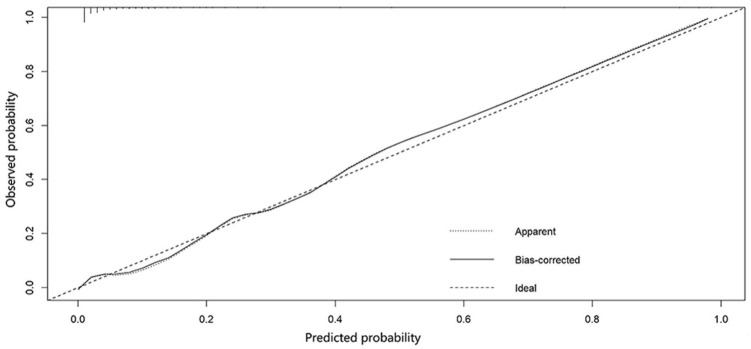
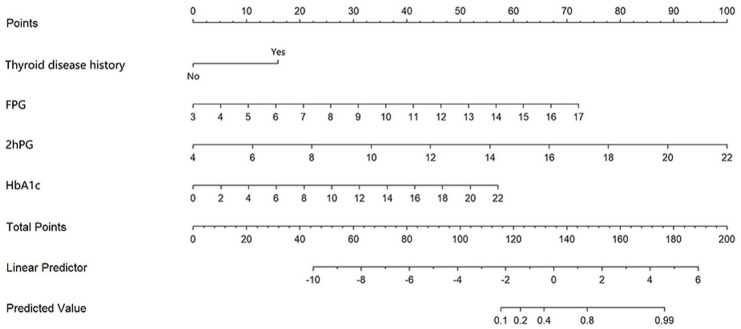
Results: Significant differences were found between the non-LADA and LADA groups in terms of thyroid disease history, diabetic ketoacidosis, fasting plasma glucose (FPG), 2-hour postprandial glucose (2hPG), and glycated hemoglobin (HbA1c) levels (p < 0.05). Logistic regression identified thyroid disease history, FPG, 2hPG, and HbA1c as key risk factors for LADA. The model achieved an area under the curve of 0.907, with a sensitivity of 76.6% and specificity of 91.9%, indicating strong discrimination and robust calibration (p = 0.275).
Conclusion: The predictive model based on thyroid disease history, FPG, 2hPG, and HbA1c demonstrates excellent predictive ability in our cohort for early identification of LADA, suggesting its potential to aid in timely intervention and improved patient outcomes.Trial registration: Not applicable.
期刊介绍:
Therapeutic Advances in Endocrinology and Metabolism delivers the highest quality peer-reviewed articles, reviews, and scholarly comment on pioneering efforts and innovative studies across all areas of endocrinology and metabolism.


 求助内容:
求助内容: 应助结果提醒方式:

 京公网安备 11010802042870号


