
Spatial resolution and image quality of radionuclides for PET imaging
IF 3
4区 医学
Q1 RADIOLOGY, NUCLEAR MEDICINE & MEDICAL IMAGING
Nuclear medicine and biology
Pub Date : 2026-03-01
Epub Date: 2026-02-23
DOI:10.1016/j.nucmedbio.2026.109612
引用次数: 0
Abstract
Objective
This study aims to characterize and compare the saturation limits, spatial resolution, and image quality of various conventional and emerging positron-emitting radionuclides using a preclinical PET/CT scanner. By characterizing the performance of these radionuclides, the study sought to provide insights into their utility in high-resolution PET imaging.
Methods
Radionuclides (18F, 43Sc, 45Ti, 48V, 52Mn, 55Co, 64Cu, 68Ga, 89Zr) were evaluated on a GNEXT PET/CT scanner (Xodus Imaging, Torrance, CA) using saturation and Derenzo phantoms. Saturation was assessed by measuring the deviation between the actual and the region of interest (ROI) activity at varying concentrations of each radionuclide. Spatial resolution was quantified using full-width half maximum (FWHM) measurements from intensity profiles across six Derenzo phantom diameter sizes (1.2 mm–4.8 mm). Signal-to-noise ratios (SNRs) were calculated as a measure of image quality and Bland-Altman plots were used to assess the repeatability of resolution measurements. Statistical comparisons of test-retest were done to evaluate differences in accuracy and consistency across radionuclides.
Results
Saturation analysis revealed a broad range of limits across radionuclides, with 64Cu having the highest saturation threshold near 2 mCi (74 MBq), while 52Mn exhibited the lowest at approximately 250 μCi (9.25 MBq). Spatial resolution was inversely related to positron energy, with radionuclides like 18F and 64Cu producing clear images down to rod sizes of 1.6 mm compared to 68Ga and 55Co, which showed blurring at the same rod size. SNR analysis confirmed the superior image quality of lower-energy radionuclides, particularly for smaller structures, visually resolvable to 1.6 mm. Bland-Altman analysis showed that across the combination of rod sizes, 18F displayed improved repeatability in resolution measurements compared to 68Ga (standard errors of 0.03 and 0.15, respectively).
Conclusion
This study demonstrates that the physical properties of radionuclides, particularly positron energy, significantly affected PET image quality, spatial resolution, and saturation thresholds. Lower-energy radionuclides like 18F and 52Mn are optimal for high-resolution applications, while higher energy radionuclides are better suited for high-activity imaging. These findings provide valuable guidance for optimizing radionuclide selection in preclinical and clinical PET imaging studies.
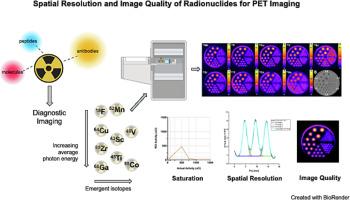
PET成像用放射性核素的空间分辨率和图像质量。
目的:本研究旨在利用临床前PET/CT扫描仪表征和比较各种传统和新兴正电子发射放射性核素的饱和极限、空间分辨率和图像质量。通过表征这些放射性核素的性能,该研究试图为它们在高分辨率PET成像中的应用提供见解。方法:放射性核素(18F, 43Sc, 45Ti, 48V, 52Mn, 55Co, 64Cu, 68Ga, 89Zr)在GNEXT PET/CT扫描仪(Xodus Imaging, Torrance, CA)上使用饱和和Derenzo幻象进行评估。饱和度是通过测量在不同浓度的每种放射性核素的实际和感兴趣区域(ROI)活动之间的偏差来评估的。空间分辨率采用全宽半最大值(FWHM)测量,测量了六个Derenzo幻体直径尺寸(1.2 mm-4.8 mm)的强度分布。计算信噪比(SNRs)作为图像质量的度量,并使用Bland-Altman图来评估分辨率测量的可重复性。进行了测试-重测试的统计比较,以评估不同放射性核素在准确性和一致性方面的差异。结果:饱和分析显示了放射性核素的广泛限制,64Cu在2 μCi (74 MBq)附近具有最高的饱和阈值,而52Mn在250 μCi (9.25 MBq)附近具有最低的饱和阈值。空间分辨率与正电子能量呈负相关,与68Ga和55Co相比,18F和64Cu等放射性核素产生的图像清晰到棒尺寸为1.6 mm,而相同棒尺寸的68Ga和55Co则显示模糊。信噪比分析证实了低能量放射性核素具有优越的图像质量,特别是对于较小的结构,视觉分辨率为1.6 mm。Bland-Altman分析表明,与68Ga相比,18F在不同棒尺寸的组合中显示出更高的分辨率测量重复性(标准误差分别为0.03和0.15)。结论:本研究表明,放射性核素的物理性质,特别是正电子能量,显著影响PET图像质量、空间分辨率和饱和阈值。低能量放射性核素如18F和52Mn是高分辨率应用的最佳选择,而高能量放射性核素更适合高活性成像。这些发现为优化临床前和临床PET成像研究中的放射性核素选择提供了有价值的指导。
本文章由计算机程序翻译,如有差异,请以英文原文为准。
求助全文
约1分钟内获得全文
求助全文
来源期刊
Nuclear medicine and biology
医学-核医学
CiteScore
6.00
自引率
9.70%
发文量
479
审稿时长
51 days
期刊介绍:
Nuclear Medicine and Biology publishes original research addressing all aspects of radiopharmaceutical science: synthesis, in vitro and ex vivo studies, in vivo biodistribution by dissection or imaging, radiopharmacology, radiopharmacy, and translational clinical studies of new targeted radiotracers. The importance of the target to an unmet clinical need should be the first consideration. If the synthesis of a new radiopharmaceutical is submitted without in vitro or in vivo data, then the uniqueness of the chemistry must be emphasized.
These multidisciplinary studies should validate the mechanism of localization whether the probe is based on binding to a receptor, enzyme, tumor antigen, or another well-defined target. The studies should be aimed at evaluating how the chemical and radiopharmaceutical properties affect pharmacokinetics, pharmacodynamics, or therapeutic efficacy. Ideally, the study would address the sensitivity of the probe to changes in disease or treatment, although studies validating mechanism alone are acceptable. Radiopharmacy practice, addressing the issues of preparation, automation, quality control, dispensing, and regulations applicable to qualification and administration of radiopharmaceuticals to humans, is an important aspect of the developmental process, but only if the study has a significant impact on the field.
Contributions on the subject of therapeutic radiopharmaceuticals also are appropriate provided that the specificity of labeled compound localization and therapeutic effect have been addressed.
 求助内容:
求助内容: 应助结果提醒方式:

 京公网安备 11010802042870号


