
CRISPR-Cas12a/Cas13a in cancer molecular diagnosis
IF 2.9
3区 医学
Q2 MEDICAL LABORATORY TECHNOLOGY
引用次数: 0
Abstract
Cancer remains a leading cause of global mortality, with early diagnosis being pivotal for improving treatment outcomes. Traditional tissue biopsy is limited by its invasiveness, inability to capture tumor heterogeneity, and failure to support dynamic monitoring. Liquid biopsy has emerged as a non-invasive alternative, enabling the analysis of circulating tumor biomarkers (e.g., ctDNA, miRNAs, exosomes) in bodily fluids. However, current liquid biopsy technologies (e.g., NGS, ddPCR) suffer from high costs, complex workflows, poor standardization, and insufficient sensitivity for low-abundance biomarkers. The CRISPR-Cas systems, particularly Cas12a and Cas13a, have revolutionized molecular diagnostics due to their programmable sequence recognition, robust signal amplification via trans-cleavage/collateral cleavage activity, and compatibility with point-of-care testing (POCT). Cas12a targets DNA molecules, enabling sensitive detection of gene mutations and DNA methylation, while Cas13a specifically recognizes RNA, facilitating direct analysis of miRNAs and viral RNAs. Additionally, these systems have been extended to non-nucleic acid biomarkers (e.g., proteins, exosomes) through signal conversion strategies. This review summarizes the latest advances in CRISPR-Cas12a/Cas13a-based biosensors for cancer molecular diagnosis, including the detection of gene mutations, epigenetic modifications, miRNAs, tumor-associated viruses, and non-nucleic acid biomarkers. We critically analyze current challenges (e.g., PAM dependence, matrix interference, multiplexing limitations, clinical validation gaps) and discuss future perspectives, such as engineering PAM-less Cas variants, integrating nanotechnology, microfluidics, and artificial intelligence/artificial intelligence (AI), and advancing clinical standardization. This review aims to provide a comprehensive reference for the development and clinical translation of CRISPR-based cancer diagnostic technologies.
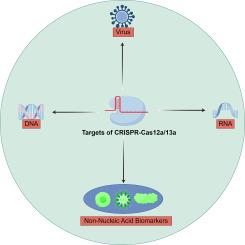
CRISPR-Cas12a/Cas13a在癌症分子诊断中的应用
癌症仍然是全球死亡的主要原因,早期诊断对于改善治疗效果至关重要。传统的组织活检受其侵入性、无法捕捉肿瘤异质性和无法支持动态监测的限制。液体活检已经成为一种非侵入性的替代方法,能够分析体液中的循环肿瘤生物标志物(例如,ctDNA, mirna,外泌体)。然而,目前的液体活检技术(如NGS、ddPCR)存在成本高、工作流程复杂、标准化差、对低丰度生物标志物敏感性不足等问题。CRISPR-Cas系统,特别是Cas12a和Cas13a,由于其可编程的序列识别,通过反式切割/侧切活性进行强大的信号扩增,以及与护理点检测(POCT)的兼容性,已经彻底改变了分子诊断。Cas12a靶向DNA分子,能够灵敏地检测基因突变和DNA甲基化,而Cas13a特异性识别RNA,便于直接分析mirna和病毒RNA。此外,这些系统已通过信号转换策略扩展到非核酸生物标志物(例如,蛋白质,外泌体)。本文综述了基于CRISPR-Cas12a/ cas13的肿瘤分子诊断生物传感器的最新进展,包括基因突变、表观遗传修饰、mirna、肿瘤相关病毒和非核酸生物标志物的检测。我们批判性地分析了当前的挑战(例如,PAM依赖,矩阵干扰,多路复用限制,临床验证差距),并讨论了未来的前景,例如工程无PAM的Cas变体,集成纳米技术,微流体,人工智能/人工智能(AI),以及推进临床标准化。本文综述旨在为基于crispr的癌症诊断技术的开发和临床转化提供综合参考。
本文章由计算机程序翻译,如有差异,请以英文原文为准。
求助全文
约1分钟内获得全文
求助全文
来源期刊
Clinica Chimica Acta
医学-医学实验技术
CiteScore
10.10
自引率
2.00%
发文量
1268
审稿时长
23 days
期刊介绍:
The Official Journal of the International Federation of Clinical Chemistry and Laboratory Medicine (IFCC)
Clinica Chimica Acta is a high-quality journal which publishes original Research Communications in the field of clinical chemistry and laboratory medicine, defined as the diagnostic application of chemistry, biochemistry, immunochemistry, biochemical aspects of hematology, toxicology, and molecular biology to the study of human disease in body fluids and cells.
The objective of the journal is to publish novel information leading to a better understanding of biological mechanisms of human diseases, their prevention, diagnosis, and patient management. Reports of an applied clinical character are also welcome. Papers concerned with normal metabolic processes or with constituents of normal cells or body fluids, such as reports of experimental or clinical studies in animals, are only considered when they are clearly and directly relevant to human disease. Evaluation of commercial products have a low priority for publication, unless they are novel or represent a technological breakthrough. Studies dealing with effects of drugs and natural products and studies dealing with the redox status in various diseases are not within the journal''s scope. Development and evaluation of novel analytical methodologies where applicable to diagnostic clinical chemistry and laboratory medicine, including point-of-care testing, and topics on laboratory management and informatics will also be considered. Studies focused on emerging diagnostic technologies and (big) data analysis procedures including digitalization, mobile Health, and artificial Intelligence applied to Laboratory Medicine are also of interest.
 求助内容:
求助内容: 应助结果提醒方式:

 京公网安备 11010802042870号


