
Energy-dependent gamma attenuation analysis of BiBZnP glass-ceramics using theoretical and computational approaches
IF 1.8
3区 工程技术
Q3 CHEMISTRY, INORGANIC & NUCLEAR
Applied Radiation and Isotopes
Pub Date : 2026-06-01
Epub Date: 2026-03-06
DOI:10.1016/j.apradiso.2026.112540
引用次数: 0
Abstract
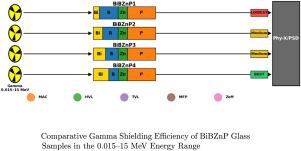
In this study, the radiation shielding performance of xBiO-(0.40-x)BO-0.15ZnO-0.45PO borophosphate glass-ceramics (BiBZnP1–BiBZnP4; ) was systematically investigated for photon energies ranging from 0.015 to 15 MeV. Theoretical mass attenuation coefficients (MAC), linear attenuation coefficients (LAC), half-value layer (HVL), tenth-value layer (TVL), mean free path (MFP), and effective atomic numbers (Z) were calculated using Phy-X/PSD software, with MAC values cross-validated via the XCOM database to ensure accuracy and reliability.
At low energies (0.015–0.06 MeV), MAC and LAC values were highest, reflecting the dominance of the photoelectric effect and the significant contribution of BiO content. A pronounced increase in MAC was observed near 0.0905 MeV, corresponding to the Bi K-edge absorption, followed by a gradual transition to Compton scattering as the primary interaction mechanism above 0.1 MeV.
In the medium-energy range (0.1–1 MeV), Compton scattering governed photon interactions, leading to predictable reductions in MAC and increases in HVL, TVL, and MFP. At higher energies (1–15 MeV), photon attenuation stabilized, with pair production effects emerging but Bi-rich compositions maintaining superior shielding performance.
Notably, BiBZnP4, with the highest BiO content, consistently exhibited the lowest HVL (0.183–4.823 cm), TVL (0.012–16.022 cm), and MFP (0.005–6.958 cm) values, alongside the highest Z across all energies, demonstrating enhanced photon attenuation. These results underscore the critical role of heavy metal oxide content in modulating gamma-ray interactions across a broad energy spectrum. This study demonstrates that Bi-rich BiBZnP glass-ceramics exhibit high theoretical shielding performance, and the results obtained constitute indicative findings that may form a basis for future experimental verification and independent simulation studies.
利用理论和计算方法分析BiBZnP微晶玻璃的能量依赖γ衰减。
在本研究中,系统地研究了xBi2O3-(0.40-x)B2O3-0.15ZnO-0.45P2O5硼磷酸盐微晶玻璃(BiBZnP1-BiBZnP4; x=0.10-0.25)在光子能量为0.015 - 15 MeV范围内的辐射屏蔽性能。采用Phy-X/PSD软件计算理论质量衰减系数(MAC)、线性衰减系数(LAC)、半值层(HVL)、十值层(TVL)、平均自由程(MFP)和有效原子序数(Zeff),并通过XCOM数据库交叉验证MAC值以确保准确性和可靠性。在低能(0.015 ~ 0.06 MeV)下,MAC和LAC值最高,反映了光电效应的主导作用和Bi2O3含量的显著贡献。在0.0905 MeV附近,MAC显著增加,对应于Bi - k边吸收,随后逐渐过渡到康普顿散射作为0.1 MeV以上的主要相互作用机制。在中能量范围内(0.1-1 MeV),康普顿散射控制光子相互作用,导致可预测的MAC降低和HVL、TVL和MFP的增加。在更高的能量(1-15 MeV)下,光子衰减稳定,偶产生效应出现,但富bi成分保持优越的屏蔽性能。值得注意的是,BiBZnP4中Bi2O3含量最高,其HVL (0.183-4.823 cm)、TVL (0.012-16.022 cm)和MFP (0.005-6.958 cm)值均最低,且所有能量的Zeff均最高,表明光子衰减增强。这些结果强调了重金属氧化物含量在调制伽马射线相互作用中的关键作用。本研究表明,富bi - BiBZnP微晶玻璃具有较高的理论屏蔽性能,所得结果具有指示性,可为未来的实验验证和独立模拟研究奠定基础。
本文章由计算机程序翻译,如有差异,请以英文原文为准。
求助全文
约1分钟内获得全文
求助全文
来源期刊
Applied Radiation and Isotopes
工程技术-核科学技术
CiteScore
3.00
自引率
12.50%
发文量
406
审稿时长
13.5 months
期刊介绍:
Applied Radiation and Isotopes provides a high quality medium for the publication of substantial, original and scientific and technological papers on the development and peaceful application of nuclear, radiation and radionuclide techniques in chemistry, physics, biochemistry, biology, medicine, security, engineering and in the earth, planetary and environmental sciences, all including dosimetry. Nuclear techniques are defined in the broadest sense and both experimental and theoretical papers are welcome. They include the development and use of α- and β-particles, X-rays and γ-rays, neutrons and other nuclear particles and radiations from all sources, including radionuclides, synchrotron sources, cyclotrons and reactors and from the natural environment.
The journal aims to publish papers with significance to an international audience, containing substantial novelty and scientific impact. The Editors reserve the rights to reject, with or without external review, papers that do not meet these criteria.
Papers dealing with radiation processing, i.e., where radiation is used to bring about a biological, chemical or physical change in a material, should be directed to our sister journal Radiation Physics and Chemistry.
 求助内容:
求助内容: 应助结果提醒方式:

 京公网安备 11010802042870号


