{"title":"High-throughput C–H activation in a bead-beater homogenizer: fast and regioselective access to 2-arylindoles","authors":"Mainak Banerjee, Shravya B., Aboy Chatterjee, Shamima Hussain and Amtita Chatterjee","doi":"10.1039/D5MR00124B","DOIUrl":null,"url":null,"abstract":"<p >High-throughput mechanochemical synthesis is rarely attempted. A bead-beater homogenizer with 24–64 slots offers a unique opportunity for high-throughput mechanosynthesis (HTMS). In this study, C–H bond activation is achieved by homogenizing multiple samples in one go in simple polypropylene (PP) vials with stainless steel balls <em>via</em> liquid-assisted grinding (LAG), with enough frictional force being employed to achieve this challenging transformation. The method demonstrates the preparation of synthetically useful 2-arylindoles through a regioselective reaction between <em>N</em>-alkylated indoles and aryl iodides, catalyzed by Pd(<small>II</small>) and facilitated by C2–H activation in the absence of phosphine ligands, using a bead-beater homogenizer. 5 mol% of Pd(OAc)<small><sub>2</sub></small> was sufficient to catalyze C2-activation of indoles in the presence of a small volume of EtOAc as the LAG agent, affording 2-arylindoles in high to excellent yields within 9 min. The method demonstrated excellent tolerance to structural variations, including electron-rich and electron-deficient substituents in both indoles and iodoarenes. However, unprotected indoles or indoles with deactivated five-membered rings could not participate well in the reaction. This simple, high-yielding, ambient-temperature high-throughput mechanochemical protocol is devoid of a formal workup step, and with a low <em>E</em>-factor (4.5) and a high Eco-scale score (73.5), it augments well with sustainability matrices.</p>","PeriodicalId":101140,"journal":{"name":"RSC Mechanochemistry","volume":" 2","pages":" 309-315"},"PeriodicalIF":0.0000,"publicationDate":"2026-01-07","publicationTypes":"Journal Article","fieldsOfStudy":null,"isOpenAccess":false,"openAccessPdf":"https://pubs.rsc.org/en/content/articlepdf/2026/mr/d5mr00124b?page=search","citationCount":"0","resultStr":null,"platform":"Semanticscholar","paperid":null,"PeriodicalName":"RSC Mechanochemistry","FirstCategoryId":"1085","ListUrlMain":"https://pubs.rsc.org/en/content/articlelanding/2026/mr/d5mr00124b","RegionNum":0,"RegionCategory":null,"ArticlePicture":[],"TitleCN":null,"AbstractTextCN":null,"PMCID":null,"EPubDate":"","PubModel":"","JCR":"","JCRName":"","Score":null,"Total":0}
引用次数: 0
Abstract
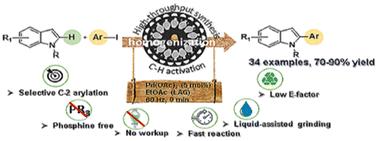
High-throughput mechanochemical synthesis is rarely attempted. A bead-beater homogenizer with 24–64 slots offers a unique opportunity for high-throughput mechanosynthesis (HTMS). In this study, C–H bond activation is achieved by homogenizing multiple samples in one go in simple polypropylene (PP) vials with stainless steel balls via liquid-assisted grinding (LAG), with enough frictional force being employed to achieve this challenging transformation. The method demonstrates the preparation of synthetically useful 2-arylindoles through a regioselective reaction between N-alkylated indoles and aryl iodides, catalyzed by Pd(II) and facilitated by C2–H activation in the absence of phosphine ligands, using a bead-beater homogenizer. 5 mol% of Pd(OAc)2 was sufficient to catalyze C2-activation of indoles in the presence of a small volume of EtOAc as the LAG agent, affording 2-arylindoles in high to excellent yields within 9 min. The method demonstrated excellent tolerance to structural variations, including electron-rich and electron-deficient substituents in both indoles and iodoarenes. However, unprotected indoles or indoles with deactivated five-membered rings could not participate well in the reaction. This simple, high-yielding, ambient-temperature high-throughput mechanochemical protocol is devoid of a formal workup step, and with a low E-factor (4.5) and a high Eco-scale score (73.5), it augments well with sustainability matrices.


 求助内容:
求助内容: 应助结果提醒方式:

 京公网安备 11010802042870号


