
Predicting antifungal concentrations that select for resistance: an enhanced approach to establish environmental thresholds
IF 9.7
1区 环境科学与生态学
Q1 ENVIRONMENTAL SCIENCES
Environment International
Pub Date : 2026-03-01
Epub Date: 2026-03-03
DOI:10.1016/j.envint.2026.110178
引用次数: 0
Abstract
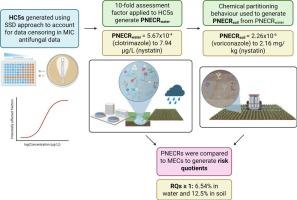
Antifungal resistance (AFR) is an emerging threat. Understanding the concentrations at which antifungals select for resistance is critical for guiding policy to minimise risks. This study aimed to determine predicted no effect concentrations for resistance (PNECRs) for antifungals in water and soil. PNECRs for water (PNECRswater) were derived from species sensitivity distributions fitted using a Maximum Likelihood Estimation approach to estimate the lower 5th percentile Hazard Concentrations (HC5s) from censored species/compound level MIC data and applying a 10-fold assessment factor. PNECRswater ranged from 5.67x10⁻⁴ (clotrimazole) to 7.94 µg/L (nystatin). PNECRs derived using standard methodologies that do not account for censoring are always higher, and therefore less conservative for environmental protection, than when considering censoring. PNECRs for soil (PNECRssoil) were derived by applying soil partitioning coefficients to PNECRswater for each antifungal, thereby providing an estimate for the bulk soil concentration needed to achieve the PNECRwater in soil pore water. These ranged from 2.26x10⁻⁶ (voriconazole) to 2.16 mg/kg (nystatin). Risk quotients were generated from measured environmental concentrations, and 6.54% for water (n = 200) and 12.5% for soil (n = 1) were over 1, suggesting selection for AFR could be occurring. This type of data generation and analyses will inform discussions about targeted mitigation strategies to reduce the risk of selection for AFR, however, PNECR estimations can be improved with increased data for certain compounds, particularly agricultural fungicides. Preventing an increase in resistance is critical for reducing the risk posed to human health from exposure to environmental AFR.
预测抗真菌浓度选择耐药性:建立环境阈值的增强方法。
抗真菌耐药性(AFR)是一个新兴的威胁。了解抗真菌药物选择产生耐药性的浓度对于指导政策以尽量减少风险至关重要。本研究旨在确定水和土壤中抗真菌药物的预测无效应抗性浓度(pnecr)。水的PNECRs (PNECRswater)来自物种敏感性分布,使用最大似然估计方法从删除的物种/化合物水平MIC数据中估计较低的第5百分位危害浓度(HC5s),并应用10倍评估因子。PNECRswater范围从5.67 × 10-4(克霉唑)到7.94µg/L(制霉菌素)。使用不考虑审查的标准方法得出的pnecr总是更高,因此在环境保护方面比考虑审查时更不保守。土壤的PNECRs (PNECRssoil)是通过将土壤分配系数应用于每种抗真菌药的PNECRswater得到的,从而提供了在土壤孔隙水中实现PNECRwater所需的土壤体积浓度的估计。剂量范围从2.26 × 10⁻⁶(伏立康唑)到2.16 mg/kg(制霉菌素)。风险商由测量的环境浓度产生,6.54%的水(n = 200)和12.5%的土壤(n = 1)超过1,表明可能发生了AFR的选择。这种类型的数据生成和分析将为关于有针对性的缓解战略的讨论提供信息,以减少选择AFR的风险,然而,随着某些化合物,特别是农业杀菌剂数据的增加,PNECR的估计可以得到改进。防止耐药性增加对于减少接触环境AFR对人类健康构成的风险至关重要。
本文章由计算机程序翻译,如有差异,请以英文原文为准。
求助全文
约1分钟内获得全文
求助全文
来源期刊
Environment International
环境科学-环境科学
CiteScore
21.90
自引率
3.40%
发文量
734
审稿时长
2.8 months
期刊介绍:
Environmental Health publishes manuscripts focusing on critical aspects of environmental and occupational medicine, including studies in toxicology and epidemiology, to illuminate the human health implications of exposure to environmental hazards. The journal adopts an open-access model and practices open peer review.
It caters to scientists and practitioners across all environmental science domains, directly or indirectly impacting human health and well-being. With a commitment to enhancing the prevention of environmentally-related health risks, Environmental Health serves as a public health journal for the community and scientists engaged in matters of public health significance concerning the environment.
 求助内容:
求助内容: 应助结果提醒方式:

 京公网安备 11010802042870号


