
Developing fast scan cyclic voltammetry at carbon fiber microelectrodes to quantify short chain fatty acids in situ
IF 4.5
2区 化学
Q1 BIOCHEMISTRY & MOLECULAR BIOLOGY
Bioelectrochemistry
Pub Date : 2026-10-01
Epub Date: 2026-03-04
DOI:10.1016/j.bioelechem.2026.109266
引用次数: 0
Abstract
Acetic, propionic, and butyric acids are short chain fatty acids (SCFAs) and the most abundant metabolites produced by gut bacteria. To uncover mechanistic insights of their function throughout the body, it is critical to measure rapid SCFA fluxes in sites of action such as brain, muscle, and skin. Current approaches have focused on fecal and plasma measurements, where SCFA levels are low and not representative of tissue-specific concentrations or fluxes. Thus, a rapid, in situ methodology is needed. Fast scan cyclic voltammetry (FSCV) at carbon fiber microelectrodes (CFMs) has the spatiotemporal resolution to fill this need. However, the electrochemical response of CFMs to SCFAs have not been explored until now. By coupling FSCV at CFMs with flow injection analysis of each SCFA, we demonstrate there are distinct peaks in the cyclic voltammograms for each fatty acid. Some of these peaks display faradaic behavior in scan rate, holding potential, and switching potential experiments. Interestingly, we identify several peaks that are concentration-sensitive and therefore are promising quantifiable markers of SCFA dynamics and fluxes. This work lays the foundation in understanding the response of CFMs to fatty acids and demonstrate the utility of FSCV at CFMs for the in situ quantitation of SCFAs.
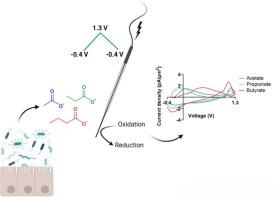
碳纤维微电极快速扫描循环伏安法原位定量短链脂肪酸。
乙酸、丙酸和丁酸是短链脂肪酸(SCFAs),是肠道细菌产生的最丰富的代谢物。为了揭示其在全身功能的机制,测量脑、肌肉和皮肤等作用部位的快速SCFA通量至关重要。目前的方法主要集中在粪便和血浆测量,其中SCFA水平较低,不能代表组织特异性浓度或通量。因此,需要一种快速的就地方法。碳纤维微电极(CFMs)的快速扫描循环伏安法(FSCV)具有满足这一需求的时空分辨率。然而,cfm对scfa的电化学响应目前还没有研究。通过将cfm的FSCV与每种SCFA的流动注射分析相结合,我们发现每种脂肪酸的循环伏安图中都有不同的峰。其中一些峰在扫描速率、保持电位和开关电位实验中显示出法拉第行为。有趣的是,我们发现了几个对浓度敏感的峰,因此是有希望的SCFA动态和通量的可量化标记。这项工作为理解cfm对脂肪酸的反应奠定了基础,并证明了FSCV在cfm中用于scfa原位定量的实用性。
本文章由计算机程序翻译,如有差异,请以英文原文为准。
求助全文
约1分钟内获得全文
求助全文
来源期刊
Bioelectrochemistry
生物-电化学
CiteScore
9.10
自引率
6.00%
发文量
238
审稿时长
38 days
期刊介绍:
An International Journal Devoted to Electrochemical Aspects of Biology and Biological Aspects of Electrochemistry
Bioelectrochemistry is an international journal devoted to electrochemical principles in biology and biological aspects of electrochemistry. It publishes experimental and theoretical papers dealing with the electrochemical aspects of:
• Electrified interfaces (electric double layers, adsorption, electron transfer, protein electrochemistry, basic principles of biosensors, biosensor interfaces and bio-nanosensor design and construction.
• Electric and magnetic field effects (field-dependent processes, field interactions with molecules, intramolecular field effects, sensory systems for electric and magnetic fields, molecular and cellular mechanisms)
• Bioenergetics and signal transduction (energy conversion, photosynthetic and visual membranes)
• Biomembranes and model membranes (thermodynamics and mechanics, membrane transport, electroporation, fusion and insertion)
• Electrochemical applications in medicine and biotechnology (drug delivery and gene transfer to cells and tissues, iontophoresis, skin electroporation, injury and repair).
• Organization and use of arrays in-vitro and in-vivo, including as part of feedback control.
• Electrochemical interrogation of biofilms as generated by microorganisms and tissue reaction associated with medical implants.
 求助内容:
求助内容: 应助结果提醒方式:

 京公网安备 11010802042870号


