{"title":"[Clinical aspects of dengue fever in the Savanna region of Togo in 2023].","authors":"Lidaw Déassoua Bawe, Awèréou Kotosso, Komivi Atsu Kpegba, Mawaba Hilim, Dondah Kozon, Bawoubadi Abaltou, Akouda Akessiwe Patassi, Majesté Ihou Watéba","doi":"10.48327/mtsi.v5i4.2025.788","DOIUrl":null,"url":null,"abstract":"<p><strong>Introduction: </strong>In 2023, the Savanes region of Togo experienced the country's first major dengue epidemic. This study aims to describe the epidemiological, clinical and evolutionary characteristics of confirmed dengue cases during this epidemic.Patients and methods. This retrospective study examined confirmed dengue cases in the Savanes health region from 15 September 2023 to 29 February 2024.Results. During the epidemic, 57 suspected cases of dengue were reported, of which 27 were confirmed. The average patient age was 32 years (range 10-65 years). The main clinical signs were a pain syndrome (n = 19), fever (n = 19), asthenia (n = 17), anorexia (n = 12) and vomiting (n = 11). The distribution of dengue clinical forms included seven cases of classic dengue without warning signs, 15 cases of dengue with warning signs, and five cases of severe dengue. Haematological parameters showed an increase in white blood cell count, particularly in severe dengue cases. Biochemically, renal and hepatic parameters increased in cases of dengue with warning signs and severe dengue. Two deaths from severe dengue were recorded, representing a case fatality rate of just over 7%.</p><p><strong>Conclusion: </strong>This study reports the first major dengue epidemic in northern Togo. A significant proportion of cases were found to be intermediate (warning signs) or severe.</p>","PeriodicalId":101416,"journal":{"name":"Medecine tropicale et sante internationale","volume":"5 4","pages":""},"PeriodicalIF":0.0000,"publicationDate":"2025-12-16","publicationTypes":"Journal Article","fieldsOfStudy":null,"isOpenAccess":false,"openAccessPdf":"https://www.ncbi.nlm.nih.gov/pmc/articles/PMC12957991/pdf/","citationCount":"0","resultStr":null,"platform":"Semanticscholar","paperid":null,"PeriodicalName":"Medecine tropicale et sante internationale","FirstCategoryId":"1085","ListUrlMain":"https://doi.org/10.48327/mtsi.v5i4.2025.788","RegionNum":0,"RegionCategory":null,"ArticlePicture":[],"TitleCN":null,"AbstractTextCN":null,"PMCID":null,"EPubDate":"2025/12/31 0:00:00","PubModel":"eCollection","JCR":"","JCRName":"","Score":null,"Total":0}
引用次数: 0
Abstract
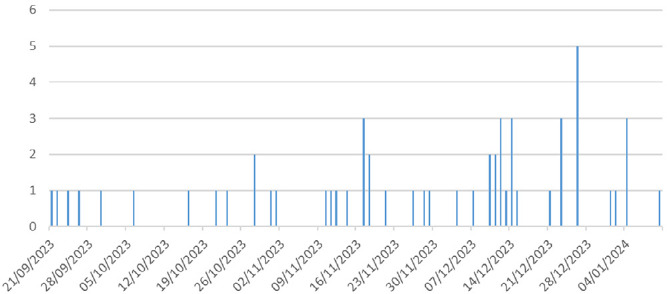
Introduction: In 2023, the Savanes region of Togo experienced the country's first major dengue epidemic. This study aims to describe the epidemiological, clinical and evolutionary characteristics of confirmed dengue cases during this epidemic.Patients and methods. This retrospective study examined confirmed dengue cases in the Savanes health region from 15 September 2023 to 29 February 2024.Results. During the epidemic, 57 suspected cases of dengue were reported, of which 27 were confirmed. The average patient age was 32 years (range 10-65 years). The main clinical signs were a pain syndrome (n = 19), fever (n = 19), asthenia (n = 17), anorexia (n = 12) and vomiting (n = 11). The distribution of dengue clinical forms included seven cases of classic dengue without warning signs, 15 cases of dengue with warning signs, and five cases of severe dengue. Haematological parameters showed an increase in white blood cell count, particularly in severe dengue cases. Biochemically, renal and hepatic parameters increased in cases of dengue with warning signs and severe dengue. Two deaths from severe dengue were recorded, representing a case fatality rate of just over 7%.
Conclusion: This study reports the first major dengue epidemic in northern Togo. A significant proportion of cases were found to be intermediate (warning signs) or severe.



 求助内容:
求助内容: 应助结果提醒方式:

 京公网安备 11010802042870号


