
17O quadrupolar chemical exchange saturation transfer (Q-CEST) NMR for investigations of molecular dynamics in solids
IF 2.1
3区 化学
Q3 BIOCHEMICAL RESEARCH METHODS
Journal of magnetic resonance
Pub Date : 2026-04-01
Epub Date: 2026-02-26
DOI:10.1016/j.jmr.2026.108045
引用次数: 0
Abstract
We introduce quadrupolar chemical exchange saturation transfer (Q-CEST) for half-integer quadrupolar nuclei such as oxygen-17 as a complementary NMR tool for studies of molecular dynamics in solids. Experiments on the model compounds NaNO3 and hydration water in fibrils formed by pyro-glutamate E3 Amyloid-β protein are combined with simulations and theoretical approaches to obtain parameters of molecular motions. We determine the rate constants for 3-site jumps of oxygen atoms in NaNO3 and rate constants and populations of tetrahedral jumps of hydration water in the proximity to protein surface below the bulk freezing point. The detection is focused on the central transition (CT). However, during the saturation the transmitter is swept across a wide range of frequencies reaching the first satellite transitions. A detailed analysis is provided for CT Q-CEST profiles in the presence of molecular dynamics covering two dynamical transitions occurring approximately in the microsecond and nanosecond time scale ranges and paying special attention to correct inclusion of the dynamics averaging of the second order quadrupolar interaction.
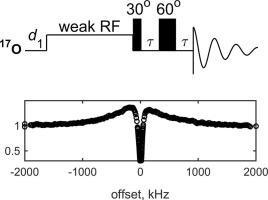
17O四极性化学交换饱和转移(Q-CEST)核磁共振用于固体分子动力学的研究。
我们介绍了四极性化学交换饱和转移(Q-CEST)的半整数四极性核,如氧-17作为一个补充的核磁共振工具,研究分子动力学的固体。采用模拟和理论相结合的方法,对热谷氨酸E3淀粉样蛋白-β形成的原纤维中的模型化合物NaNO3和水合水进行了实验,获得了分子运动参数。我们测定了NaNO3中氧原子的3位跳变速率常数和蛋白质表面附近水合水在体积冰点以下的四面体跳变速率常数和居群。检测的重点是中央过渡(CT)。然而,在饱和期间,发射机被扫过到达第一颗卫星转换的广泛频率范围。详细分析了分子动力学下的CT Q-CEST谱,包括大约在微秒和纳秒时间尺度范围内发生的两个动力学转变,并特别注意正确包含二阶四极相互作用的动力学平均。
本文章由计算机程序翻译,如有差异,请以英文原文为准。
求助全文
约1分钟内获得全文
求助全文
来源期刊
CiteScore
3.80
自引率
13.60%
发文量
150
审稿时长
69 days
期刊介绍:
The Journal of Magnetic Resonance presents original technical and scientific papers in all aspects of magnetic resonance, including nuclear magnetic resonance spectroscopy (NMR) of solids and liquids, electron spin/paramagnetic resonance (EPR), in vivo magnetic resonance imaging (MRI) and spectroscopy (MRS), nuclear quadrupole resonance (NQR) and magnetic resonance phenomena at nearly zero fields or in combination with optics. The Journal''s main aims include deepening the physical principles underlying all these spectroscopies, publishing significant theoretical and experimental results leading to spectral and spatial progress in these areas, and opening new MR-based applications in chemistry, biology and medicine. The Journal also seeks descriptions of novel apparatuses, new experimental protocols, and new procedures of data analysis and interpretation - including computational and quantum-mechanical methods - capable of advancing MR spectroscopy and imaging.
 求助内容:
求助内容: 应助结果提醒方式:

 京公网安备 11010802042870号


