Evaluation of Short Term and Long Term Subjective and Objective Cognitive Outcomes Following ECT for Depression in a Naturalistic Ambulatory Setting: A Cohort Study.
Sarah A Goegan, Gary M Hasey, Jelena P King, Bruno J Losier, Peter J Bieling, Margaret C McKinnon, Heather E McNeely
{"title":"Evaluation of Short Term and Long Term Subjective and Objective Cognitive Outcomes Following ECT for Depression in a Naturalistic Ambulatory Setting: A Cohort Study.","authors":"Sarah A Goegan, Gary M Hasey, Jelena P King, Bruno J Losier, Peter J Bieling, Margaret C McKinnon, Heather E McNeely","doi":"10.31083/AP45286","DOIUrl":null,"url":null,"abstract":"<p><strong>Background: </strong>This cohort study examined changes in cognitive outcomes, subjective memory, and depressive symptoms in an understudied area: electroconvulsive therapy (ECT) delivered in a naturalistic ambulatory setting with a heterogeneous, clinically complex sample of individuals with mixed mood disorders.</p><p><strong>Methods: </strong>Participants were adults (mean age = 45.7 years; female gender = 69%) receiving ambulatory ECT for a major depressive episode (Major Depressive Disorder = 81.4%; Bipolar Spectrum Disorder = 18.9%); 62.9% had at least 1 co-occurring mental health diagnosis. Clinical and cognitive assessments were completed at baseline (n = 100), mid-ECT (n = 94), 2-4 weeks (n = 64), 6-months (n = 34), and 12-months (n = 19) post-ECT. Neurocognitive performance was assessed using the Repeatable Battery for Assessment of Neuropsychological Status® (RBANS) at all timepoints, except mid-ECT and subjective memory was assessed using the Squire Subjective Memory Questionnaire (SSMQ).</p><p><strong>Results: </strong>Overall, cognitive performance was lower than expected compared to premorbid estimates at baseline but did not significantly worsen following ECT (<i>p</i> > 0.05), with the exception of a transient decline in verbal fluency scores. Patients endorsed elevated subjective memory complaints before and after ECT, which differed by treatment response as indicated by a significant Time by Response Group interaction <i>p</i> = 0.039. There were significant main effects of time in both 'Responders' (≥50% improvement in Beck Depression Inventory [BDI-II] score post-ECT), <i>p</i> < 0.001 and 'Non-Responders' (<50% improvement in BDI-II) <i>p</i> = 0.021. Within group, after controlling for multiple comparisons, there was a clear trend for SSMQ scores to improve across most time points in the 'Responder' group, but subjective memory declined and remained around baseline level in the 'Non-Responder' group across follow-up. In the sample as a whole, rapid reduction in BDI-II scores from baseline to mid-ECT predicted rapid improvement in SSMQ scores, <i>p</i> = 0.013.</p><p><strong>Conclusions: </strong>Clinically complex adults referred to ECT for depression presented with prominent memory concerns and performed below expectation compared to their estimated premorbid cognitive functioning at baseline. Naturalistic delivery of ECT did not appear to be associated with prolonged adverse cognitive outcomes; however, subjective memory concerns and below-expected cognitive performance persisted during follow-up. Treatment response impacted subjective memory outcomes, with only 'Responders' endorsing slightly reduced, though still persistent, subjective memory concerns following ECT. Conclusions on the long-term impacts of ECT are tempered by the high lost to follow up (LTFU) rate observed across follow-up assessments (66% LTFU at 6-months, 81% LTFU at 12-months). Nonetheless, these findings emphasize the need to address subtle cognitive deficits and memory complaints that persist following ECT, even in individuals demonstrating clinical improvement.</p>","PeriodicalId":72151,"journal":{"name":"Alpha psychiatry","volume":"27 1","pages":"45286"},"PeriodicalIF":2.9000,"publicationDate":"2026-02-03","publicationTypes":"Journal Article","fieldsOfStudy":null,"isOpenAccess":false,"openAccessPdf":"https://www.ncbi.nlm.nih.gov/pmc/articles/PMC12957962/pdf/","citationCount":"0","resultStr":null,"platform":"Semanticscholar","paperid":null,"PeriodicalName":"Alpha psychiatry","FirstCategoryId":"1085","ListUrlMain":"https://doi.org/10.31083/AP45286","RegionNum":0,"RegionCategory":null,"ArticlePicture":[],"TitleCN":null,"AbstractTextCN":null,"PMCID":null,"EPubDate":"2026/2/1 0:00:00","PubModel":"eCollection","JCR":"Q3","JCRName":"PSYCHIATRY","Score":null,"Total":0}
引用次数: 0
Abstract
Background: This cohort study examined changes in cognitive outcomes, subjective memory, and depressive symptoms in an understudied area: electroconvulsive therapy (ECT) delivered in a naturalistic ambulatory setting with a heterogeneous, clinically complex sample of individuals with mixed mood disorders.
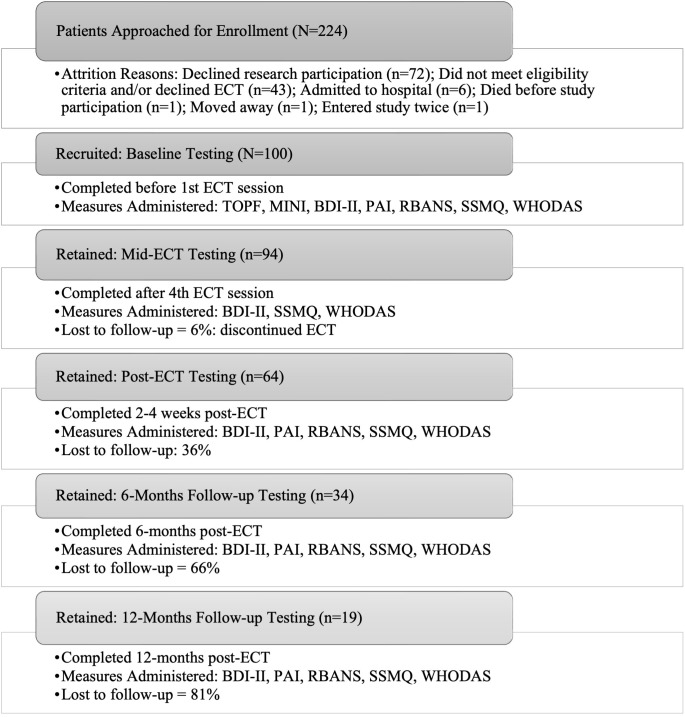
Methods: Participants were adults (mean age = 45.7 years; female gender = 69%) receiving ambulatory ECT for a major depressive episode (Major Depressive Disorder = 81.4%; Bipolar Spectrum Disorder = 18.9%); 62.9% had at least 1 co-occurring mental health diagnosis. Clinical and cognitive assessments were completed at baseline (n = 100), mid-ECT (n = 94), 2-4 weeks (n = 64), 6-months (n = 34), and 12-months (n = 19) post-ECT. Neurocognitive performance was assessed using the Repeatable Battery for Assessment of Neuropsychological Status® (RBANS) at all timepoints, except mid-ECT and subjective memory was assessed using the Squire Subjective Memory Questionnaire (SSMQ).
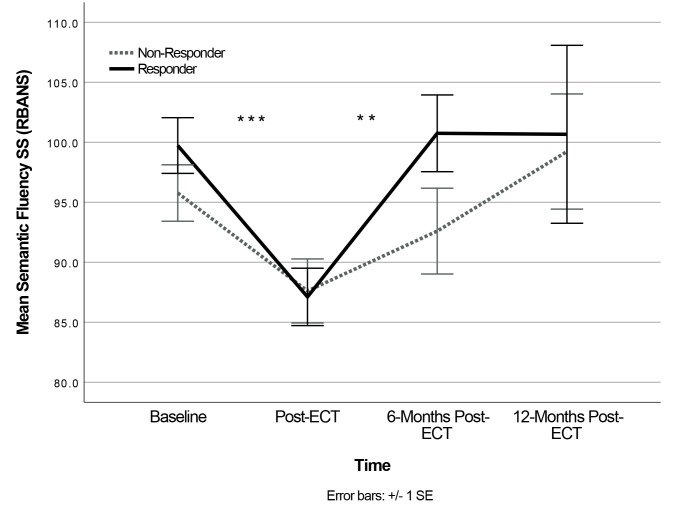
Results: Overall, cognitive performance was lower than expected compared to premorbid estimates at baseline but did not significantly worsen following ECT (p > 0.05), with the exception of a transient decline in verbal fluency scores. Patients endorsed elevated subjective memory complaints before and after ECT, which differed by treatment response as indicated by a significant Time by Response Group interaction p = 0.039. There were significant main effects of time in both 'Responders' (≥50% improvement in Beck Depression Inventory [BDI-II] score post-ECT), p < 0.001 and 'Non-Responders' (<50% improvement in BDI-II) p = 0.021. Within group, after controlling for multiple comparisons, there was a clear trend for SSMQ scores to improve across most time points in the 'Responder' group, but subjective memory declined and remained around baseline level in the 'Non-Responder' group across follow-up. In the sample as a whole, rapid reduction in BDI-II scores from baseline to mid-ECT predicted rapid improvement in SSMQ scores, p = 0.013.
Conclusions: Clinically complex adults referred to ECT for depression presented with prominent memory concerns and performed below expectation compared to their estimated premorbid cognitive functioning at baseline. Naturalistic delivery of ECT did not appear to be associated with prolonged adverse cognitive outcomes; however, subjective memory concerns and below-expected cognitive performance persisted during follow-up. Treatment response impacted subjective memory outcomes, with only 'Responders' endorsing slightly reduced, though still persistent, subjective memory concerns following ECT. Conclusions on the long-term impacts of ECT are tempered by the high lost to follow up (LTFU) rate observed across follow-up assessments (66% LTFU at 6-months, 81% LTFU at 12-months). Nonetheless, these findings emphasize the need to address subtle cognitive deficits and memory complaints that persist following ECT, even in individuals demonstrating clinical improvement.



 求助内容:
求助内容: 应助结果提醒方式:

 京公网安备 11010802042870号


