{"title":"Relationship Between Negative Cognition and Poor Quality of Life and Anxiety in Adolescents: A Meta-Analysis.","authors":"Şenay Kılınçel, Oğuzhan Kılınçel","doi":"10.31083/AP46205","DOIUrl":null,"url":null,"abstract":"<p><strong>Background: </strong>Anxiety disorders are among the most prevalent psychiatric conditions during adolescence and are closely associated with maladaptive cognitive processes and impaired quality of life (QoL). However, the magnitude of these associations and the factors moderating them remain inconsistent across studies. This meta-analysis aimed to synthesize the available empirical evidence on the relationships between negative cognitions, QoL, and anxiety in adolescents, and to examine potential moderating variables.</p><p><strong>Methods: </strong>In accordance with the PRISMA 2020 guidelines, a systematic literature search was conducted across PubMed, Embase, PsycINFO, Web of Science, Scopus, and grey literature sources. Eligible studies included adolescents aged 10-19 years and reported correlation coefficients between negative cognitions or QoL and anxiety. A total of 42 studies (N = 27,845) were included and pooled using random-effects models, with Fisher's z-transformed correlation coefficients as the primary effect size. Moderator analyses examined the influence of measurement instruments, sample characteristics (clinical vs. non-clinical), age, gender distribution, and study quality.</p><p><strong>Results: </strong>Across 34 studies (n = 21,006), negative cognitions showed a moderate positive association with anxiety (r = 0.41, 95% CI: 0.37-0.45, <i>p</i> < 0.001). Across 26 studies (n = 15,784), QoL demonstrated a moderate inverse association with anxiety (r = -0.36, 95% CI: -0.41 to -0.31, <i>p</i> < 0.001). Substantial heterogeneity was observed for both outcomes (I<sup>2</sup> = 68% for negative cognitions and 72% for QoL). Moderator analyses revealed stronger associations in clinical samples (negative cognition-anxiety r = 0.47; QoL-anxiety r = -0.42) compared with school- or community-based samples. Gender distribution significantly moderated effect sizes, with studies including more than >60% female participants reporting stronger associations (negative cognition-anxiety r = 0.44; QoL-anxiety r = -0.39, both <i>p</i> < 0.05). Measurement instruments also influenced results: the Dysfunctional Attitude Scale yielded the strongest associations between negative cognitions and anxiety (r = 0.45, <i>p</i> < 0.001), whereas QoL-anxiety associations were most pronounced when assessed using the KIDSCREEN instrument (r = -0.39, <i>p</i> < 0.001). Age group and country income level did not significantly moderate associations, although slightly stronger correlations were observed among older adolescents (15-19 years) compared with younger adolescents. Sensitivity analyses and publication bias assessments supported the robustness of the findings.</p><p><strong>Conclusion: </strong>Negative cognitions and reduced quality of life are robustly associated with anxiety in adolescents, particularly in clinical samples and in studies with a predominance of female participants. These findings provide strong support for cognitive-behavioral models of adolescent anxiety and underscore the importance of integrating cognitive restructuring with quality-of-life-enhancing strategies in prevention and intervention programs. Future longitudinal and cross-cultural research is needed to clarify causal mechanisms and to optimize mental health care for adolescents.</p>","PeriodicalId":72151,"journal":{"name":"Alpha psychiatry","volume":"27 1","pages":"46205"},"PeriodicalIF":2.9000,"publicationDate":"2026-02-25","publicationTypes":"Journal Article","fieldsOfStudy":null,"isOpenAccess":false,"openAccessPdf":"https://www.ncbi.nlm.nih.gov/pmc/articles/PMC12957976/pdf/","citationCount":"0","resultStr":null,"platform":"Semanticscholar","paperid":null,"PeriodicalName":"Alpha psychiatry","FirstCategoryId":"1085","ListUrlMain":"https://doi.org/10.31083/AP46205","RegionNum":0,"RegionCategory":null,"ArticlePicture":[],"TitleCN":null,"AbstractTextCN":null,"PMCID":null,"EPubDate":"2026/2/1 0:00:00","PubModel":"eCollection","JCR":"Q3","JCRName":"PSYCHIATRY","Score":null,"Total":0}
引用次数: 0
Abstract
Background: Anxiety disorders are among the most prevalent psychiatric conditions during adolescence and are closely associated with maladaptive cognitive processes and impaired quality of life (QoL). However, the magnitude of these associations and the factors moderating them remain inconsistent across studies. This meta-analysis aimed to synthesize the available empirical evidence on the relationships between negative cognitions, QoL, and anxiety in adolescents, and to examine potential moderating variables.
Methods: In accordance with the PRISMA 2020 guidelines, a systematic literature search was conducted across PubMed, Embase, PsycINFO, Web of Science, Scopus, and grey literature sources. Eligible studies included adolescents aged 10-19 years and reported correlation coefficients between negative cognitions or QoL and anxiety. A total of 42 studies (N = 27,845) were included and pooled using random-effects models, with Fisher's z-transformed correlation coefficients as the primary effect size. Moderator analyses examined the influence of measurement instruments, sample characteristics (clinical vs. non-clinical), age, gender distribution, and study quality.
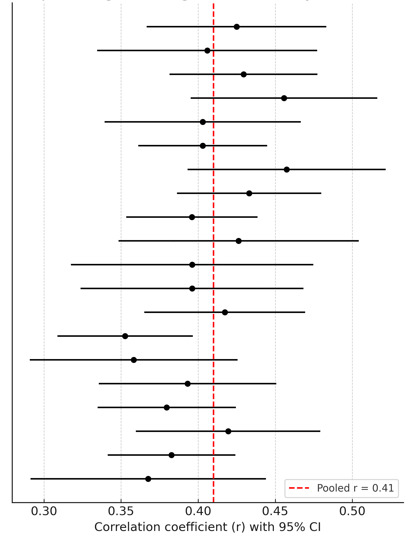
Results: Across 34 studies (n = 21,006), negative cognitions showed a moderate positive association with anxiety (r = 0.41, 95% CI: 0.37-0.45, p < 0.001). Across 26 studies (n = 15,784), QoL demonstrated a moderate inverse association with anxiety (r = -0.36, 95% CI: -0.41 to -0.31, p < 0.001). Substantial heterogeneity was observed for both outcomes (I2 = 68% for negative cognitions and 72% for QoL). Moderator analyses revealed stronger associations in clinical samples (negative cognition-anxiety r = 0.47; QoL-anxiety r = -0.42) compared with school- or community-based samples. Gender distribution significantly moderated effect sizes, with studies including more than >60% female participants reporting stronger associations (negative cognition-anxiety r = 0.44; QoL-anxiety r = -0.39, both p < 0.05). Measurement instruments also influenced results: the Dysfunctional Attitude Scale yielded the strongest associations between negative cognitions and anxiety (r = 0.45, p < 0.001), whereas QoL-anxiety associations were most pronounced when assessed using the KIDSCREEN instrument (r = -0.39, p < 0.001). Age group and country income level did not significantly moderate associations, although slightly stronger correlations were observed among older adolescents (15-19 years) compared with younger adolescents. Sensitivity analyses and publication bias assessments supported the robustness of the findings.
Conclusion: Negative cognitions and reduced quality of life are robustly associated with anxiety in adolescents, particularly in clinical samples and in studies with a predominance of female participants. These findings provide strong support for cognitive-behavioral models of adolescent anxiety and underscore the importance of integrating cognitive restructuring with quality-of-life-enhancing strategies in prevention and intervention programs. Future longitudinal and cross-cultural research is needed to clarify causal mechanisms and to optimize mental health care for adolescents.




 求助内容:
求助内容: 应助结果提醒方式:

 京公网安备 11010802042870号


