{"title":"UPLC-MS/MS Analytical Method for the Simultaneous Quantification of Diazepam, Nordazepam, and Oxazepam in Patients With Alcohol Dependence.","authors":"Xiao-Lin Li, Wan-Ting Huang, Xiao-Jia Ni, Hao-Yang Lu, Shan-Qing Huang, Yu-Qing Li, Huan-Shan Xie, Yu-Guan Wen, Zhan-Zhang Wang, De-Wei Shang","doi":"10.31083/AP38973","DOIUrl":null,"url":null,"abstract":"<p><strong>Background: </strong>To establish a method for the simultaneous quantification of diazepam (DIA) and its active metabolites, nordazepam (NorD) and oxazepam (OXAZ), and provide a reference range for therapeutic concentrations in patients with alcohol dependence.</p><p><strong>Methods: </strong>Simple and direct protein precipitation was used to extract the biological samples. Subsequent separation was performed on an Agilent XDB-C18 column (50 mm × 4.6 mm, 1.8 μm) with a column temperature maintained at 35 °C and a flow rate of 0.5 mL/min via ultra-high performance liquid chromatography-tandem mass spectrometry (UPLC-MS/MS). The mobile phase consisted of methanol-water containing 5 mM ammonium formate (75:25, v/v). Detection was conducted using electrospray ionization in multiple reaction monitoring modes: <i>m/z</i> 284.6→193.2 for DIA, <i>m/z</i> 270.5→140.1 for NorD, <i>m/z</i> 286.9→241.1 for OXAZ, <i>m/z</i> 289.6→198.2 for DIA-D5, <i>m/z</i> 275.5→140.0 for NorD-D5, and <i>m/z</i> 291.9→246.1 for OXAZ-D5. The linear response range for DIA, NorD, and OXAZ was 1-1500 ng/mL.</p><p><strong>Results: </strong>The key parameters of the bioanalytical method were validated: the average extraction recovery was 95%-101% (CV <6%); calibration curves exhibited good linearity over the concentration range (R<sup>2</sup> ≥0.99 for all analytes); accuracy was within 85%-115%; and intra-day and inter-day precision were satisfactory (CVs <15%). The concentrations of analytes in 26 routine therapeutic drug monitoring (TDM) samples from patients with alcohol dependence were determined.</p><p><strong>Conclusions: </strong>We developed and validated a rapid, simple, and economic UPLC-MS/MS method for the quantification of DIA, NorD, and OXAZ in human serum. The method is well-suited for the determination of serum levels of DIA and its active metabolites in patients with alcohol dependence, and could be further applied to TDM and subsequent studies.</p>","PeriodicalId":72151,"journal":{"name":"Alpha psychiatry","volume":"27 1","pages":"38973"},"PeriodicalIF":2.9000,"publicationDate":"2026-02-26","publicationTypes":"Journal Article","fieldsOfStudy":null,"isOpenAccess":false,"openAccessPdf":"https://www.ncbi.nlm.nih.gov/pmc/articles/PMC12957979/pdf/","citationCount":"0","resultStr":null,"platform":"Semanticscholar","paperid":null,"PeriodicalName":"Alpha psychiatry","FirstCategoryId":"1085","ListUrlMain":"https://doi.org/10.31083/AP38973","RegionNum":0,"RegionCategory":null,"ArticlePicture":[],"TitleCN":null,"AbstractTextCN":null,"PMCID":null,"EPubDate":"2026/2/1 0:00:00","PubModel":"eCollection","JCR":"Q3","JCRName":"PSYCHIATRY","Score":null,"Total":0}
引用次数: 0
Abstract
Background: To establish a method for the simultaneous quantification of diazepam (DIA) and its active metabolites, nordazepam (NorD) and oxazepam (OXAZ), and provide a reference range for therapeutic concentrations in patients with alcohol dependence.
Methods: Simple and direct protein precipitation was used to extract the biological samples. Subsequent separation was performed on an Agilent XDB-C18 column (50 mm × 4.6 mm, 1.8 μm) with a column temperature maintained at 35 °C and a flow rate of 0.5 mL/min via ultra-high performance liquid chromatography-tandem mass spectrometry (UPLC-MS/MS). The mobile phase consisted of methanol-water containing 5 mM ammonium formate (75:25, v/v). Detection was conducted using electrospray ionization in multiple reaction monitoring modes: m/z 284.6→193.2 for DIA, m/z 270.5→140.1 for NorD, m/z 286.9→241.1 for OXAZ, m/z 289.6→198.2 for DIA-D5, m/z 275.5→140.0 for NorD-D5, and m/z 291.9→246.1 for OXAZ-D5. The linear response range for DIA, NorD, and OXAZ was 1-1500 ng/mL.
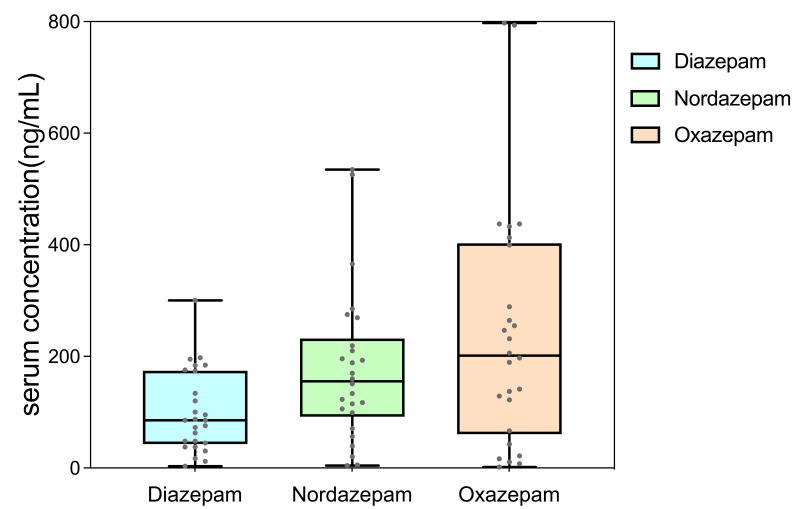
Results: The key parameters of the bioanalytical method were validated: the average extraction recovery was 95%-101% (CV <6%); calibration curves exhibited good linearity over the concentration range (R2 ≥0.99 for all analytes); accuracy was within 85%-115%; and intra-day and inter-day precision were satisfactory (CVs <15%). The concentrations of analytes in 26 routine therapeutic drug monitoring (TDM) samples from patients with alcohol dependence were determined.
Conclusions: We developed and validated a rapid, simple, and economic UPLC-MS/MS method for the quantification of DIA, NorD, and OXAZ in human serum. The method is well-suited for the determination of serum levels of DIA and its active metabolites in patients with alcohol dependence, and could be further applied to TDM and subsequent studies.




 求助内容:
求助内容: 应助结果提醒方式:

 京公网安备 11010802042870号


