Chu Li, Yuyao Jin, Wanwan Xu, Yuqi Shao, Yingying Hu
{"title":"Maternal air pollution exposure and postpartum depression: a systematic review and meta-analysis.","authors":"Chu Li, Yuyao Jin, Wanwan Xu, Yuqi Shao, Yingying Hu","doi":"10.7189/jogh.16.04020","DOIUrl":null,"url":null,"abstract":"<p><strong>Background: </strong>Air pollution is an environmental stimulus that may predispose pregnant women to postpartum depression (PPD). However, the relationship between maternal exposure to air pollutants and PPD is still unclear. Understanding the magnitude of this effect is critical to developing public health policies that protect women's reproductive health.</p><p><strong>Methods: </strong>We searched all studies published in PubMed, Embase, Scopus, and Web of Science up to December 2024. The research protocol has been registered in PROSPERO. Test for homogeneity based on Cochran's Q and I<sup>2</sup> statistics was calculated, and the restricted maximum likelihood random effect model was applied. We assessed the overall quality of pooled estimates, the influence of single studies on the meta-analytic estimates, sources of between-study heterogeneity, and publication bias.</p><p><strong>Results: </strong>Of the 7881 unique publications identified, nine studies met the inclusion criteria for final review, involving 405 635 pregnant women. We comprehensively assessed the available data on air pollutants and PPD risk. Maternal exposure to particulate matter diameter ≤10 μm (PM<sub>10</sub>) increases the risk of PPD (pooled odds ratio (OR) = 1.08; 95% CI = 1.02-1.14, the whole pregnancy; pooled OR = 1.09; 95% CI = 1.03-1.15, the second trimester). Additionally, PPD was significantly associated with an increase of carbon monoxide (CO), nitrate ion (NO<sub>3</sub><sup>-</sup>), and ammonium ion (NH<sub>4</sub><sup>+</sup>).</p><p><strong>Conclusions: </strong>Maternal exposure to PM<sub>10</sub>, CO, NO<sub>3</sub><sup>-</sup>, and NH<sub>4</sub><sup>+</sup> during pregnancy is associated with PPD occurrence, especially in the second trimester. Interventions to improve air pollutants may mitigate the maternal risks of developing PPD. Our findings support public health interventions and environmental policy reforms to protect maternal mental health.</p><p><strong>Registration: </strong>PROSPERO CRD42024626359.</p>","PeriodicalId":48734,"journal":{"name":"Journal of Global Health","volume":"16 ","pages":"04020"},"PeriodicalIF":4.3000,"publicationDate":"2026-03-06","publicationTypes":"Journal Article","fieldsOfStudy":null,"isOpenAccess":false,"openAccessPdf":"https://www.ncbi.nlm.nih.gov/pmc/articles/PMC12968735/pdf/","citationCount":"0","resultStr":null,"platform":"Semanticscholar","paperid":null,"PeriodicalName":"Journal of Global Health","FirstCategoryId":"3","ListUrlMain":"https://doi.org/10.7189/jogh.16.04020","RegionNum":3,"RegionCategory":"医学","ArticlePicture":[],"TitleCN":null,"AbstractTextCN":null,"PMCID":null,"EPubDate":"","PubModel":"","JCR":"Q1","JCRName":"PUBLIC, ENVIRONMENTAL & OCCUPATIONAL HEALTH","Score":null,"Total":0}
引用次数: 0
Abstract
Background: Air pollution is an environmental stimulus that may predispose pregnant women to postpartum depression (PPD). However, the relationship between maternal exposure to air pollutants and PPD is still unclear. Understanding the magnitude of this effect is critical to developing public health policies that protect women's reproductive health.
Methods: We searched all studies published in PubMed, Embase, Scopus, and Web of Science up to December 2024. The research protocol has been registered in PROSPERO. Test for homogeneity based on Cochran's Q and I2 statistics was calculated, and the restricted maximum likelihood random effect model was applied. We assessed the overall quality of pooled estimates, the influence of single studies on the meta-analytic estimates, sources of between-study heterogeneity, and publication bias.
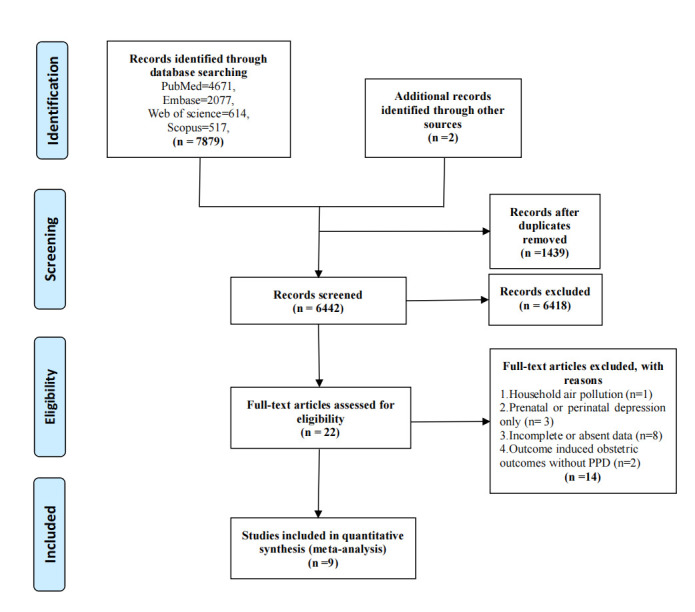
Results: Of the 7881 unique publications identified, nine studies met the inclusion criteria for final review, involving 405 635 pregnant women. We comprehensively assessed the available data on air pollutants and PPD risk. Maternal exposure to particulate matter diameter ≤10 μm (PM10) increases the risk of PPD (pooled odds ratio (OR) = 1.08; 95% CI = 1.02-1.14, the whole pregnancy; pooled OR = 1.09; 95% CI = 1.03-1.15, the second trimester). Additionally, PPD was significantly associated with an increase of carbon monoxide (CO), nitrate ion (NO3-), and ammonium ion (NH4+).
Conclusions: Maternal exposure to PM10, CO, NO3-, and NH4+ during pregnancy is associated with PPD occurrence, especially in the second trimester. Interventions to improve air pollutants may mitigate the maternal risks of developing PPD. Our findings support public health interventions and environmental policy reforms to protect maternal mental health.
期刊介绍:
Journal of Global Health is a peer-reviewed journal published by the Edinburgh University Global Health Society, a not-for-profit organization registered in the UK. We publish editorials, news, viewpoints, original research and review articles in two issues per year.



 求助内容:
求助内容: 应助结果提醒方式:

 京公网安备 11010802042870号


