Relationship between the preoperative status of the inferior rectus muscle and recovery time of ocular symptoms in patients with inferior orbital blowout fractures using computed tomography.
{"title":"Relationship between the preoperative status of the inferior rectus muscle and recovery time of ocular symptoms in patients with inferior orbital blowout fractures using computed tomography.","authors":"Joon Hyuk Lee, Yong Ha Kim, Sung Eun Kim","doi":"10.7181/acfs.2025.0075","DOIUrl":null,"url":null,"abstract":"<p><strong>Background: </strong>Inferior orbital blowout fractures (BOF) cause ocular symptoms like diplopia and extraocular muscle limitation, influenced by inferior rectus muscle (IRM) status. This study evaluated the relationship between preoperative IRM status on computed tomography (CT) and ocular symptom recovery time.</p><p><strong>Methods: </strong>This retrospective study analyzed 127 patients with inferior BOF and ocular symptoms (2012-2024). Inclusion criteria included age 18-80 years and preoperative CT availability. IRM status was assessed for bone interruption, herniation extent, and swelling (short/ long axis ratio < 0.54 or ≥ 0.54). Recovery times were analyzed using t-tests and Kaplan-Meier survival analysis (p< 0.05).</p><p><strong>Results: </strong>Of 127 patients (mean age, 35 years; 67.7% male), 66 (52.0%) recovered from ocular symptoms within 7 days, 53 (41.7%) within 30-90 days, and eight (6.3%) had diplopia that remained as a permanent sequela at the last follow-up. Diplopia recovery time was longer in IRM-bone contact (16.9± 5.5 days, n= 35) and bone-pierced IRM (29.4± 10.3 days, n= 15) groups versus no-contact (5.1± 4.2 days, n= 77; p= 0.02, t-test). Herniation and swelling showed no significant correlation (p> 0.05).</p><p><strong>Conclusion: </strong>Preoperative CT-based assessment of the IRM-bone interface predicts diplopia recovery time, with bone-pierced IRM linked to prolonged recovery. Patients with bone-pierced IRM may require closer follow-up and careful consideration of timely surgical management.</p>","PeriodicalId":52238,"journal":{"name":"Archives of Craniofacial Surgery","volume":"27 1","pages":"28-33"},"PeriodicalIF":0.0000,"publicationDate":"2026-02-01","publicationTypes":"Journal Article","fieldsOfStudy":null,"isOpenAccess":false,"openAccessPdf":"https://www.ncbi.nlm.nih.gov/pmc/articles/PMC12968649/pdf/","citationCount":"0","resultStr":null,"platform":"Semanticscholar","paperid":null,"PeriodicalName":"Archives of Craniofacial Surgery","FirstCategoryId":"1085","ListUrlMain":"https://doi.org/10.7181/acfs.2025.0075","RegionNum":0,"RegionCategory":null,"ArticlePicture":[],"TitleCN":null,"AbstractTextCN":null,"PMCID":null,"EPubDate":"2026/2/20 0:00:00","PubModel":"Epub","JCR":"Q2","JCRName":"Medicine","Score":null,"Total":0}
引用次数: 0
Abstract
Background: Inferior orbital blowout fractures (BOF) cause ocular symptoms like diplopia and extraocular muscle limitation, influenced by inferior rectus muscle (IRM) status. This study evaluated the relationship between preoperative IRM status on computed tomography (CT) and ocular symptom recovery time.
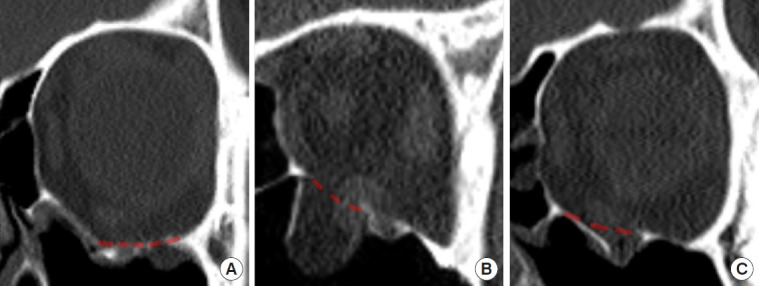
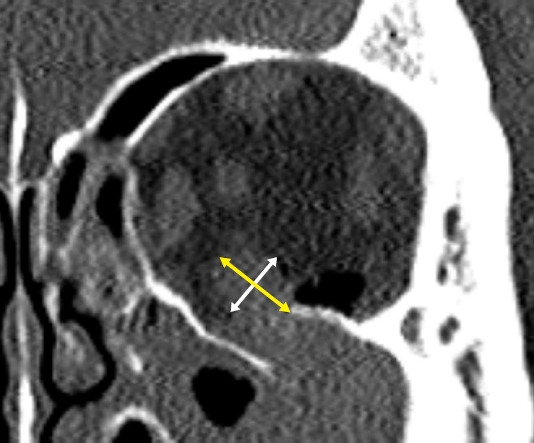
Methods: This retrospective study analyzed 127 patients with inferior BOF and ocular symptoms (2012-2024). Inclusion criteria included age 18-80 years and preoperative CT availability. IRM status was assessed for bone interruption, herniation extent, and swelling (short/ long axis ratio < 0.54 or ≥ 0.54). Recovery times were analyzed using t-tests and Kaplan-Meier survival analysis (p< 0.05).
Results: Of 127 patients (mean age, 35 years; 67.7% male), 66 (52.0%) recovered from ocular symptoms within 7 days, 53 (41.7%) within 30-90 days, and eight (6.3%) had diplopia that remained as a permanent sequela at the last follow-up. Diplopia recovery time was longer in IRM-bone contact (16.9± 5.5 days, n= 35) and bone-pierced IRM (29.4± 10.3 days, n= 15) groups versus no-contact (5.1± 4.2 days, n= 77; p= 0.02, t-test). Herniation and swelling showed no significant correlation (p> 0.05).
Conclusion: Preoperative CT-based assessment of the IRM-bone interface predicts diplopia recovery time, with bone-pierced IRM linked to prolonged recovery. Patients with bone-pierced IRM may require closer follow-up and careful consideration of timely surgical management.



 求助内容:
求助内容: 应助结果提醒方式:

 京公网安备 11010802042870号


