Manuel Vaqueiro Graña, María José González Burgo, Beatriz Calderón Cruz, Nadia Álvarez Expósito, Carmen Lourdes Rey Cordo, Susana Romero Santos, María Carmen Domínguez Grandal, José Luis Chamorro Martín, Evaristo García Martinez, Ana María Goicoechea-Castaño, Ana Concheiro Guisán
{"title":"Impact of growth hormone therapy on ambulatory blood pressure in small-for-gestational-age children.","authors":"Manuel Vaqueiro Graña, María José González Burgo, Beatriz Calderón Cruz, Nadia Álvarez Expósito, Carmen Lourdes Rey Cordo, Susana Romero Santos, María Carmen Domínguez Grandal, José Luis Chamorro Martín, Evaristo García Martinez, Ana María Goicoechea-Castaño, Ana Concheiro Guisán","doi":"10.6065/apem.2550052.026","DOIUrl":null,"url":null,"abstract":"<p><strong>Purpose: </strong>Prematurity and low birth weight increase cardiovascular risk, including hypertension (HTN). However, the combined effect of these factors along with others in the development of HTN is unclear. This study aimed to identify changes in blood pressure in small-for-gestational-age (SGA) patients treated with recombinant human growth hormone (rhGH) by comparison with healthy controls.</p><p><strong>Methods: </strong>We conducted a case-control study with 72 SGA and healthy controls, aged 6 to 16 years. Blood pressure was assessed through office and 24-hour ambulatory blood pressure monitoring (ABPM) recordings (at least 40 measurements including daytime and nighttime), and results were compared between SGA children on rhGH treatment and healthy peers.</p><p><strong>Results: </strong>Forty-six SGA children (41% preterm) on rhGH therapy and 26 healthy controls were enrolled. Despite an average of 5 years of rhGH treatment, no significant difference in HTN frequency was found between groups. However, multiple regression analysis revealed a 0.451 increase in 24-hour diastolic blood pressure (DBP) standard deviation score (SDS) in SGA children on rhGH (P=0.032). Daytime DBP SDS was also increased (0.462; P=0.042). An inverse correlation between weight and gestational age at birth was established. SGA children in the prepubertal stage showed a greater increase in 24-hour DBP SDS than those in the pubertal stage (0.499; P=0.009). Overweight was independently associated with increased 24-hour (0.950; P=0.002) and daytime DBP SDS (1.005; P=0.001).</p><p><strong>Conclusion: </strong>Prolonged rhGH treatment in SGA patients did not increase the risk of HTN. However, ABPM detected subtle changes that highlight the need for careful blood pressure monitoring in overweight prepubertal children.</p>","PeriodicalId":44915,"journal":{"name":"Annals of Pediatric Endocrinology & Metabolism","volume":"31 1","pages":"11-19"},"PeriodicalIF":3.3000,"publicationDate":"2026-02-01","publicationTypes":"Journal Article","fieldsOfStudy":null,"isOpenAccess":false,"openAccessPdf":"https://www.ncbi.nlm.nih.gov/pmc/articles/PMC12963737/pdf/","citationCount":"0","resultStr":null,"platform":"Semanticscholar","paperid":null,"PeriodicalName":"Annals of Pediatric Endocrinology & Metabolism","FirstCategoryId":"1085","ListUrlMain":"https://doi.org/10.6065/apem.2550052.026","RegionNum":0,"RegionCategory":null,"ArticlePicture":[],"TitleCN":null,"AbstractTextCN":null,"PMCID":null,"EPubDate":"2026/2/28 0:00:00","PubModel":"Epub","JCR":"Q3","JCRName":"ENDOCRINOLOGY & METABOLISM","Score":null,"Total":0}
引用次数: 0
Abstract
Purpose: Prematurity and low birth weight increase cardiovascular risk, including hypertension (HTN). However, the combined effect of these factors along with others in the development of HTN is unclear. This study aimed to identify changes in blood pressure in small-for-gestational-age (SGA) patients treated with recombinant human growth hormone (rhGH) by comparison with healthy controls.
Methods: We conducted a case-control study with 72 SGA and healthy controls, aged 6 to 16 years. Blood pressure was assessed through office and 24-hour ambulatory blood pressure monitoring (ABPM) recordings (at least 40 measurements including daytime and nighttime), and results were compared between SGA children on rhGH treatment and healthy peers.
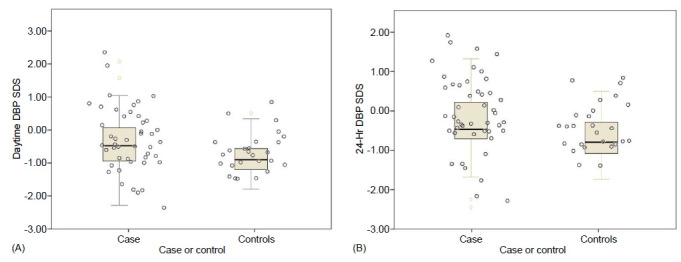
Results: Forty-six SGA children (41% preterm) on rhGH therapy and 26 healthy controls were enrolled. Despite an average of 5 years of rhGH treatment, no significant difference in HTN frequency was found between groups. However, multiple regression analysis revealed a 0.451 increase in 24-hour diastolic blood pressure (DBP) standard deviation score (SDS) in SGA children on rhGH (P=0.032). Daytime DBP SDS was also increased (0.462; P=0.042). An inverse correlation between weight and gestational age at birth was established. SGA children in the prepubertal stage showed a greater increase in 24-hour DBP SDS than those in the pubertal stage (0.499; P=0.009). Overweight was independently associated with increased 24-hour (0.950; P=0.002) and daytime DBP SDS (1.005; P=0.001).
Conclusion: Prolonged rhGH treatment in SGA patients did not increase the risk of HTN. However, ABPM detected subtle changes that highlight the need for careful blood pressure monitoring in overweight prepubertal children.
期刊介绍:
The Annals of Pediatric Endocrinology & Metabolism Journal is the official publication of the Korean Society of Pediatric Endocrinology. Its formal abbreviated title is “Ann Pediatr Endocrinol Metab”. It is a peer-reviewed open access journal of medicine published in English. The journal was launched in 1996 under the title of ‘Journal of Korean Society of Pediatric Endocrinology’ until 2011 (pISSN 1226-2242). Since 2012, the title is now changed to ‘Annals of Pediatric Endocrinology & Metabolism’. The Journal is published four times per year on the last day of March, June, September, and December. It is widely distributed for free to members of the Korean Society of Pediatric Endocrinology, medical schools, libraries, and academic institutions. The journal is indexed/tracked/covered by web sites of PubMed Central, PubMed, Emerging Sources Citation Index (ESCI), Scopus, EBSCO, EMBASE, KoreaMed, KoMCI, KCI, Science Central, DOI/CrossRef, Directory of Open Access Journals(DOAJ), and Google Scholar. The aims of Annals of Pediatric Endocrinology & Metabolism are to contribute to the advancements in the fields of pediatric endocrinology & metabolism through the scientific reviews and interchange of all of pediatric endocrinology and metabolism. It aims to reflect the latest clinical, translational, and basic research trends from worldwide valuable achievements. In addition, genome research, epidemiology, public education and clinical practice guidelines in each country are welcomed for publication. The Journal particularly focuses on research conducted with Asian-Pacific children whose genetic and environmental backgrounds are different from those of the Western. Area of specific interest include the following : Growth, puberty, glucose metabolism including diabetes mellitus, obesity, nutrition, disorders of sexual development, pituitary, thyroid, parathyroid, adrenal cortex, bone or other endocrine and metabolic disorders from infancy through adolescence.


 求助内容:
求助内容: 应助结果提醒方式:

 京公网安备 11010802042870号


