Myung Ji Yoo, Ji-Eun Lee, Eun Young Joo, Jisun Park, Young Ju Suh, Su Jin Kim
{"title":"Early prediction of transient versus permanent congenital hypothyroidism: a retrospective cohort study.","authors":"Myung Ji Yoo, Ji-Eun Lee, Eun Young Joo, Jisun Park, Young Ju Suh, Su Jin Kim","doi":"10.6065/apem.2550066.033","DOIUrl":null,"url":null,"abstract":"<p><strong>Purpose: </strong>Early differentiation between transient congenital hypothyroidism (TCH) and permanent congenital hypothyroidism (PCH) is crucial for optimizing the duration of treatment. This retrospective cohort study aimed to evaluate whether levothyroxine (LT4) dose requirements over time can predict TCH and guide earlier discontinuation of treatment.</p><p><strong>Methods: </strong>We retrospectively analyzed 105 infants with congenital hypothyroidism and normal thyroid glands confirmed by imaging at a single tertiary care center (Inha University Hospital) between January 2013 and December 2022. Patients were classified into TCH (n=70) or PCH (n=35) based on thyroid function after LT4 withdrawal at 3 years of age. LT4 dose/kg at 6, 12, and 24 months, along with clinical and biochemical parameters, were compared between the 2 groups. Receiver operating characteristic (ROC) curve analysis was used to assess the predictive performance of LT4 dose thresholds.</p><p><strong>Results: </strong>The LT4 dose was significantly lower in the TCH group at 6 (3.16±0.83 μg/kg vs. 3.75±0.99 μg/kg, P=0.005), 12 (2.51±0.82 μg/kg vs. 3.37±1.17 μg/kg, P<0.001), and 24 months (2.02±0.61 μg/kg vs. 3.09±1.19 μg/kg, P<0.001). ROC curve analysis showed an area under the curve (AUC) of 0.649, 0.746, and 0.794 at 6, 12, and 24 months, respectively. A logistic regression model incorporating LT4 dose, birth weight, and thyroid-stimulating hormone (TSH) levels improved prediction accuracy (AUC: 0.740, 0.782, 0.833 at 6, 12, and 24 months, respectively).</p><p><strong>Conclusion: </strong>LT4 dose requirements at 6, 12, and 24 months serve as useful indicators for differentiating TCH from PCH. A combined predictive model incorporating LT4 dose, birth weight, and TSH levels may improve diagnostic accuracy, supporting earlier discontinuation of treatment.</p>","PeriodicalId":44915,"journal":{"name":"Annals of Pediatric Endocrinology & Metabolism","volume":"31 1","pages":"38-44"},"PeriodicalIF":3.3000,"publicationDate":"2026-02-01","publicationTypes":"Journal Article","fieldsOfStudy":null,"isOpenAccess":false,"openAccessPdf":"https://www.ncbi.nlm.nih.gov/pmc/articles/PMC12963730/pdf/","citationCount":"0","resultStr":null,"platform":"Semanticscholar","paperid":null,"PeriodicalName":"Annals of Pediatric Endocrinology & Metabolism","FirstCategoryId":"1085","ListUrlMain":"https://doi.org/10.6065/apem.2550066.033","RegionNum":0,"RegionCategory":null,"ArticlePicture":[],"TitleCN":null,"AbstractTextCN":null,"PMCID":null,"EPubDate":"2026/2/28 0:00:00","PubModel":"Epub","JCR":"Q3","JCRName":"ENDOCRINOLOGY & METABOLISM","Score":null,"Total":0}
引用次数: 0
Abstract
Purpose: Early differentiation between transient congenital hypothyroidism (TCH) and permanent congenital hypothyroidism (PCH) is crucial for optimizing the duration of treatment. This retrospective cohort study aimed to evaluate whether levothyroxine (LT4) dose requirements over time can predict TCH and guide earlier discontinuation of treatment.
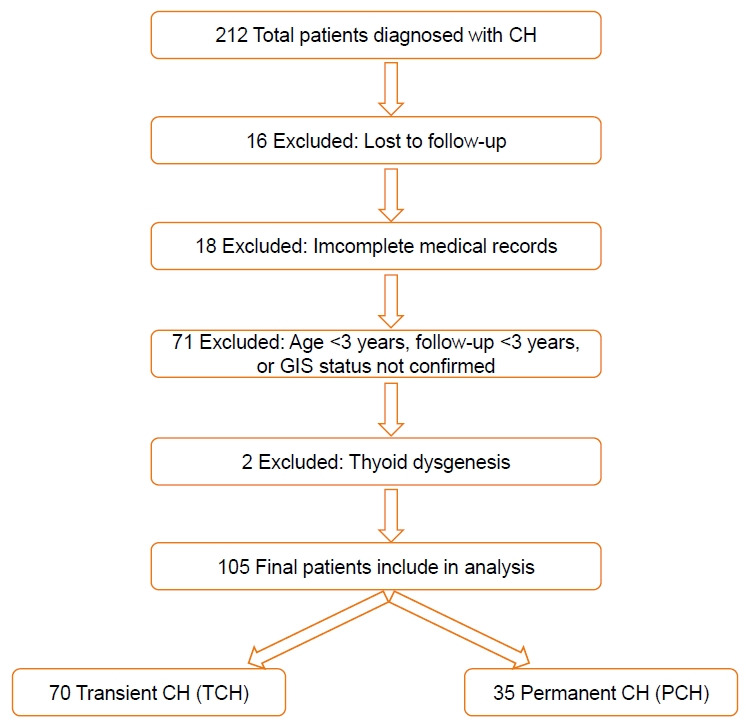
Methods: We retrospectively analyzed 105 infants with congenital hypothyroidism and normal thyroid glands confirmed by imaging at a single tertiary care center (Inha University Hospital) between January 2013 and December 2022. Patients were classified into TCH (n=70) or PCH (n=35) based on thyroid function after LT4 withdrawal at 3 years of age. LT4 dose/kg at 6, 12, and 24 months, along with clinical and biochemical parameters, were compared between the 2 groups. Receiver operating characteristic (ROC) curve analysis was used to assess the predictive performance of LT4 dose thresholds.
Results: The LT4 dose was significantly lower in the TCH group at 6 (3.16±0.83 μg/kg vs. 3.75±0.99 μg/kg, P=0.005), 12 (2.51±0.82 μg/kg vs. 3.37±1.17 μg/kg, P<0.001), and 24 months (2.02±0.61 μg/kg vs. 3.09±1.19 μg/kg, P<0.001). ROC curve analysis showed an area under the curve (AUC) of 0.649, 0.746, and 0.794 at 6, 12, and 24 months, respectively. A logistic regression model incorporating LT4 dose, birth weight, and thyroid-stimulating hormone (TSH) levels improved prediction accuracy (AUC: 0.740, 0.782, 0.833 at 6, 12, and 24 months, respectively).
Conclusion: LT4 dose requirements at 6, 12, and 24 months serve as useful indicators for differentiating TCH from PCH. A combined predictive model incorporating LT4 dose, birth weight, and TSH levels may improve diagnostic accuracy, supporting earlier discontinuation of treatment.
期刊介绍:
The Annals of Pediatric Endocrinology & Metabolism Journal is the official publication of the Korean Society of Pediatric Endocrinology. Its formal abbreviated title is “Ann Pediatr Endocrinol Metab”. It is a peer-reviewed open access journal of medicine published in English. The journal was launched in 1996 under the title of ‘Journal of Korean Society of Pediatric Endocrinology’ until 2011 (pISSN 1226-2242). Since 2012, the title is now changed to ‘Annals of Pediatric Endocrinology & Metabolism’. The Journal is published four times per year on the last day of March, June, September, and December. It is widely distributed for free to members of the Korean Society of Pediatric Endocrinology, medical schools, libraries, and academic institutions. The journal is indexed/tracked/covered by web sites of PubMed Central, PubMed, Emerging Sources Citation Index (ESCI), Scopus, EBSCO, EMBASE, KoreaMed, KoMCI, KCI, Science Central, DOI/CrossRef, Directory of Open Access Journals(DOAJ), and Google Scholar. The aims of Annals of Pediatric Endocrinology & Metabolism are to contribute to the advancements in the fields of pediatric endocrinology & metabolism through the scientific reviews and interchange of all of pediatric endocrinology and metabolism. It aims to reflect the latest clinical, translational, and basic research trends from worldwide valuable achievements. In addition, genome research, epidemiology, public education and clinical practice guidelines in each country are welcomed for publication. The Journal particularly focuses on research conducted with Asian-Pacific children whose genetic and environmental backgrounds are different from those of the Western. Area of specific interest include the following : Growth, puberty, glucose metabolism including diabetes mellitus, obesity, nutrition, disorders of sexual development, pituitary, thyroid, parathyroid, adrenal cortex, bone or other endocrine and metabolic disorders from infancy through adolescence.




 求助内容:
求助内容: 应助结果提醒方式:

 京公网安备 11010802042870号


