
Optimization of a MWCNTs-AuNPs composite-modified electrochemical immunosensor with anti-fouling property for highly sensitive and rapid detection of BNP in myocardial infarction-induced heart failure diagnosis
IF 4.5
2区 化学
Q1 BIOCHEMISTRY & MOLECULAR BIOLOGY
Bioelectrochemistry
Pub Date : 2026-10-01
Epub Date: 2026-02-28
DOI:10.1016/j.bioelechem.2026.109258
引用次数: 0
Abstract
Brain natriuretic peptide (BNP) is a sensitive biomarker for acute heart failure (AHF). Rapid, sensitive, and anti-fouling BNP detection in serum remains clinically unmet. Herein, a novel electrochemical immunosensor with synergistic signal amplification and anti-fouling ability was constructed via layered AuNPs/MWCNTs-AuNPs modification. Bottom AuNPs mitigate MWCNTs agglomeration and enable stable Anti-BNP immobilization via Au![]() S bonds, MWCNTs enhance conductivity, and top AuNPs amplify signals, forming an efficient electron-transport network. A nitrocellulose (NC) membrane was laminated for anti-fouling via rapid contaminant sieving. Under optimization, the sensor shows a linear range of 7.81–8 × 10³ pg/mL for BNP, with a detection limit of 8.14 × 10⁻² pg/mL (3σ, n = 11), outperforming ELISA. It exhibits excellent selectivity (vs. cTn-I, glucose, IL-6), repeatability (RSD = 2.3%), and stability (92.4% retention over 30 days). Serum recovery rates of 102–105% confirm anti-fouling reliability. This cost-effective platform promises POCT for AHF and underpins anti-fouling biosensor development.
S bonds, MWCNTs enhance conductivity, and top AuNPs amplify signals, forming an efficient electron-transport network. A nitrocellulose (NC) membrane was laminated for anti-fouling via rapid contaminant sieving. Under optimization, the sensor shows a linear range of 7.81–8 × 10³ pg/mL for BNP, with a detection limit of 8.14 × 10⁻² pg/mL (3σ, n = 11), outperforming ELISA. It exhibits excellent selectivity (vs. cTn-I, glucose, IL-6), repeatability (RSD = 2.3%), and stability (92.4% retention over 30 days). Serum recovery rates of 102–105% confirm anti-fouling reliability. This cost-effective platform promises POCT for AHF and underpins anti-fouling biosensor development.
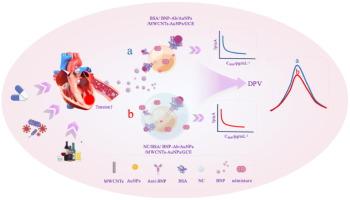
MWCNTs-AuNPs复合修饰抗污染电化学免疫传感器在心肌梗死性心力衰竭诊断中的高灵敏度和快速检测
脑钠肽(BNP)是急性心力衰竭(AHF)的敏感生物标志物。快速、灵敏、抗污染的血清BNP检测仍未在临床上实现。本文通过层状AuNPs/MWCNTs-AuNPs修饰,构建了一种具有协同信号放大和防污能力的新型电化学免疫传感器。底部AuNPs可减轻MWCNTs团聚并通过AuS键实现稳定的Anti-BNP固定化,MWCNTs可增强电导率,顶部AuNPs可放大信号,形成高效的电子传递网络。采用快速过滤的方法制备了一种硝基纤维素(NC)防污膜。优化后,该传感器对BNP的检测线性范围为7.81 ~ 8 × 10³ pg/mL,检出限为8.14 × 10-2 pg/mL (3σ, n = 11),优于ELISA。它具有优良的选择性(相对于ctn - 1、葡萄糖、IL-6)、重复性(RSD = 2.3%)和稳定性(30天内保留率为92.4%)。102-105%的血清回收率证实了抗污染的可靠性。这个具有成本效益的平台为AHF提供了POCT,并支持了防污生物传感器的开发。
本文章由计算机程序翻译,如有差异,请以英文原文为准。
求助全文
约1分钟内获得全文
求助全文
来源期刊
Bioelectrochemistry
生物-电化学
CiteScore
9.10
自引率
6.00%
发文量
238
审稿时长
38 days
期刊介绍:
An International Journal Devoted to Electrochemical Aspects of Biology and Biological Aspects of Electrochemistry
Bioelectrochemistry is an international journal devoted to electrochemical principles in biology and biological aspects of electrochemistry. It publishes experimental and theoretical papers dealing with the electrochemical aspects of:
• Electrified interfaces (electric double layers, adsorption, electron transfer, protein electrochemistry, basic principles of biosensors, biosensor interfaces and bio-nanosensor design and construction.
• Electric and magnetic field effects (field-dependent processes, field interactions with molecules, intramolecular field effects, sensory systems for electric and magnetic fields, molecular and cellular mechanisms)
• Bioenergetics and signal transduction (energy conversion, photosynthetic and visual membranes)
• Biomembranes and model membranes (thermodynamics and mechanics, membrane transport, electroporation, fusion and insertion)
• Electrochemical applications in medicine and biotechnology (drug delivery and gene transfer to cells and tissues, iontophoresis, skin electroporation, injury and repair).
• Organization and use of arrays in-vitro and in-vivo, including as part of feedback control.
• Electrochemical interrogation of biofilms as generated by microorganisms and tissue reaction associated with medical implants.
 求助内容:
求助内容: 应助结果提醒方式:

 京公网安备 11010802042870号


