{"title":"Handling Four Systematic Effects in Three Gravimetric Geoid Determination Methods from a Viewpoint of the Centimetre-Precise Geoid","authors":"R. Goyal, S. J. Claessens","doi":"10.1007/s10712-026-09940-z","DOIUrl":null,"url":null,"abstract":"<div><p>Over the past few decades, calculating a cm-precise geoid has been a major pursuit of geodesists. Numerous geoid modelling methods exist because geoid modelling theory was necessarily developed with some assumptions, which are handled differently by respective research groups. In the literature, numerous papers discuss in detail the theory of (aspects of) any one computational method. There are also numerous papers with empirical comparisons between different geoid modelling methods, where differences in excess of 1 cm are typically found. Almost all previous studies simply provide numerical comparisons of final geoid models, but more work is required to find out what causes the discrepancies. This study reviews the similarities and dissimilarities among three different geoid modelling methods: the approach followed at Curtin University of Technology, the Stokes-Helmert method, and the method of Least Squares Modification of Stokes formula with additive corrections. These methods may provide varying solutions due to, including but not limited to, choices of parameters and freely available data (Global Geopotential Models, Digital Elevation Models), kernel modifications, handling of the dataset (gridding, merging, interpolation etc.), etc. However, only the four following aspects are covered in this paper, i.e. the handling of 1) topographic masses, 2) atmospheric masses, 3) the ellipsoidal shape of the Earth, and 4) downward continuation. The major motivation behind this study is that with the pursuit of the cm-precise geoid, different geoid modelling methods should agree with one another within a given threshold because methods differ primarily in handling the discussed four aspects. Therefore, this study reviews these four aspects and compares them to identify the possible causes of discrepancies between the geoid modelling methods. Further, since no numerical comparisons are available on handling these corrections individually in different methods, this paper compares the mathematical formulations and suggests strategies as a roadmap to quantify the identified discrepancies among the methods.</p></div>","PeriodicalId":49458,"journal":{"name":"Surveys in Geophysics","volume":"47 2","pages":"395 - 448"},"PeriodicalIF":7.1000,"publicationDate":"2026-03-03","publicationTypes":"Journal Article","fieldsOfStudy":null,"isOpenAccess":false,"openAccessPdf":"","citationCount":"0","resultStr":null,"platform":"Semanticscholar","paperid":null,"PeriodicalName":"Surveys in Geophysics","FirstCategoryId":"89","ListUrlMain":"https://link.springer.com/article/10.1007/s10712-026-09940-z","RegionNum":2,"RegionCategory":"地球科学","ArticlePicture":[],"TitleCN":null,"AbstractTextCN":null,"PMCID":null,"EPubDate":"","PubModel":"","JCR":"Q1","JCRName":"GEOCHEMISTRY & GEOPHYSICS","Score":null,"Total":0}
引用次数: 0
Abstract
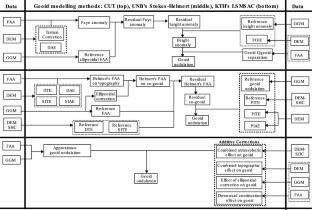
Over the past few decades, calculating a cm-precise geoid has been a major pursuit of geodesists. Numerous geoid modelling methods exist because geoid modelling theory was necessarily developed with some assumptions, which are handled differently by respective research groups. In the literature, numerous papers discuss in detail the theory of (aspects of) any one computational method. There are also numerous papers with empirical comparisons between different geoid modelling methods, where differences in excess of 1 cm are typically found. Almost all previous studies simply provide numerical comparisons of final geoid models, but more work is required to find out what causes the discrepancies. This study reviews the similarities and dissimilarities among three different geoid modelling methods: the approach followed at Curtin University of Technology, the Stokes-Helmert method, and the method of Least Squares Modification of Stokes formula with additive corrections. These methods may provide varying solutions due to, including but not limited to, choices of parameters and freely available data (Global Geopotential Models, Digital Elevation Models), kernel modifications, handling of the dataset (gridding, merging, interpolation etc.), etc. However, only the four following aspects are covered in this paper, i.e. the handling of 1) topographic masses, 2) atmospheric masses, 3) the ellipsoidal shape of the Earth, and 4) downward continuation. The major motivation behind this study is that with the pursuit of the cm-precise geoid, different geoid modelling methods should agree with one another within a given threshold because methods differ primarily in handling the discussed four aspects. Therefore, this study reviews these four aspects and compares them to identify the possible causes of discrepancies between the geoid modelling methods. Further, since no numerical comparisons are available on handling these corrections individually in different methods, this paper compares the mathematical formulations and suggests strategies as a roadmap to quantify the identified discrepancies among the methods.
期刊介绍:
Surveys in Geophysics publishes refereed review articles on the physical, chemical and biological processes occurring within the Earth, on its surface, in its atmosphere and in the near-Earth space environment, including relations with other bodies in the solar system. Observations, their interpretation, theory and modelling are covered in papers dealing with any of the Earth and space sciences.

 求助内容:
求助内容: 应助结果提醒方式:

 京公网安备 11010802042870号


