
Hierarchical maximum likelihood estimation for time-resolved NMR data
IF 1.9
3区 化学
Q3 BIOCHEMICAL RESEARCH METHODS
Journal of magnetic resonance
Pub Date : 2026-04-01
Epub Date: 2026-02-25
DOI:10.1016/j.jmr.2026.108044
引用次数: 0
Abstract
Metabolic monitoring and reaction rate estimation using hyperpolarized NMR technology requires accurate quantitative analysis of multidimensional data scenarios. Currently, this analysis is often performed in a two-stage procedure, which is prone to errors in uncertainty propagation and estimation. We propose an approach derived from a Bayesian hierarchical model that intrinsically propagates uncertainties and operates on the full data to maximize the precision at minimal uncertainty. In an analytic treatment, we reduce the estimation procedure to a least-squares optimization problem which can be understood as an extension of the Variable Projection (VarPro) approach for data scenarios with two predictors. We investigate the method’s efficacy in two experiments with hyperpolarized metabolites recorded with conventional high-field NMR devices and a micronscale NMR setup using Nitrogen-Vacancy centers in diamond for detection, respectively. In both examples, the new approach improves estimates compared to Fourier methods and proves operational advantages over a two-stage procedure employing VarPro. While the approach presented is motivated by NMR analysis, it is straightforwardly applicable to further estimation scenarios with similar data structure, such as time-resolved photospectroscopy.
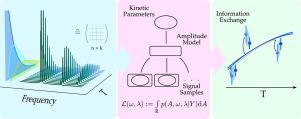
时间分辨核磁共振数据的层次最大似然估计。
利用超极化核磁共振技术进行代谢监测和反应速率估计需要对多维数据场景进行精确的定量分析。目前,这种分析通常是分两阶段进行的,这在不确定性传播和估计中容易出现错误。我们提出了一种源自贝叶斯层次模型的方法,该方法本质上传播不确定性,并对完整数据进行操作,以最小的不确定性最大化精度。在分析处理中,我们将估计过程简化为最小二乘优化问题,该问题可以理解为具有两个预测因子的数据场景的变量投影(VarPro)方法的扩展。我们在两个实验中研究了该方法的有效性,分别用传统的高场核磁共振设备和微尺度核磁共振装置记录了超极化代谢物,并使用金刚石中的氮空位中心进行检测。在这两个例子中,与傅立叶方法相比,新方法提高了估算值,并证明了与使用VarPro的两阶段程序相比的操作优势。虽然提出的方法是由核磁共振分析驱动的,但它可以直接适用于具有类似数据结构的进一步估计场景,例如时间分辨光谱学。
本文章由计算机程序翻译,如有差异,请以英文原文为准。
求助全文
约1分钟内获得全文
求助全文
来源期刊
CiteScore
3.80
自引率
13.60%
发文量
150
审稿时长
69 days
期刊介绍:
The Journal of Magnetic Resonance presents original technical and scientific papers in all aspects of magnetic resonance, including nuclear magnetic resonance spectroscopy (NMR) of solids and liquids, electron spin/paramagnetic resonance (EPR), in vivo magnetic resonance imaging (MRI) and spectroscopy (MRS), nuclear quadrupole resonance (NQR) and magnetic resonance phenomena at nearly zero fields or in combination with optics. The Journal''s main aims include deepening the physical principles underlying all these spectroscopies, publishing significant theoretical and experimental results leading to spectral and spatial progress in these areas, and opening new MR-based applications in chemistry, biology and medicine. The Journal also seeks descriptions of novel apparatuses, new experimental protocols, and new procedures of data analysis and interpretation - including computational and quantum-mechanical methods - capable of advancing MR spectroscopy and imaging.
 求助内容:
求助内容: 应助结果提醒方式:

 京公网安备 11010802042870号


