{"title":"Preoperative Low Serum Basophil Levels Predict Poor Prognosis for the Patients with Esophageal Squamous Cell Carcinoma.","authors":"Fumiaki Shiratori, Satoshi Yajima, Takashi Suzuki, Yoko Oshima, Teruki Yamakawa, Yuichiro Ohtsuka, Hideaki Shimada","doi":"10.5761/atcs.oa.26-00001","DOIUrl":null,"url":null,"abstract":"<p><strong>Purpose: </strong>A decrease in peripheral basophil count has recently been suggested as a potential marker of poor prognosis in malignancies. This study aimed to determine the optimal cutoff value for basophil count and assess its clinicopathological and prognostic significance in esophageal squamous cell carcinoma (ESCC).</p><p><strong>Methods: </strong>We retrospectively analyzed 194 patients with ESCC (157 men, 37 women; mean age, 67 years [range, 34-88]) who underwent curative surgery between 2010 and 2020, including 100 who received neoadjuvant chemotherapy. Receiver-operating characteristic curve analysis identified an optimal basophil cutoff value of 17.4/μL. Patients were divided into low- and high-basophil groups, and clinicopathological factors and prognosis were assessed using univariate and multivariate analyses.</p><p><strong>Results: </strong>Low-basophil counts were significantly correlated with low neutrophil counts but not with C-reactive protein level. Multivariate analysis to predict overall survival identified deep invasion, elevated C-reactive protein, and low-basophil count as independent predictors of a poor prognosis (P <0.05).</p><p><strong>Conclusion: </strong>Low preoperative basophil count is an independent adverse prognostic factor in ESCC. As basophil count was not correlated with C-reactive protein, it may provide prognostic value beyond conventional inflammation-based markers and could represent a simple, low-cost biomarker to aid risk stratification in the preoperative setting.</p>","PeriodicalId":93877,"journal":{"name":"Annals of thoracic and cardiovascular surgery : official journal of the Association of Thoracic and Cardiovascular Surgeons of Asia","volume":"32 1","pages":""},"PeriodicalIF":1.3000,"publicationDate":"2026-01-01","publicationTypes":"Journal Article","fieldsOfStudy":null,"isOpenAccess":false,"openAccessPdf":"https://www.ncbi.nlm.nih.gov/pmc/articles/PMC12967339/pdf/","citationCount":"0","resultStr":null,"platform":"Semanticscholar","paperid":null,"PeriodicalName":"Annals of thoracic and cardiovascular surgery : official journal of the Association of Thoracic and Cardiovascular Surgeons of Asia","FirstCategoryId":"1085","ListUrlMain":"https://doi.org/10.5761/atcs.oa.26-00001","RegionNum":0,"RegionCategory":null,"ArticlePicture":[],"TitleCN":null,"AbstractTextCN":null,"PMCID":null,"EPubDate":"","PubModel":"","JCR":"","JCRName":"","Score":null,"Total":0}
引用次数: 0
Abstract
Purpose: A decrease in peripheral basophil count has recently been suggested as a potential marker of poor prognosis in malignancies. This study aimed to determine the optimal cutoff value for basophil count and assess its clinicopathological and prognostic significance in esophageal squamous cell carcinoma (ESCC).
Methods: We retrospectively analyzed 194 patients with ESCC (157 men, 37 women; mean age, 67 years [range, 34-88]) who underwent curative surgery between 2010 and 2020, including 100 who received neoadjuvant chemotherapy. Receiver-operating characteristic curve analysis identified an optimal basophil cutoff value of 17.4/μL. Patients were divided into low- and high-basophil groups, and clinicopathological factors and prognosis were assessed using univariate and multivariate analyses.
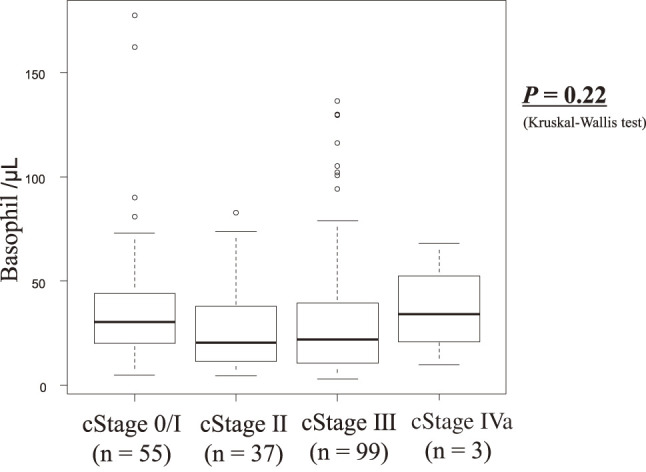
Results: Low-basophil counts were significantly correlated with low neutrophil counts but not with C-reactive protein level. Multivariate analysis to predict overall survival identified deep invasion, elevated C-reactive protein, and low-basophil count as independent predictors of a poor prognosis (P <0.05).
Conclusion: Low preoperative basophil count is an independent adverse prognostic factor in ESCC. As basophil count was not correlated with C-reactive protein, it may provide prognostic value beyond conventional inflammation-based markers and could represent a simple, low-cost biomarker to aid risk stratification in the preoperative setting.




 求助内容:
求助内容: 应助结果提醒方式:

 京公网安备 11010802042870号


