
Metabolic syndromes mediate the association between depression and cardiovascular diseases in the UK Biobank Population Study
IF 2.7
Q3 ENDOCRINOLOGY & METABOLISM
Comprehensive psychoneuroendocrinology
Pub Date : 2026-02-01
Epub Date: 2026-02-17
DOI:10.1016/j.cpnec.2026.100340
引用次数: 0
Abstract
Objective
This study aimed to assess the potential mediating role of metabolic syndrome (MetS) between depression and cardiovascular disease (CVD).
Methods
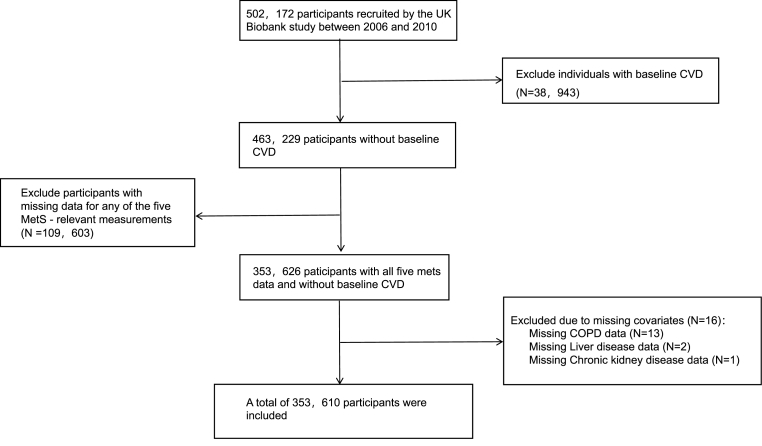
This population-based prospective cohort study analyzed data collected between March 2006 and December 2010 from 353,610 participants aged 37 to 73 years from the UK Biobank. Depression was assessed using self-reported questionnaires and linked hospital-based clinical depression diagnosis. MetS was defined as the presence of 3 or more of unhealthy waist circumference, dyslipidemia, hypertension, hyperglycemia and hypertriglyceridemia. Incident CVD was identified through linked hospital and death records. Counterfactual-based mediation analysis was conducted to estimate the mediating effect.
Results
After an average follow-up of 15 years, 38424 CVD events occurred in 353,610 participants (55% women; mean age at baseline, 56 years). Study findings indicated a significant direct association between depression and CVD (HR = 1.310; 95% CI, 1.277-1.342). A significant indirect association was also observed between depression and CVD (HR = 1.035; 95% CI, 1.031-1.037), indicating that 12.9% of the association of depression with CVD was mediated by MetS. Among the components of MetS, unhealthy waist circumference showed the largest estimated mediated proportion (PM = 10.2%; NIE HR = 1.027). MetS accounted for a higher proportion of the association between depression and CVD in males (PM = 14.2%; NIE HR = 1.026), than females (PM = 11.2%; NIE HR = 1.034). Blood pressure mediated the association only in participants aged ≥55 years (PM = −2.2%).
Conclusion
MetS partially mediates the association between depression and CVD during midlife. Unhealthy waist circumference may be the most important potential target for preventive interventions.
代谢综合征介导抑郁症和心血管疾病之间的关联在英国生物银行人口研究。
目的:探讨代谢综合征(MetS)在抑郁症和心血管疾病(CVD)之间的潜在中介作用。方法:这项基于人群的前瞻性队列研究分析了2006年3月至2010年12月从英国生物银行收集的353,610名年龄在37至73岁之间的参与者的数据。通过自我报告问卷和相关的医院临床抑郁症诊断来评估抑郁症。MetS定义为存在3种或以上不健康腰围、血脂异常、高血压、高血糖和高甘油三酯血症。通过关联的医院和死亡记录确定心血管疾病事件。采用基于反事实的中介分析来评估中介效应。结果:平均随访15年后,353,610名参与者发生38424例心血管疾病事件(55%为女性,基线平均年龄56岁)。研究结果表明,抑郁与心血管疾病之间存在显著的直接关联(HR = 1.310; 95% CI, 1.277-1.342)。抑郁症与CVD之间也存在显著的间接关联(HR = 1.035; 95% CI, 1.031-1.037),表明12.9%的抑郁症与CVD的关联是由MetS介导的。在met的各成分中,不健康腰围的介导比例估计最大(PM = 10.2%; NIE HR = 1.027)。met在男性抑郁症和心血管疾病之间的关联中所占的比例(PM = 14.2%, NIE HR = 1.026)高于女性(PM = 11.2%, NIE HR = 1.034)。血压仅在年龄≥55岁的参与者中介导了这种关联(PM = -2.2%)。结论:met在中年抑郁和心血管疾病之间起部分介导作用。不健康的腰围可能是预防干预最重要的潜在目标。
本文章由计算机程序翻译,如有差异,请以英文原文为准。
求助全文
约1分钟内获得全文
求助全文
来源期刊

Comprehensive psychoneuroendocrinology
Psychiatry and Mental Health
CiteScore
3.10
自引率
0.00%
发文量
0
审稿时长
62 days
 求助内容:
求助内容: 应助结果提醒方式:

 京公网安备 11010802042870号


