Tijana Cvetković, Masoud Nazarizadeh, Tereza Koudelková, Fedor Lishchenko, Yen H T Dinh, Eduardo Almansa, Hannah Osland, Tomáš Scholz, Zdeněk Lajbner, Qiaz Q H Hua, Marie Drábková, Jan Štefka
{"title":"Amplicon sequencing reveals the cryptic diversity in the dicyemid parasites of coleoid cephalopods sampled from the Atlantic and Pacific Oceans.","authors":"Tijana Cvetković, Masoud Nazarizadeh, Tereza Koudelková, Fedor Lishchenko, Yen H T Dinh, Eduardo Almansa, Hannah Osland, Tomáš Scholz, Zdeněk Lajbner, Qiaz Q H Hua, Marie Drábková, Jan Štefka","doi":"10.1007/s42995-026-00353-w","DOIUrl":null,"url":null,"abstract":"<p><p>Dicyemids (phylum Dicyemida), primarily found in the renal organs of coleoid cephalopods, are a unique group of morphologically simple parasites with global distribution. Here, we investigated the diversity and prevalence of dicyemid communities in a wide range of cephalopod hosts across four geographic zones (the North East Atlantic, Mediterranean Sea, China Sea in the Western North Pacific, and Australia in the South Pacific) using Illumina sequencing of the <i>18S rDNA</i> amplicons. Across 227 host samples, we identified 482 amplicon sequence variants, which clustered into 95 genetic types. The results indicated a higher number of distinct genetic types within Dicyemida than those currently identified through morphology-based taxonomy. Our finding of 46 dicyemid types in the common cuttlefish (<i>Sepia officinalis</i>) contrasts sharply with the previous records of a maximum of four species in this host. Furthermore, only a few host species exhibited a single dicyemid type, while most harbored multiple types; several types were distributed worldwide. Additionally, we identified eight new cephalopod hosts in the Pacific. Analyses of community (α) diversity suggested the unique character of certain geographical areas, such as the Bass Strait (Australia). β-diversity analyses confirmed that geographic location and host species were significant determinants of the dicyemid community composition. These results suggest that current species classifications may underestimate the true diversity of dicyemids. They emphasize the intricate interplay between geography, host specificity, and dicyemid community diversity.</p><p><strong>Supplementary information: </strong>The online version contains supplementary material available at 10.1007/s42995-026-00353-w.</p>","PeriodicalId":53218,"journal":{"name":"Marine Life Science & Technology","volume":"8 1","pages":"16-31"},"PeriodicalIF":5.3000,"publicationDate":"2026-02-17","publicationTypes":"Journal Article","fieldsOfStudy":null,"isOpenAccess":false,"openAccessPdf":"https://www.ncbi.nlm.nih.gov/pmc/articles/PMC12953835/pdf/","citationCount":"0","resultStr":null,"platform":"Semanticscholar","paperid":null,"PeriodicalName":"Marine Life Science & Technology","FirstCategoryId":"99","ListUrlMain":"https://doi.org/10.1007/s42995-026-00353-w","RegionNum":2,"RegionCategory":"生物学","ArticlePicture":[],"TitleCN":null,"AbstractTextCN":null,"PMCID":null,"EPubDate":"2026/2/1 0:00:00","PubModel":"eCollection","JCR":"Q1","JCRName":"MARINE & FRESHWATER BIOLOGY","Score":null,"Total":0}
引用次数: 0
Abstract
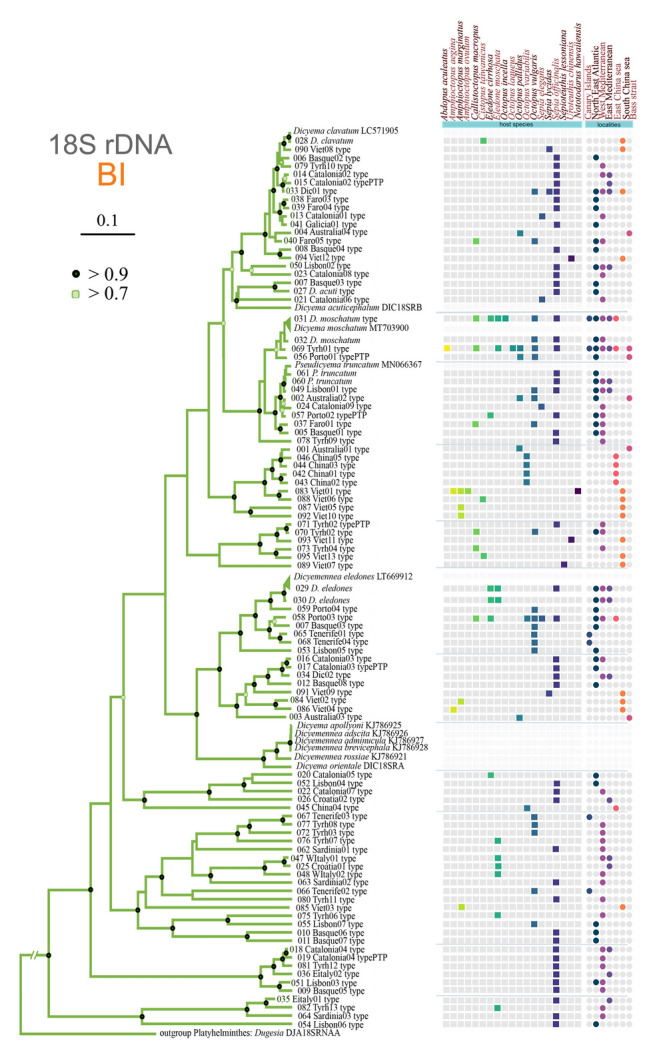
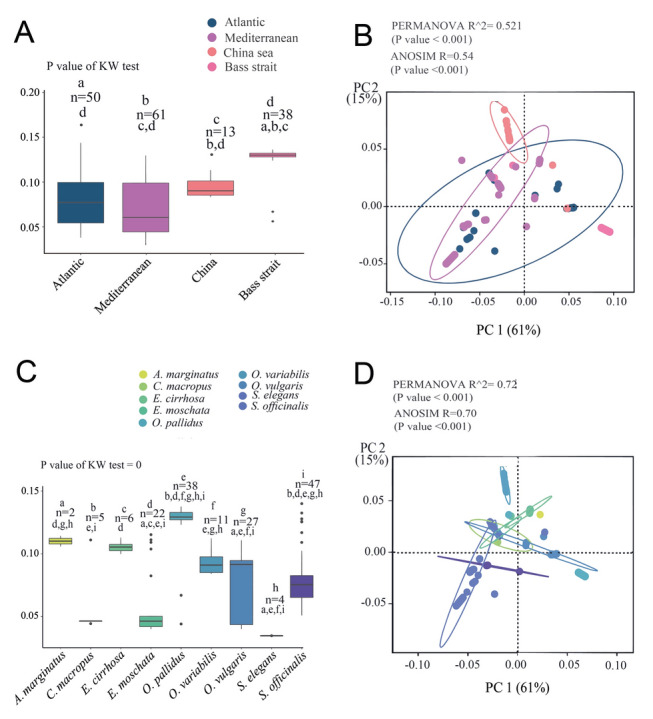
Dicyemids (phylum Dicyemida), primarily found in the renal organs of coleoid cephalopods, are a unique group of morphologically simple parasites with global distribution. Here, we investigated the diversity and prevalence of dicyemid communities in a wide range of cephalopod hosts across four geographic zones (the North East Atlantic, Mediterranean Sea, China Sea in the Western North Pacific, and Australia in the South Pacific) using Illumina sequencing of the 18S rDNA amplicons. Across 227 host samples, we identified 482 amplicon sequence variants, which clustered into 95 genetic types. The results indicated a higher number of distinct genetic types within Dicyemida than those currently identified through morphology-based taxonomy. Our finding of 46 dicyemid types in the common cuttlefish (Sepia officinalis) contrasts sharply with the previous records of a maximum of four species in this host. Furthermore, only a few host species exhibited a single dicyemid type, while most harbored multiple types; several types were distributed worldwide. Additionally, we identified eight new cephalopod hosts in the Pacific. Analyses of community (α) diversity suggested the unique character of certain geographical areas, such as the Bass Strait (Australia). β-diversity analyses confirmed that geographic location and host species were significant determinants of the dicyemid community composition. These results suggest that current species classifications may underestimate the true diversity of dicyemids. They emphasize the intricate interplay between geography, host specificity, and dicyemid community diversity.
Supplementary information: The online version contains supplementary material available at 10.1007/s42995-026-00353-w.
期刊介绍:
Marine Life Science & Technology (MLST), established in 2019, is dedicated to publishing original research papers that unveil new discoveries and theories spanning a wide spectrum of life sciences and technologies. This includes fundamental biology, fisheries science and technology, medicinal bioresources, food science, biotechnology, ecology, and environmental biology, with a particular focus on marine habitats.
The journal is committed to nurturing synergistic interactions among these diverse disciplines, striving to advance multidisciplinary approaches within the scientific field. It caters to a readership comprising biological scientists, aquaculture researchers, marine technologists, biological oceanographers, and ecologists.


 求助内容:
求助内容: 应助结果提醒方式:

 京公网安备 11010802042870号


