{"title":"Secular Trends in Height, Body Mass, and BMI among Girls in the Eastern Poland Region (1986-2021): Public Health Perspectives.","authors":"Agnieszka Wasiluk, Jerzy Saczuk","doi":"10.2478/sjph-2026-0006","DOIUrl":null,"url":null,"abstract":"<p><strong>Introduction: </strong>To assess long-term changes in body mass index (BMI) and weight status among girls from Eastern Poland between 1986 and 2021.</p><p><strong>Methods: </strong>Data were obtained from repeated cross-sectional, population-based surveys conducted in Eastern Poland in 1986, 1996, 2006, 2016, and 2021. The study included 14,825 girls aged 8, 13, and 17 years, recruited from the same schools across survey waves. Body height and body mass were measured by trained personnel using standardised procedures, and BMI was calculated. Weight status categories (underweight, normal weight, overweight and obesity) were defined using international BMI cut-off points. Statistical analyses included analysis of variance and post hoc comparisons.</p><p><strong>Results: </strong>Between 1986 and 2021, the largest increase in BMI was observed among 13-year-old girls (+1.66 kg/m<sup>2</sup>), followed by 8-year-olds (+1.14 kg/m<sup>2</sup>), while a decrease occurred among 17-year-olds (-1.13 kg/m<sup>2</sup>). The prevalence of underweight declined among 8- and 13-year-olds by 2.70 and 3.15 percentage points, respectively, but increased among 17-year-olds by 1.85 percentage points. In parallel, the combined prevalence of overweight and obesity increased across all age groups: 19.89 percentage points among 8-year-olds, 10.66 among 13-year-olds, and 3.87 among 17-year-olds, with the greatest increases occurring in recent survey periods.</p><p><strong>Conclusions: </strong>Over the past 35 years, BMI distribution among girls in Eastern Poland has shifted towards higher values, accompanied by a rise in overweight and obesity. The increase in underweight among older adolescents may reflect psychosocial pressures. These findings highlight the need for age-specific public health strategies addressing both excessive and insufficient body mass.</p>","PeriodicalId":45127,"journal":{"name":"Zdravstveno Varstvo","volume":"65 1","pages":"41-50"},"PeriodicalIF":2.4000,"publicationDate":"2026-03-01","publicationTypes":"Journal Article","fieldsOfStudy":null,"isOpenAccess":false,"openAccessPdf":"https://www.ncbi.nlm.nih.gov/pmc/articles/PMC12955847/pdf/","citationCount":"0","resultStr":null,"platform":"Semanticscholar","paperid":null,"PeriodicalName":"Zdravstveno Varstvo","FirstCategoryId":"3","ListUrlMain":"https://doi.org/10.2478/sjph-2026-0006","RegionNum":4,"RegionCategory":"医学","ArticlePicture":[],"TitleCN":null,"AbstractTextCN":null,"PMCID":null,"EPubDate":"","PubModel":"","JCR":"Q3","JCRName":"PUBLIC, ENVIRONMENTAL & OCCUPATIONAL HEALTH","Score":null,"Total":0}
引用次数: 0
Abstract
Introduction: To assess long-term changes in body mass index (BMI) and weight status among girls from Eastern Poland between 1986 and 2021.
Methods: Data were obtained from repeated cross-sectional, population-based surveys conducted in Eastern Poland in 1986, 1996, 2006, 2016, and 2021. The study included 14,825 girls aged 8, 13, and 17 years, recruited from the same schools across survey waves. Body height and body mass were measured by trained personnel using standardised procedures, and BMI was calculated. Weight status categories (underweight, normal weight, overweight and obesity) were defined using international BMI cut-off points. Statistical analyses included analysis of variance and post hoc comparisons.
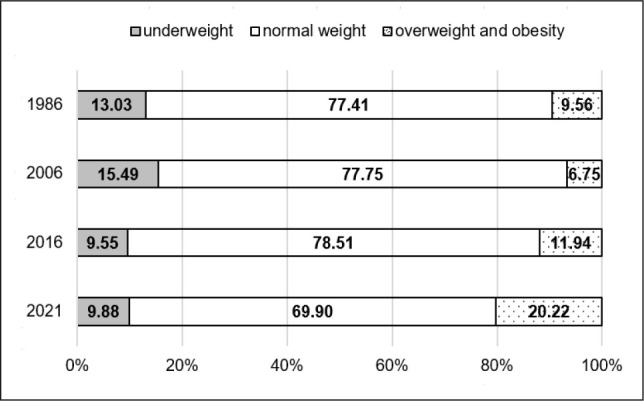
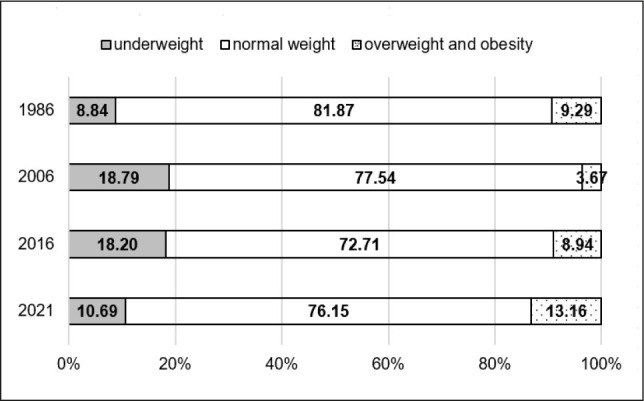
Results: Between 1986 and 2021, the largest increase in BMI was observed among 13-year-old girls (+1.66 kg/m2), followed by 8-year-olds (+1.14 kg/m2), while a decrease occurred among 17-year-olds (-1.13 kg/m2). The prevalence of underweight declined among 8- and 13-year-olds by 2.70 and 3.15 percentage points, respectively, but increased among 17-year-olds by 1.85 percentage points. In parallel, the combined prevalence of overweight and obesity increased across all age groups: 19.89 percentage points among 8-year-olds, 10.66 among 13-year-olds, and 3.87 among 17-year-olds, with the greatest increases occurring in recent survey periods.
Conclusions: Over the past 35 years, BMI distribution among girls in Eastern Poland has shifted towards higher values, accompanied by a rise in overweight and obesity. The increase in underweight among older adolescents may reflect psychosocial pressures. These findings highlight the need for age-specific public health strategies addressing both excessive and insufficient body mass.



 求助内容:
求助内容: 应助结果提醒方式:

 京公网安备 11010802042870号


