Haonan D Xu, Mihaly Badonyi, Marilyn Paul, Watanyoo Sopipong, Stuart A MacGowan, Joseph A Marsh, David H Murray
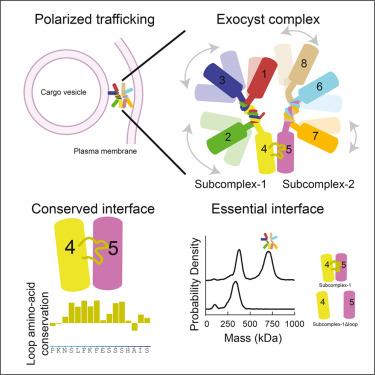
{"title":"Structural extension of the human exocyst is enabled by a minimal interface.","authors":"Haonan D Xu, Mihaly Badonyi, Marilyn Paul, Watanyoo Sopipong, Stuart A MacGowan, Joseph A Marsh, David H Murray","doi":"10.1016/j.str.2026.02.004","DOIUrl":null,"url":null,"abstract":"<p><p>In multicellular organisms, the machinery responsible for polarized trafficking directs constitutive cargo secretion at distinct sites of the plasma membrane, cilia, and junctional structures. Central to this machinery is the exocyst complex, which tethers cargo vesicles to their destination membrane, alongside other intracellular membrane tethering roles. Precisely how the exocyst spatially integrates membranes and membrane resident binding partners is unclear. Here, we address the structural morphology and formation of the human exocyst complex. Through structural approaches coupled to predictive models, we determined that the exocyst and its subcomplexes have extended \"arm-like\" structures that help maximize its reach. Moreover, we demonstrate minimal intersubunit interaction, in contrast to prior models. Nucleation of the holocomplex occurs through a single site, explaining its spatial extension. Our results provide the biochemical basis for exocyst complex assembly, suggesting an ornate extended architecture.</p>","PeriodicalId":22168,"journal":{"name":"Structure","volume":" ","pages":"870-879.e5"},"PeriodicalIF":4.3000,"publicationDate":"2026-05-07","publicationTypes":"Journal Article","fieldsOfStudy":null,"isOpenAccess":false,"openAccessPdf":"","citationCount":"0","resultStr":null,"platform":"Semanticscholar","paperid":null,"PeriodicalName":"Structure","FirstCategoryId":"99","ListUrlMain":"https://doi.org/10.1016/j.str.2026.02.004","RegionNum":2,"RegionCategory":"生物学","ArticlePicture":[],"TitleCN":null,"AbstractTextCN":null,"PMCID":null,"EPubDate":"2026/3/3 0:00:00","PubModel":"Epub","JCR":"Q2","JCRName":"BIOCHEMISTRY & MOLECULAR BIOLOGY","Score":null,"Total":0}
引用次数: 0
Abstract
In multicellular organisms, the machinery responsible for polarized trafficking directs constitutive cargo secretion at distinct sites of the plasma membrane, cilia, and junctional structures. Central to this machinery is the exocyst complex, which tethers cargo vesicles to their destination membrane, alongside other intracellular membrane tethering roles. Precisely how the exocyst spatially integrates membranes and membrane resident binding partners is unclear. Here, we address the structural morphology and formation of the human exocyst complex. Through structural approaches coupled to predictive models, we determined that the exocyst and its subcomplexes have extended "arm-like" structures that help maximize its reach. Moreover, we demonstrate minimal intersubunit interaction, in contrast to prior models. Nucleation of the holocomplex occurs through a single site, explaining its spatial extension. Our results provide the biochemical basis for exocyst complex assembly, suggesting an ornate extended architecture.
期刊介绍:
Structure aims to publish papers of exceptional interest in the field of structural biology. The journal strives to be essential reading for structural biologists, as well as biologists and biochemists that are interested in macromolecular structure and function. Structure strongly encourages the submission of manuscripts that present structural and molecular insights into biological function and mechanism. Other reports that address fundamental questions in structural biology, such as structure-based examinations of protein evolution, folding, and/or design, will also be considered. We will consider the application of any method, experimental or computational, at high or low resolution, to conduct structural investigations, as long as the method is appropriate for the biological, functional, and mechanistic question(s) being addressed. Likewise, reports describing single-molecule analysis of biological mechanisms are welcome.
In general, the editors encourage submission of experimental structural studies that are enriched by an analysis of structure-activity relationships and will not consider studies that solely report structural information unless the structure or analysis is of exceptional and broad interest. Studies reporting only homology models, de novo models, or molecular dynamics simulations are also discouraged unless the models are informed by or validated by novel experimental data; rationalization of a large body of existing experimental evidence and making testable predictions based on a model or simulation is often not considered sufficient.

 求助内容:
求助内容: 应助结果提醒方式:

 京公网安备 11010802042870号


