
Can cell-based therapies bridge the gap between research and reality in the treatment of myocarditis? A systematic review and meta-analysis
IF 4
3区 环境科学与生态学
Q3 CELL & TISSUE ENGINEERING
引用次数: 0
Abstract
Introduction
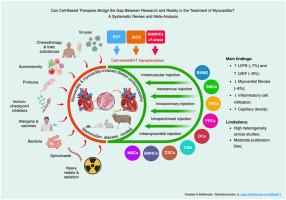
Myocarditis is a non-ischaemic myocardial injury caused by infectious agents, immune-mediated diseases, cardiotoxic drugs, and vaccines. Treatment options are largely supportive, with emphasis on close monitoring, exclusion of other diseases explaining symptoms, adherence to heart failure treatment recommendations, and consideration of etiology-directed interventions, if applicable, such as antiviral or immunosuppressive agents, steroids, discontinuation of antineoplastic therapy, and strategies to increase left ventricular (LV) ejection fraction (LVEF). In this context, cell-based therapies (CBTs) have emerged as a new therapeutic strategy and were believed to fill this gap. However, results were inconsistent across studies, which necessitates the need for rigorous systematic reviews to analyze available evidence comprehensively.
Methods
The review protocol was registered on the PROSPERO website, and the study was conducted in accordance with PRISMA regulations. Searches were conducted in Embase, CINAHL Plus via EBSCO host, Web of Science, Scopus, and PubMed. A total of 60 original papers published between 2004 and 2022 in 48 peer-reviewed journals were included in the meta-analysis to determine the efficacy of CBTs on the LV fractional shortening (LVFS), LVEF, capillary density (CD), inflammatory cell infiltration rate (ICIR), and fibrotic area (FA). The risk of bias (RoB) and study quality were assessed using the SYRCLE RoB tool and CAMARADES checklist, respectively. As the preliminary assessment indicated substantial heterogeneity among the included studies, a random-effects model was applied to pool effect sizes. Subgroup analyses were performed to explore potential sources of heterogeneity across studies. Publication bias was assessed by visual inspection of funnel plots for asymmetry and statistically evaluated using Egger's regression test.
Results
In total, the adapted and optimized search strategy retrieved 14,503 records from five databases. The majority of studies exhibited an unclear or high risk of bias in several domains, particularly selection bias and performance bias. Quality assessment revealed that only four studies (6.7%) were classified as high quality and four (6.7%) as low quality, while the remaining 52 studies (86.7%) were rated as moderate quality, with scores ranging from 4 to 6. CBTs improved LVFS (%) by 7.17 [95 % CI: 5.67, 8.66], LVEF (%) by 9.00 [95 % CI: 7.03, 10.97], CD (capillaries/mm2) by 300.50 [95 % CI: 45.01, 555.99] and decreased ICIR (cells/mm2) and FA (%) by −178.99 [95 % CI: −225.91, −132.08] and −6.04 [95 % CI: −6.83, −5.25], respectively. However, significant heterogeneity between studies was maintained at I2 = 84-99%.
Conclusion
Despite significant heterogeneity and moderate publication bias, the results were very encouraging, as reflected in the consistent effect directions across all studies in terms of cardiac function and histology. Overall, our results demonstrated the need for well-designed studies with adequate animal sample sizes, a standardized approach to reporting, and mechanistic investigations that directly link structural remodeling to functional recovery. Addressing these issues will be critical steps for conducting large-scale clinical trials.
细胞疗法能否弥合心肌炎治疗研究与现实之间的差距?系统回顾和荟萃分析。
心肌炎是由感染性病原体、免疫介导性疾病、心脏毒性药物和疫苗引起的非缺血性心肌损伤。治疗选择在很大程度上是支持性的,重点是密切监测,排除其他疾病解释的症状,坚持心力衰竭治疗建议,并考虑病因导向的干预措施,如抗病毒或免疫抑制剂,类固醇,停止抗肿瘤治疗,以及增加左心室射血分数(LVEF)的策略。在这种背景下,基于细胞的疗法(CBTs)已经成为一种新的治疗策略,并被认为填补了这一空白。然而,不同研究的结果并不一致,这就需要进行严格的系统评价,以全面分析现有证据。方法:审查方案在PROSPERO网站上注册,并按照PRISMA规定进行研究。检索在Embase, CINAHL Plus通过EBSCO主机,Web of Science, Scopus和PubMed进行。本荟萃分析纳入了2004年至2022年间发表在48份同行评审期刊上的60篇原创论文,以确定cbt对左室分数缩短(LVFS)、LVEF、毛细血管密度(CD)、炎症细胞浸润率(ICIR)和纤维化面积(FA)的疗效。偏倚风险(RoB)和研究质量分别使用sycle RoB工具和CAMARADES检查表进行评估。由于初步评估表明纳入的研究存在很大的异质性,因此采用随机效应模型来确定池效应大小。进行亚组分析以探索研究间异质性的潜在来源。发表偏倚采用不对称漏斗图的目视检验评估,统计学上采用Egger回归检验评估。结果:优化后的搜索策略共从5个数据库中检索到14503条记录。大多数研究在几个领域表现出不明确或高风险的偏倚,特别是选择偏倚和表现偏倚。质量评价结果显示,高质量研究4项(6.7%),低质量研究4项(6.7%),中等质量研究52项(86.7%),评分范围为4 ~ 6分。cbt使LVFS(%)提高7.17 [95% CI: 5.67, 8.66], LVEF(%)提高9.00 [95% CI: 7.03, 10.97], CD(毛细血管/mm2)提高300.50 [95% CI: 45.01, 555.99], ICIR(细胞/mm2)和FA(%)分别降低-178.99 [95% CI: -225.91, -132.08]和-6.04 [95% CI: -6.83, -5.25]。然而,研究之间的显著异质性维持在I2 = 84-99%。结论:尽管存在显著的异质性和中度发表偏倚,但所有研究在心功能和组织学方面的效果方向一致,结果非常令人鼓舞。总的来说,我们的结果表明,需要设计良好的研究,有足够的动物样本量,标准化的报告方法,以及直接将结构重塑与功能恢复联系起来的机制调查。解决这些问题将是进行大规模临床试验的关键步骤。
本文章由计算机程序翻译,如有差异,请以英文原文为准。
求助全文
约1分钟内获得全文
求助全文
来源期刊
Regenerative Therapy
Engineering-Biomedical Engineering
CiteScore
6.00
自引率
2.30%
发文量
106
审稿时长
49 days
期刊介绍:
Regenerative Therapy is the official peer-reviewed online journal of the Japanese Society for Regenerative Medicine.
Regenerative Therapy is a multidisciplinary journal that publishes original articles and reviews of basic research, clinical translation, industrial development, and regulatory issues focusing on stem cell biology, tissue engineering, and regenerative medicine.
 求助内容:
求助内容: 应助结果提醒方式:

 京公网安备 11010802042870号


