Faisal Ali Bin Abbooud AlQhtani, Meer Zakirulla, Zuhair Motlak Alkahtani, Bandar Yahya Alshehri, Malaz M Mustafa, Sana Mofleh Alshahrani
{"title":"Predictors of Empathy in Dental Education: Insights from a Cross-Sectional Measurement Using the Jefferson Scale.","authors":"Faisal Ali Bin Abbooud AlQhtani, Meer Zakirulla, Zuhair Motlak Alkahtani, Bandar Yahya Alshehri, Malaz M Mustafa, Sana Mofleh Alshahrani","doi":"10.3290/j.ohpd.c_2537","DOIUrl":null,"url":null,"abstract":"<p><strong>Purpose: </strong>Empathy is a vital attribute for effective patient care in dentistry, yet studies indicate a concerning decline in empathy levels during academic training. This research addresses the influence of gender and academic progression on dental students' empathy levels. This study aimed to investigate variations in empathy levels among dental students at King Khalid University and to examine the associations between gender, academic year, and empathy levels.</p><p><strong>Materials and methods: </strong>A cross-sectional study was conducted between January and May 2024. The study included 204 dental students (122 males, 82 females) with a mean age of 21.18 (± 2.43) years, representing an 81.6% response rate. Empathy was assessed using the validated Jefferson Scale of Empathy-Health Profession Students (JSE-HPS). Statistical analysis was performed using independent samples t-tests and one-way ANOVA to compare the mean scores.</p><p><strong>Results: </strong>A statistically significant difference in overall empathy was observed between genders (p = 0.002), with female students (mean = 108.34, SD = 14.23) reporting higher scores than male students (mean = 101.20, SD = 13.30). Additionally, empathy scores varied statistically significantly across academic years (p = 0.001), indicating a general decline from the first year (mean = 108.37, SD = 13.97) to the fifth year (mean = 98.33, SD = 15.12). Females outperformed males on all three subscales: perspective taking, compassionate care, and walking in patients' shoes. The trajectories of the subscales exhibited variability, with 'compassionate care' peaking in the first year, while 'perspective taking reached' its highest point in the third year.</p><p><strong>Conclusions: </strong>Empathy in dental students is statistically significantly influenced by both sex and academic progression. These findings highlight the critical need for targeted educational strategies to foster and sustain empathy throughout dental training, thereby ensuring the development of patient-centered practitioners.</p>","PeriodicalId":19696,"journal":{"name":"Oral health & preventive dentistry","volume":"24 ","pages":"155-163"},"PeriodicalIF":1.4000,"publicationDate":"2026-03-04","publicationTypes":"Journal Article","fieldsOfStudy":null,"isOpenAccess":false,"openAccessPdf":"https://www.ncbi.nlm.nih.gov/pmc/articles/PMC12959094/pdf/","citationCount":"0","resultStr":null,"platform":"Semanticscholar","paperid":null,"PeriodicalName":"Oral health & preventive dentistry","FirstCategoryId":"3","ListUrlMain":"https://doi.org/10.3290/j.ohpd.c_2537","RegionNum":4,"RegionCategory":"医学","ArticlePicture":[],"TitleCN":null,"AbstractTextCN":null,"PMCID":null,"EPubDate":"","PubModel":"","JCR":"Q3","JCRName":"DENTISTRY, ORAL SURGERY & MEDICINE","Score":null,"Total":0}
引用次数: 0
Abstract
Purpose: Empathy is a vital attribute for effective patient care in dentistry, yet studies indicate a concerning decline in empathy levels during academic training. This research addresses the influence of gender and academic progression on dental students' empathy levels. This study aimed to investigate variations in empathy levels among dental students at King Khalid University and to examine the associations between gender, academic year, and empathy levels.
Materials and methods: A cross-sectional study was conducted between January and May 2024. The study included 204 dental students (122 males, 82 females) with a mean age of 21.18 (± 2.43) years, representing an 81.6% response rate. Empathy was assessed using the validated Jefferson Scale of Empathy-Health Profession Students (JSE-HPS). Statistical analysis was performed using independent samples t-tests and one-way ANOVA to compare the mean scores.
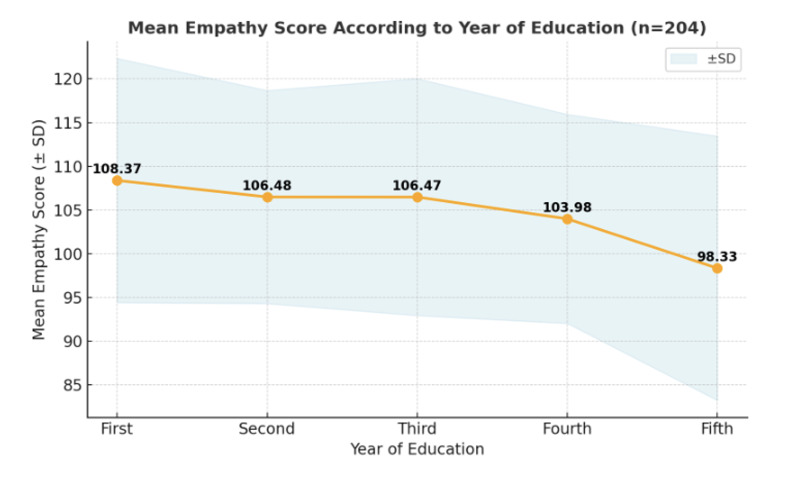
Results: A statistically significant difference in overall empathy was observed between genders (p = 0.002), with female students (mean = 108.34, SD = 14.23) reporting higher scores than male students (mean = 101.20, SD = 13.30). Additionally, empathy scores varied statistically significantly across academic years (p = 0.001), indicating a general decline from the first year (mean = 108.37, SD = 13.97) to the fifth year (mean = 98.33, SD = 15.12). Females outperformed males on all three subscales: perspective taking, compassionate care, and walking in patients' shoes. The trajectories of the subscales exhibited variability, with 'compassionate care' peaking in the first year, while 'perspective taking reached' its highest point in the third year.
Conclusions: Empathy in dental students is statistically significantly influenced by both sex and academic progression. These findings highlight the critical need for targeted educational strategies to foster and sustain empathy throughout dental training, thereby ensuring the development of patient-centered practitioners.
期刊介绍:
Clinicians, general practitioners, teachers, researchers, and public health administrators will find this journal an indispensable source of essential, timely information about scientific progress in the fields of oral health and the prevention of caries, periodontal diseases, oral mucosal diseases, and dental trauma. Central topics, including oral hygiene, oral epidemiology, oral health promotion, and public health issues, are covered in peer-reviewed articles such as clinical and basic science research reports; reviews; invited focus articles, commentaries, and guest editorials; and symposium, workshop, and conference proceedings.


 求助内容:
求助内容: 应助结果提醒方式:

 京公网安备 11010802042870号


