
Accelerometer-Derived Physical Activity Associated With Incidence and Progression Trajectory of Cardiometabolic Multimorbidity
IF 6.7
2区 医学
Q1 MEDICINE, GENERAL & INTERNAL
Mayo Clinic proceedings
Pub Date : 2026-05-01
Epub Date: 2026-03-05
DOI:10.1016/j.mayocp.2025.11.020
引用次数: 0
Abstract
Objective
To examine the associations between physical activity (PA) and the transition from healthy status to first cardiometabolic disease (FCMD), subsequently to cardiometabolic multimorbidity (CMM), and further to death.
Patients and Methods
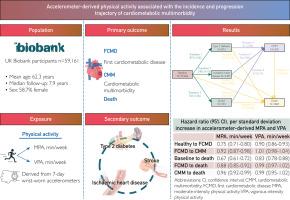
Objectively measured PA was derived from wrist-worn accelerometer data collected during 7 days in a separate cohort of 59,161 participants during 2013 to 2015. Cardiometabolic multimorbidity was defined as the occurrence of at least 2 cardiometabolic diseases including type 2 diabetes, ischemic heart disease, and stroke. Multistate models were used to examine the impact of PA on the incidence and progression trajectory of CMM.
Results
During a median 7.9 years of follow-up, FCMD developed in 4074 individuals, CMM developed in 295, and 2893 died in the accelerometer-derived cohort. Performing guideline-adherent moderate-intensity physical activity (MPA; 150-300 min/wk) was related to a 29% lower risk of FCMD (hazard ratio [HR], 0.71 [0.62 to 0.81]) and a 40% lower risk of CMM (HR, 0.60 [0.39 to 0.93]). The strength of the association of MPA with the transition from healthy baseline to FCMD was greater than that of the transition from FCMD to CMM, with HRs (95% CIs) per 244.7 min/wk increase of 0.75 (0.71 to 0.80) and 0.92 (0.87 to 0.98), respectively. On dividing FCMD into 3 specific cardiometabolic diseases, there were comparable trends of MPA on the disease-specific transitions from healthy baseline to FCMD and subsequent CMM.
Conclusion
Physical activity played comparable roles in transitions from healthy baseline to FCMD and then to CMM. These findings suggest that improving PA is a potential strategy for preventing CMM development.
加速度计衍生的体力活动与心脏代谢多病的发病率和进展轨迹相关。
目的:探讨身体活动(PA)与从健康状态转变为首发心脏代谢疾病(FCMD)、随后转变为心脏代谢多病(CMM)、进而死亡之间的关系。患者和方法:客观测量的PA来自于2013年至2015年期间59,161名参与者在7天内收集的腕带加速度计数据。心脏代谢多病定义为至少发生2种心脏代谢疾病,包括2型糖尿病、缺血性心脏病和中风。采用多状态模型研究PA对CMM发病和发展轨迹的影响。结果:在中位7.9年的随访期间,在加速度计衍生的队列中,有4074人发生FCMD, 295人发生CMM, 2893人死亡。按照指南进行中等强度体力活动(MPA; 150-300分钟/周)可使手足口病的风险降低29%(危险比[HR], 0.71[0.62至0.81]),使CMM的风险降低40%(危险比[HR], 0.60[0.39至0.93])。MPA与从健康基线向口蹄疫过渡的相关性大于从口蹄疫向CMM过渡的相关性,每244.7 min/周的hr (95% ci)分别增加0.75(0.71 ~ 0.80)和0.92(0.87 ~ 0.98)。在将手足口病分为3种特定的心脏代谢疾病时,MPA在从健康基线到手足口病和随后的CMM的疾病特异性转变上有可比性的趋势。结论:体育活动在从健康基线到口蹄疫再到慢性mm的转变中发挥了相当的作用。这些发现表明,改善PA是预防CMM发展的潜在策略。
本文章由计算机程序翻译,如有差异,请以英文原文为准。
求助全文
约1分钟内获得全文
求助全文
来源期刊
Mayo Clinic proceedings
医学-医学:内科
CiteScore
16.80
自引率
1.10%
发文量
383
审稿时长
37 days
期刊介绍:
Mayo Clinic Proceedings is a premier peer-reviewed clinical journal in general medicine. Sponsored by Mayo Clinic, it is one of the most widely read and highly cited scientific publications for physicians. Since 1926, Mayo Clinic Proceedings has continuously published articles that focus on clinical medicine and support the professional and educational needs of its readers. The journal welcomes submissions from authors worldwide and includes Nobel-prize-winning research in its content. With an Impact Factor of 8.9, Mayo Clinic Proceedings is ranked #20 out of 167 journals in the Medicine, General and Internal category, placing it in the top 12% of these journals. It invites manuscripts on clinical and laboratory medicine, health care policy and economics, medical education and ethics, and related topics.
 求助内容:
求助内容: 应助结果提醒方式:

 京公网安备 11010802042870号


