Abdel Martinez, Fatimah Bello, Brandon Cantazaro, Luisa Montoya, Frank Mendiola
{"title":"Tuberculosis Presenting as Multiple Pulmonary Nodules Mimicking Malignancy.","authors":"Abdel Martinez, Fatimah Bello, Brandon Cantazaro, Luisa Montoya, Frank Mendiola","doi":"10.1177/23247096261429205","DOIUrl":null,"url":null,"abstract":"<p><p>Multiple pulmonary nodules often raise concern for metastatic malignancy; however, the differential diagnosis is broad and includes infectious, inflammatory, granulomatous, vascular, and benign etiologies. Tuberculosis (TB), although uncommon, can present with multiple nodules that closely mimic metastatic disease on advanced imaging, requiring careful clinicoradiologic and microbiologic correlation. We describe a woman in her 50s who presented with dyspnea and new-onset heart failure, in whom imaging revealed mediastinal lymphadenopathy and bilateral pulmonary nodules concerning for malignancy. Evaluation was limited by concurrent COVID-19 infection, and CT-guided biopsy demonstrated necrotizing granulomas without evidence of malignancy or infection. She later re-presented with fever and productive cough, with imaging showing progression to cavitary lung lesions. Bronchoscopy was deferred due to high procedural risk, and sputum studies ultimately confirmed pulmonary TB by positive AFB smear and MTB PCR. She was started on standard antituberculous therapy and discharged with directly observed treatment. This case highlights the importance of maintaining a broad differential diagnosis when evaluating multiple pulmonary nodules and emphasizes the role of microbiologic testing in establishing the diagnosis when invasive procedures are not feasible.</p>","PeriodicalId":16198,"journal":{"name":"Journal of investigative medicine high impact case reports","volume":"14 ","pages":"23247096261429205"},"PeriodicalIF":0.8000,"publicationDate":"2026-01-01","publicationTypes":"Journal Article","fieldsOfStudy":null,"isOpenAccess":false,"openAccessPdf":"https://www.ncbi.nlm.nih.gov/pmc/articles/PMC12966580/pdf/","citationCount":"0","resultStr":null,"platform":"Semanticscholar","paperid":null,"PeriodicalName":"Journal of investigative medicine high impact case reports","FirstCategoryId":"1085","ListUrlMain":"https://doi.org/10.1177/23247096261429205","RegionNum":0,"RegionCategory":null,"ArticlePicture":[],"TitleCN":null,"AbstractTextCN":null,"PMCID":null,"EPubDate":"2026/3/4 0:00:00","PubModel":"Epub","JCR":"Q3","JCRName":"MEDICINE, GENERAL & INTERNAL","Score":null,"Total":0}
引用次数: 0
Abstract
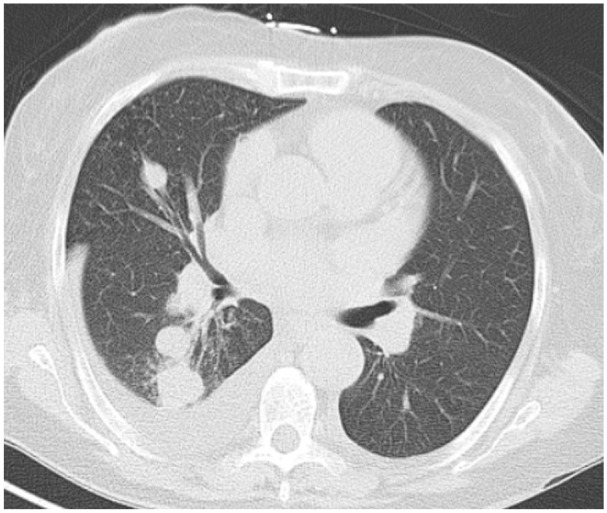
Multiple pulmonary nodules often raise concern for metastatic malignancy; however, the differential diagnosis is broad and includes infectious, inflammatory, granulomatous, vascular, and benign etiologies. Tuberculosis (TB), although uncommon, can present with multiple nodules that closely mimic metastatic disease on advanced imaging, requiring careful clinicoradiologic and microbiologic correlation. We describe a woman in her 50s who presented with dyspnea and new-onset heart failure, in whom imaging revealed mediastinal lymphadenopathy and bilateral pulmonary nodules concerning for malignancy. Evaluation was limited by concurrent COVID-19 infection, and CT-guided biopsy demonstrated necrotizing granulomas without evidence of malignancy or infection. She later re-presented with fever and productive cough, with imaging showing progression to cavitary lung lesions. Bronchoscopy was deferred due to high procedural risk, and sputum studies ultimately confirmed pulmonary TB by positive AFB smear and MTB PCR. She was started on standard antituberculous therapy and discharged with directly observed treatment. This case highlights the importance of maintaining a broad differential diagnosis when evaluating multiple pulmonary nodules and emphasizes the role of microbiologic testing in establishing the diagnosis when invasive procedures are not feasible.
期刊介绍:
The AFMR is committed to enhancing the training and career development of our members and to furthering its mission to facilitate the conduct of research to improve medical care. Case reports represent an important avenue for trainees (interns, residents, and fellows) and early-stage faculty to demonstrate productive, scholarly activity.



 求助内容:
求助内容: 应助结果提醒方式:

 京公网安备 11010802042870号


