{"title":"Integration of dual-energy computed tomography and radiomics to improve noninvasive assessment of liver fibrosis: A retrospective study.","authors":"Takayuki Miyachi, Shintaro Ichikawa, Tatsunori Kobayashi, Akihiro Osugi, Ren Suzuki, Masatoshi Kakuya, Satoshi Funayama, Yukichi Tanahashi, Kumi Ozaki, Satoshi Goshima","doi":"10.25259/JCIS_255_2025","DOIUrl":null,"url":null,"abstract":"<p><strong>Objectives: </strong>Few studies have used radiomics analysis to virtual monochromatic images (VMI) and material density images (MDI) for the assessment of liver fibrosis. Therefore, this retrospective study aimed to investigate whether integrating dual-energy computed tomography (CT) with radiomics analysis can predict Fibrosis-4 (FIB-4) index risk groups.</p><p><strong>Material and methods: </strong>A total of 137 patients were classified on the basis of the FIB-4 index: 40 as low-risk (FIB-4 index <1.3), 57 as intermediate-risk (1.3≤ FIB-4 index <2.67), and 40 as high-risk (FIB-4 index ≥2.67) for liver fibrosis. VMIs (70-keV and 40-keV images) and MDI (iodine-water images) were generated from the equilibrium-phase dual-energy CT data, and radiomic features were extracted from the same liver segmentation to develop models for distinguishing between FIB-4 risk groups.</p><p><strong>Results: </strong>Distinguishing between low-risk and high-risk groups yielded mean area under the curve (AUC) values (95% confidence intervals) of 0.69 (0.57-0.80) for the 70-keV images, 0.77 (0.67-0.88) for the 40-keV images, and 0.77 (0.66-0.87) for the iodine-water images, with statistically significant differences between the 70-keV images and the 40-keV (<i>P</i> = 0.01) and iodine-water images (<i>P</i> = 0.04). To distinguish between the low-risk and intermediate-risk groups, all image types showed similar AUC values ranging from 0.64 to 0.66, with no significant differences. For distinguishing intermediate-risk and high-risk groups, the 40-keV and iodine-water images showed a trend toward higher AUC values than the 70-keV images; however, no statistically significant differences were observed.</p><p><strong>Conclusion: </strong>This study demonstrates the feasibility of combining dual-energy CT with radiomics for noninvasive liver fibrosis risk stratification using the FIB-4 index.</p>","PeriodicalId":15512,"journal":{"name":"Journal of Clinical Imaging Science","volume":"16 ","pages":"8"},"PeriodicalIF":1.1000,"publicationDate":"2026-02-23","publicationTypes":"Journal Article","fieldsOfStudy":null,"isOpenAccess":false,"openAccessPdf":"https://www.ncbi.nlm.nih.gov/pmc/articles/PMC12954249/pdf/","citationCount":"0","resultStr":null,"platform":"Semanticscholar","paperid":null,"PeriodicalName":"Journal of Clinical Imaging Science","FirstCategoryId":"1085","ListUrlMain":"https://doi.org/10.25259/JCIS_255_2025","RegionNum":0,"RegionCategory":null,"ArticlePicture":[],"TitleCN":null,"AbstractTextCN":null,"PMCID":null,"EPubDate":"2026/1/1 0:00:00","PubModel":"eCollection","JCR":"Q3","JCRName":"RADIOLOGY, NUCLEAR MEDICINE & MEDICAL IMAGING","Score":null,"Total":0}
引用次数: 0
Abstract
Objectives: Few studies have used radiomics analysis to virtual monochromatic images (VMI) and material density images (MDI) for the assessment of liver fibrosis. Therefore, this retrospective study aimed to investigate whether integrating dual-energy computed tomography (CT) with radiomics analysis can predict Fibrosis-4 (FIB-4) index risk groups.
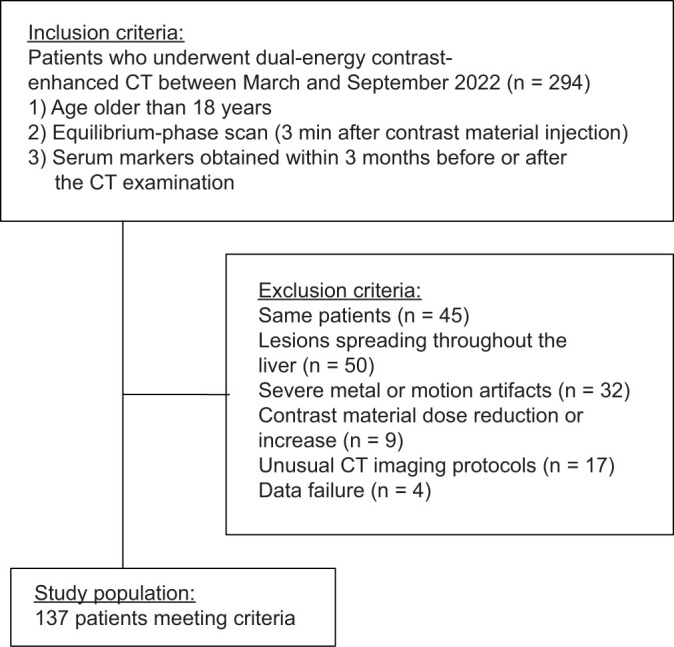
Material and methods: A total of 137 patients were classified on the basis of the FIB-4 index: 40 as low-risk (FIB-4 index <1.3), 57 as intermediate-risk (1.3≤ FIB-4 index <2.67), and 40 as high-risk (FIB-4 index ≥2.67) for liver fibrosis. VMIs (70-keV and 40-keV images) and MDI (iodine-water images) were generated from the equilibrium-phase dual-energy CT data, and radiomic features were extracted from the same liver segmentation to develop models for distinguishing between FIB-4 risk groups.
Results: Distinguishing between low-risk and high-risk groups yielded mean area under the curve (AUC) values (95% confidence intervals) of 0.69 (0.57-0.80) for the 70-keV images, 0.77 (0.67-0.88) for the 40-keV images, and 0.77 (0.66-0.87) for the iodine-water images, with statistically significant differences between the 70-keV images and the 40-keV (P = 0.01) and iodine-water images (P = 0.04). To distinguish between the low-risk and intermediate-risk groups, all image types showed similar AUC values ranging from 0.64 to 0.66, with no significant differences. For distinguishing intermediate-risk and high-risk groups, the 40-keV and iodine-water images showed a trend toward higher AUC values than the 70-keV images; however, no statistically significant differences were observed.
Conclusion: This study demonstrates the feasibility of combining dual-energy CT with radiomics for noninvasive liver fibrosis risk stratification using the FIB-4 index.
期刊介绍:
The Journal of Clinical Imaging Science (JCIS) is an open access peer-reviewed journal committed to publishing high-quality articles in the field of Imaging Science. The journal aims to present Imaging Science and relevant clinical information in an understandable and useful format. The journal is owned and published by the Scientific Scholar. Audience Our audience includes Radiologists, Researchers, Clinicians, medical professionals and students. Review process JCIS has a highly rigorous peer-review process that makes sure that manuscripts are scientifically accurate, relevant, novel and important. Authors disclose all conflicts, affiliations and financial associations such that the published content is not biased.




 求助内容:
求助内容: 应助结果提醒方式:

 京公网安备 11010802042870号


