{"title":"Contrast-specific conversion factor for accurate radiation dose estimation in contrast-enhanced abdominal computed tomography.","authors":"Yoshinori Funama, Daisuke Sakabe, Takeshi Nakaura, Seitaro Oda, Masafumi Kidoh, Yasunori Nagayama, Toshinori Hirai","doi":"10.25259/JCIS_151_2025","DOIUrl":null,"url":null,"abstract":"<p><strong>Objectives: </strong>The objective of the study is to determine the contrast-specific conversion factor (cCF) based on the dose differences between non-enhanced computed tomography (NECT) and contrast-enhanced CT (CECT) in abdominal imaging, with the aim of improving the accuracy of radiation dose estimation in contrast-enhanced examinations.</p><p><strong>Material and methods: </strong>The study included 33 adult patients who underwent both NECT and CECT. CECT image acquisition commenced 80 s after the start of iodinated contrast medium injection. A Monte Carlo simulation tool was used to estimate the radiation dose delivered to each patient during NECT and CECT. Organ doses for the liver, spleen, and both kidneys were measured using 120-kVp images. The cCF was calculated as the ratio of the organ dose in CECT to that in NECT. The cCF values are dependent on the scan protocol-, CT vendor-, and X-ray photon energy.</p><p><strong>Results: </strong>The mean organ doses during NECT were 10.45 mGy for the liver, 11.19 mGy for the spleen, and 11.47 mGy for both kidneys. During CECT, these values increased to 15.83 mGy, 17.56 mGy, and 20.75 mGy, respectively. The mean cCFs of CECT relative to NECT were 1.52 for the liver, 1.83 for the spleen, and 1.87 for both kidneys.</p><p><strong>Conclusion: </strong>Applying the cCF to NECT-based dose estimates enables more accurate assessment of radiation exposure in CECT examinations.</p>","PeriodicalId":15512,"journal":{"name":"Journal of Clinical Imaging Science","volume":"16 ","pages":"7"},"PeriodicalIF":1.1000,"publicationDate":"2026-02-16","publicationTypes":"Journal Article","fieldsOfStudy":null,"isOpenAccess":false,"openAccessPdf":"https://www.ncbi.nlm.nih.gov/pmc/articles/PMC12954228/pdf/","citationCount":"0","resultStr":null,"platform":"Semanticscholar","paperid":null,"PeriodicalName":"Journal of Clinical Imaging Science","FirstCategoryId":"1085","ListUrlMain":"https://doi.org/10.25259/JCIS_151_2025","RegionNum":0,"RegionCategory":null,"ArticlePicture":[],"TitleCN":null,"AbstractTextCN":null,"PMCID":null,"EPubDate":"2026/1/1 0:00:00","PubModel":"eCollection","JCR":"Q3","JCRName":"RADIOLOGY, NUCLEAR MEDICINE & MEDICAL IMAGING","Score":null,"Total":0}
引用次数: 0
Abstract
Objectives: The objective of the study is to determine the contrast-specific conversion factor (cCF) based on the dose differences between non-enhanced computed tomography (NECT) and contrast-enhanced CT (CECT) in abdominal imaging, with the aim of improving the accuracy of radiation dose estimation in contrast-enhanced examinations.
Material and methods: The study included 33 adult patients who underwent both NECT and CECT. CECT image acquisition commenced 80 s after the start of iodinated contrast medium injection. A Monte Carlo simulation tool was used to estimate the radiation dose delivered to each patient during NECT and CECT. Organ doses for the liver, spleen, and both kidneys were measured using 120-kVp images. The cCF was calculated as the ratio of the organ dose in CECT to that in NECT. The cCF values are dependent on the scan protocol-, CT vendor-, and X-ray photon energy.
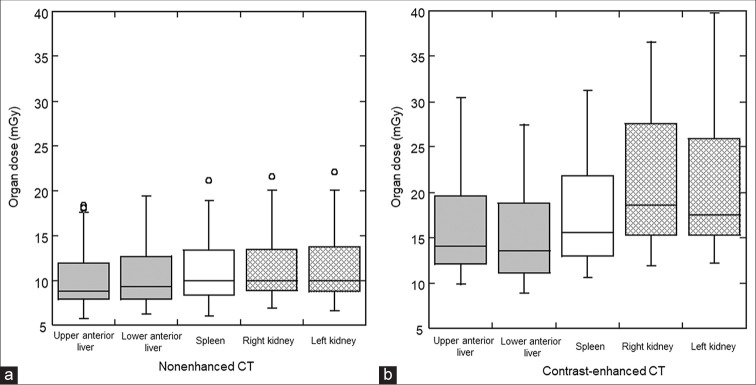
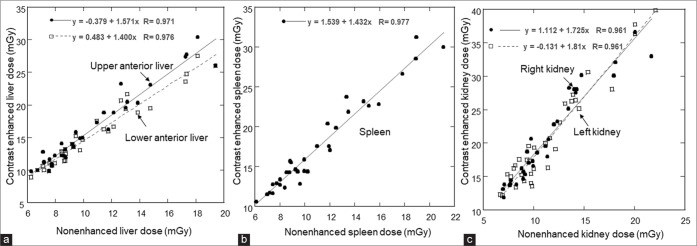
Results: The mean organ doses during NECT were 10.45 mGy for the liver, 11.19 mGy for the spleen, and 11.47 mGy for both kidneys. During CECT, these values increased to 15.83 mGy, 17.56 mGy, and 20.75 mGy, respectively. The mean cCFs of CECT relative to NECT were 1.52 for the liver, 1.83 for the spleen, and 1.87 for both kidneys.
Conclusion: Applying the cCF to NECT-based dose estimates enables more accurate assessment of radiation exposure in CECT examinations.
期刊介绍:
The Journal of Clinical Imaging Science (JCIS) is an open access peer-reviewed journal committed to publishing high-quality articles in the field of Imaging Science. The journal aims to present Imaging Science and relevant clinical information in an understandable and useful format. The journal is owned and published by the Scientific Scholar. Audience Our audience includes Radiologists, Researchers, Clinicians, medical professionals and students. Review process JCIS has a highly rigorous peer-review process that makes sure that manuscripts are scientifically accurate, relevant, novel and important. Authors disclose all conflicts, affiliations and financial associations such that the published content is not biased.


 求助内容:
求助内容: 应助结果提醒方式:

 京公网安备 11010802042870号


