Implementation of a Novel Patient-Reported Outcome Measure for the Assessment of Symptoms in Children Living With Chronic Kidney Disease (PRO-Kid)-Program Report.
Banke Oketola, Karma Abukasm, Ke Fan Bei, Kelly Loverock, Kim Widger, Valerie Umaefulam, Leanne Dunne, Sarah Kirby, Rahul Chanchlani, Claire Adams, Adam Rapoport, Janis Dionne, Lorraine Hamiwka, Marie-Michele Gaudreault-Tremblay, Jean-Philippe Roy, Sara Davison, Allison Dart, Mina Matsuda-Abedini
{"title":"Implementation of a Novel Patient-Reported Outcome Measure for the Assessment of Symptoms in Children Living With Chronic Kidney Disease (PRO-Kid)-Program Report.","authors":"Banke Oketola, Karma Abukasm, Ke Fan Bei, Kelly Loverock, Kim Widger, Valerie Umaefulam, Leanne Dunne, Sarah Kirby, Rahul Chanchlani, Claire Adams, Adam Rapoport, Janis Dionne, Lorraine Hamiwka, Marie-Michele Gaudreault-Tremblay, Jean-Philippe Roy, Sara Davison, Allison Dart, Mina Matsuda-Abedini","doi":"10.1177/20543581261424742","DOIUrl":null,"url":null,"abstract":"<p><strong>Purpose of the program: </strong>Children with chronic kidney disease (CKD) experience significant physical and psychological symptoms, necessitating patient-reported outcome (PRO) measurement tools to quantify symptoms, and to improve communication between children with CKD and their health care providers. This study aimed to implement the novel PRO-Kid tool into pediatric CKD and dialysis programs in Canada.</p><p><strong>Sources of information: </strong>The PRO-Kid tool is a novel 14-item questionnaire that was developed and validated by our research team, in partnership with patients living with childhood-onset CKD and caregivers for children with G3-G5 CKD, including dialysis. PRO-Kid measures both the frequency and impact of CKD symptoms in children ages eight to 18 years. It showed strong internal consistency and validity, as demonstrated by a Cronbach alpha of .83 (95% confidence interval [CI], 0.78-0.88) for the frequency scale, and .84 (95% CI, 0.80-0.89) on the impact scale.</p><p><strong>Methods: </strong>The PRO-Kid tool is being implemented in seven Pediatric Nephrology Programs across Canada. Guided by the Consolidated Framework for Implementation Research (CFIR), organizational readiness at each of the sites was assessed via surveys and focus groups. To date, the PRO-Kid tool (eight- to 18-year-old version) and site-specific toolkits have been implemented at three sites that were ready to launch (HSC, Winnipeg; BC Children's Hospital, Vancouver; and McMaster Children's Hospital, Hamilton). Implementation outcomes, such as the number of patients reached and patient and provider satisfaction, were evaluated using audits, surveys, and focus groups guided by the Reach, Effectiveness, Adoption, Implementation, and Maintenance (RE-AIM) framework.</p><p><strong>Key findings: </strong>The organizational readiness assessment identified different electronic medical records and preferences for paper-based data collection methods across sites as well as the need to translate the PRO-Kid tool into other languages. Preliminary evaluation revealed that PRO-Kid is easy to use and is satisfactory to both patients and health care providers. Local champions were identified as key facilitators of implementation efforts. PRO-Kid can help improve communication between children with CKD and their health care providers in identifying symptoms that may not otherwise come up (be disclosed) during clinical encounters. However, language and low reading levels are barriers for some children, and unavailability of clinical staff can limit the use of the tool at some sites.</p><p><strong>Implications: </strong>Local teams will be required to play crucial roles in integrating the use of the tool in clinical settings. To ensure the tool can be applied across diverse populations, the validation of PRO-Kid tool two to four years old, five to seven years old, and French versions are ongoing. The availability of different versions of the tool will ensure equitable access and promote sustainability of the tool.</p>","PeriodicalId":9426,"journal":{"name":"Canadian Journal of Kidney Health and Disease","volume":"13 ","pages":"20543581261424742"},"PeriodicalIF":1.5000,"publicationDate":"2026-02-28","publicationTypes":"Journal Article","fieldsOfStudy":null,"isOpenAccess":false,"openAccessPdf":"https://www.ncbi.nlm.nih.gov/pmc/articles/PMC12954019/pdf/","citationCount":"0","resultStr":null,"platform":"Semanticscholar","paperid":null,"PeriodicalName":"Canadian Journal of Kidney Health and Disease","FirstCategoryId":"1085","ListUrlMain":"https://doi.org/10.1177/20543581261424742","RegionNum":0,"RegionCategory":null,"ArticlePicture":[],"TitleCN":null,"AbstractTextCN":null,"PMCID":null,"EPubDate":"2026/1/1 0:00:00","PubModel":"eCollection","JCR":"Q3","JCRName":"UROLOGY & NEPHROLOGY","Score":null,"Total":0}
引用次数: 0
Abstract
Purpose of the program: Children with chronic kidney disease (CKD) experience significant physical and psychological symptoms, necessitating patient-reported outcome (PRO) measurement tools to quantify symptoms, and to improve communication between children with CKD and their health care providers. This study aimed to implement the novel PRO-Kid tool into pediatric CKD and dialysis programs in Canada.
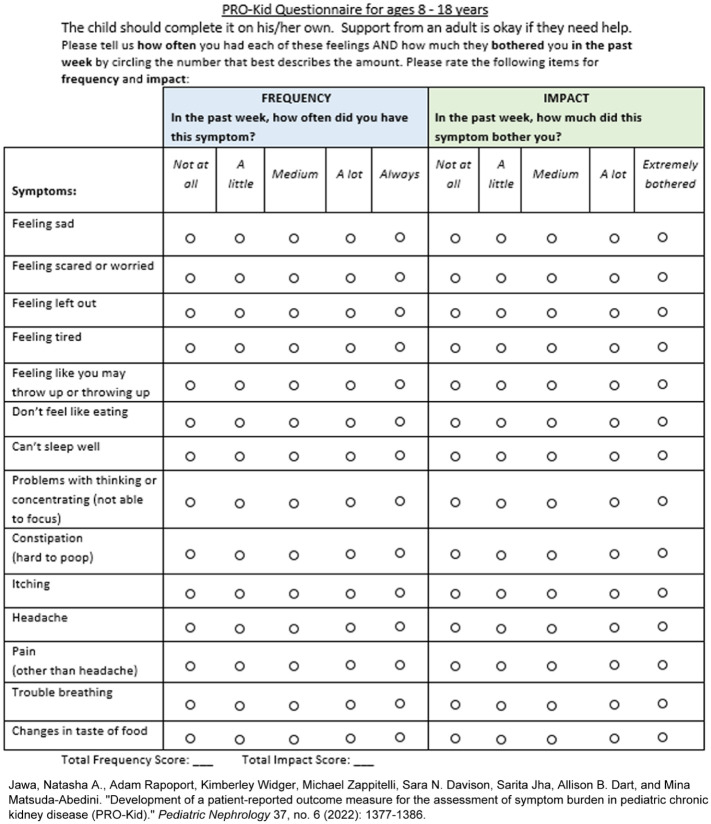
Sources of information: The PRO-Kid tool is a novel 14-item questionnaire that was developed and validated by our research team, in partnership with patients living with childhood-onset CKD and caregivers for children with G3-G5 CKD, including dialysis. PRO-Kid measures both the frequency and impact of CKD symptoms in children ages eight to 18 years. It showed strong internal consistency and validity, as demonstrated by a Cronbach alpha of .83 (95% confidence interval [CI], 0.78-0.88) for the frequency scale, and .84 (95% CI, 0.80-0.89) on the impact scale.
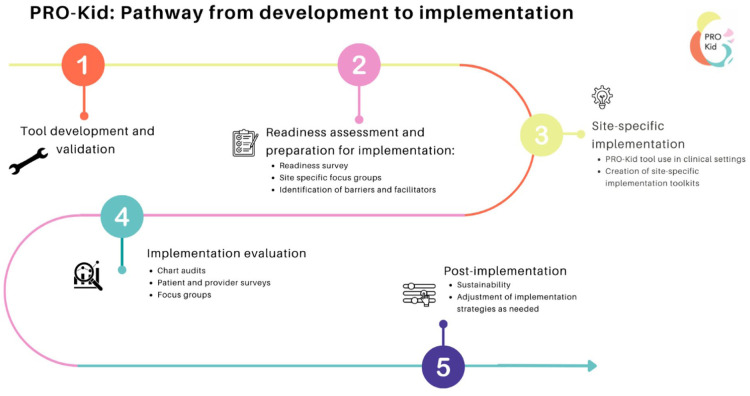
Methods: The PRO-Kid tool is being implemented in seven Pediatric Nephrology Programs across Canada. Guided by the Consolidated Framework for Implementation Research (CFIR), organizational readiness at each of the sites was assessed via surveys and focus groups. To date, the PRO-Kid tool (eight- to 18-year-old version) and site-specific toolkits have been implemented at three sites that were ready to launch (HSC, Winnipeg; BC Children's Hospital, Vancouver; and McMaster Children's Hospital, Hamilton). Implementation outcomes, such as the number of patients reached and patient and provider satisfaction, were evaluated using audits, surveys, and focus groups guided by the Reach, Effectiveness, Adoption, Implementation, and Maintenance (RE-AIM) framework.
Key findings: The organizational readiness assessment identified different electronic medical records and preferences for paper-based data collection methods across sites as well as the need to translate the PRO-Kid tool into other languages. Preliminary evaluation revealed that PRO-Kid is easy to use and is satisfactory to both patients and health care providers. Local champions were identified as key facilitators of implementation efforts. PRO-Kid can help improve communication between children with CKD and their health care providers in identifying symptoms that may not otherwise come up (be disclosed) during clinical encounters. However, language and low reading levels are barriers for some children, and unavailability of clinical staff can limit the use of the tool at some sites.
Implications: Local teams will be required to play crucial roles in integrating the use of the tool in clinical settings. To ensure the tool can be applied across diverse populations, the validation of PRO-Kid tool two to four years old, five to seven years old, and French versions are ongoing. The availability of different versions of the tool will ensure equitable access and promote sustainability of the tool.
期刊介绍:
Canadian Journal of Kidney Health and Disease, the official journal of the Canadian Society of Nephrology, is an open access, peer-reviewed online journal that encourages high quality submissions focused on clinical, translational and health services delivery research in the field of chronic kidney disease, dialysis, kidney transplantation and organ donation. Our mandate is to promote and advocate for kidney health as it impacts national and international communities. Basic science, translational studies and clinical studies will be peer reviewed and processed by an Editorial Board comprised of geographically diverse Canadian and international nephrologists, internists and allied health professionals; this Editorial Board is mandated to ensure highest quality publications.



 求助内容:
求助内容: 应助结果提醒方式:

 京公网安备 11010802042870号


