
Fabrication of noncrosslinked poly(N-dodecyl acrylamide) monolayer-thick sheets by exfoliation using poor solvents
IF 2.7
4区 化学
Q3 POLYMER SCIENCE
引用次数: 0
Abstract
Two-dimensional polymeric materials (2DPMs) have attracted increasing attention from researchers owing to their unique structural and functional properties. Most reported 2DPMs are composed of covalently crosslinked polymer networks to ensure structural integrity. Herein, we demonstrate the exfoliation of large-area noncrosslinked 2DPMs from stacked lamellar films composed of poly(N-dodecyl acrylamide) (pDDA). Generally, pDDA forms a well-oriented lamellar structure via nanophase segregation of the hydrophilic main chain and hydrophobic alkyl side chains. In this work, monolayers were exfoliated from the stacked lamellae using poor solvents. Systematic solvent-dependent exfoliation studies revealed that hexane, ethyl acetate, and 2-propanol effectively exfoliated micrometer-scale monolayer sheets, whereas the polar methanol solvent induced polymer dissolution into random coils. Atomic force microscopy and transmission electron microscopy analyses confirmed the formation of nanosheets with sizes of a few micrometers and lateral dimensions approximately equal to the monolayer thickness. Furthermore, spin-transferred 2DPMs exhibited unique dendritic or spider web-like network morphologies, which were influenced by the solvent choice and centrifugal forces. Thus, this study provides a simple and scalable approach for preparing large-area noncrosslinked 2DPMs and offers insights into controlling their morphology through solvent selection. Two-dimensional polymeric materials (2DPMs) with unique structural and functional properties are typically crosslinked for stability. Here, large-area noncrosslinked 2DPMs were exfoliated from lamellar films of poly(N-dodecyl acrylamide) (pDDA), which forms nanophase-separated lamellae via segregation of hydrophilic and hydrophobic segments. Poor-solvent exfoliation using hexane, ethyl acetate, or 2-propanol produced micrometer-scale monolayer nanosheets, whereas methanol dissolved the polymer. AFM and TEM confirmed nanosheet morphology, and spin-transferred films displayed dendritic or spiderweb-like networks dependent on solvent and centrifugal forces, offering a simple, scalable route to morphology-controlled noncrosslinked 2DPMs.
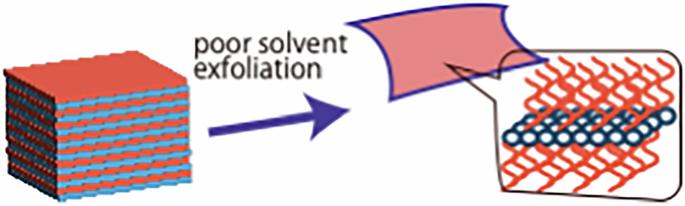
用劣质溶剂剥离法制备非交联聚n -十二烷基丙烯酰胺单层厚片材
二维高分子材料以其独特的结构和功能特性受到越来越多研究者的关注。大多数报道的2dpm由共价交联聚合物网络组成,以确保结构完整性。在此,我们展示了由聚n -十二烷基丙烯酰胺(pDDA)组成的堆叠层状薄膜的大面积非交联2dpm的剥离。通常,pDDA通过亲水性主链和疏水性烷基侧链的纳米相分离形成取向良好的层状结构。在这项工作中,单层从堆叠的片层中剥离使用劣质溶剂。系统的溶剂依赖性剥离研究表明,己烷、乙酸乙酯和2-丙醇可以有效地剥离微米尺度的单层片,而极性甲醇溶剂则会导致聚合物溶解成随机线圈。原子力显微镜和透射电子显微镜分析证实了纳米片的形成,其尺寸为几微米,横向尺寸约等于单层厚度。此外,自旋转移的2dpm表现出独特的枝状或蜘蛛网状网络形态,这受溶剂选择和离心力的影响。因此,本研究为制备大面积非交联2dpm提供了一种简单且可扩展的方法,并为通过溶剂选择控制其形态提供了见解。二维聚合物材料(2dpm)具有独特的结构和功能特性,通常是交联的稳定性。在这里,大面积非交联的2dpm从聚n -十二烷基丙烯酰胺(pDDA)的片层膜上剥离,通过亲疏水段的分离形成纳米相分离的片层。使用正己烷、乙酸乙酯或2-丙醇进行低溶剂剥离,可产生微米级单层纳米片,而甲醇可溶解聚合物。原子力显微镜(AFM)和透射电镜(TEM)证实了纳米片的形貌,自旋转移膜显示出依赖于溶剂和离心力的枝状或蜘蛛网状网络,为形貌控制的非交联2dpm提供了一种简单、可扩展的途径。
本文章由计算机程序翻译,如有差异,请以英文原文为准。
求助全文
约1分钟内获得全文
求助全文
来源期刊
Polymer Journal
化学-高分子科学
CiteScore
5.60
自引率
7.10%
发文量
131
审稿时长
2.5 months
期刊介绍:
Polymer Journal promotes research from all aspects of polymer science from anywhere in the world and aims to provide an integrated platform for scientific communication that assists the advancement of polymer science and related fields. The journal publishes Original Articles, Notes, Short Communications and Reviews.
Subject areas and topics of particular interest within the journal''s scope include, but are not limited to, those listed below:
Polymer synthesis and reactions
Polymer structures
Physical properties of polymers
Polymer surface and interfaces
Functional polymers
Supramolecular polymers
Self-assembled materials
Biopolymers and bio-related polymer materials
Polymer engineering.
 求助内容:
求助内容: 应助结果提醒方式:

 京公网安备 11010802042870号


