
Polyacrylic acid nanoparticles encapsulating doxorubicin: structural analysis and encapsulation mechanism
IF 2.7
4区 化学
Q3 POLYMER SCIENCE
引用次数: 0
Abstract
Monodisperse poly(acrylic acid) (PAA) nanoparticles were synthesized via precipitation polymerization. Markedly high loading of the anticancer drug doxorubicin hydrochloride (DOX) was achieved, with drug contents reaching approximately 44 wt%, which exceeds the values typically reported for polymer-based nanocarriers. Structural analyses using transmission electron microscopy and small-angle X-ray scattering (SAXS) revealed that the encapsulated DOX was not distributed uniformly but instead formed a distinct core-localized DOX-rich domain while maintaining the spherical morphology of the PAA nanoparticles. Notably, each PAA nanoparticle typically contained a single DOX-rich domain, and morphologies with multiple domains were rarely observed, indicating a single-domain nucleation and growth mechanism. Quantitative single-particle fluorescence analysis further demonstrated that the proportion of DOX-loaded particles increased systematically with increasing drug loading, reaching 75.8% at 44 wt%, which was consistent with the results of the SAXS analysis. In addition, the PAA nanoparticles exhibited strong and stable affinity toward hydroxyapatite, underscoring their potential for bone-targeted drug delivery. Collectively, these findings establish PAA nanoparticles as robust, high-capacity carriers with unique structural features and bone affinity, offering a promising platform for advanced drug delivery systems, particularly in the treatment of metastatic cancers. Monodisperse poly(acrylic acid) nanoparticles encapsulate doxorubicin at high contents (~44 wt%), forming a single core-localized DOX-rich domain as revealed by SAXS and TEM while retaining spherical morphology. Single-particle fluorescence showed that the fraction of DOX-positive particles increased with loading, reaching 75.8% at 44 wt% DOX. The particles also exhibit strong hydroxyapatite affinity, highlighting their promise as robust, high-capacity carriers for bone-targeted drug delivery and potential treatment of metastatic cancers.
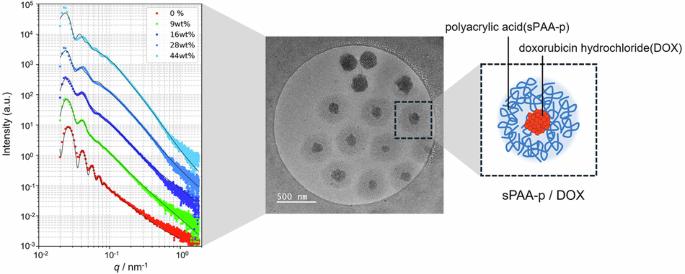
聚丙烯酸纳米颗粒包封阿霉素:结构分析及包封机理
采用沉淀法合成了单分散聚丙烯酸(PAA)纳米颗粒。抗肿瘤药物盐酸多柔比星(DOX)的载药量明显高,药物含量达到约44%,超过了聚合物基纳米载体的典型报道值。利用透射电子显微镜和小角度x射线散射(SAXS)对PAA纳米颗粒进行结构分析,发现包封后的DOX并非均匀分布,而是形成了一个明显的核心定位的富含DOX的结构域,同时保持了PAA纳米颗粒的球形形貌。值得注意的是,每个PAA纳米颗粒通常含有一个富含dox的结构域,而具有多个结构域的形貌很少被观察到,这表明PAA纳米颗粒的成核和生长机制是单一的。单颗粒荧光定量分析进一步表明,dox负载颗粒的比例随着载药量的增加而系统增加,在44 wt%时达到75.8%,这与SAXS分析的结果一致。此外,PAA纳米颗粒对羟基磷灰石表现出强大而稳定的亲和力,强调了它们在骨靶向药物递送方面的潜力。总的来说,这些发现证明了PAA纳米颗粒是一种强大的、高容量的载体,具有独特的结构特征和骨亲和力,为先进的药物输送系统提供了一个有希望的平台,特别是在转移性癌症的治疗中。单分散的聚丙烯酸纳米颗粒包封了高含量的阿霉素(~44 wt%),通过SAXS和TEM发现形成了一个单核定位的富含dox的结构域,同时保持了球形形态。单颗粒荧光显示,DOX阳性颗粒的比例随着负载的增加而增加,在44 wt% DOX时达到75.8%。这些颗粒还表现出很强的羟基磷灰石亲和力,突显了它们作为骨靶向药物递送和转移性癌症潜在治疗的强大、高容量载体的前景。
本文章由计算机程序翻译,如有差异,请以英文原文为准。
求助全文
约1分钟内获得全文
求助全文
来源期刊
Polymer Journal
化学-高分子科学
CiteScore
5.60
自引率
7.10%
发文量
131
审稿时长
2.5 months
期刊介绍:
Polymer Journal promotes research from all aspects of polymer science from anywhere in the world and aims to provide an integrated platform for scientific communication that assists the advancement of polymer science and related fields. The journal publishes Original Articles, Notes, Short Communications and Reviews.
Subject areas and topics of particular interest within the journal''s scope include, but are not limited to, those listed below:
Polymer synthesis and reactions
Polymer structures
Physical properties of polymers
Polymer surface and interfaces
Functional polymers
Supramolecular polymers
Self-assembled materials
Biopolymers and bio-related polymer materials
Polymer engineering.
 求助内容:
求助内容: 应助结果提醒方式:

 京公网安备 11010802042870号


