
Fish-borne trematode metacercarial infections as bioindicators for heavy-metal contamination in cyprinoid fish from Northeastern Thailand
IF 3.1
Q2 PARASITOLOGY
Food and Waterborne Parasitology
Pub Date : 2026-03-01
Epub Date: 2026-02-18
DOI:10.1016/j.fawpar.2026.e00321
引用次数: 0
Abstract
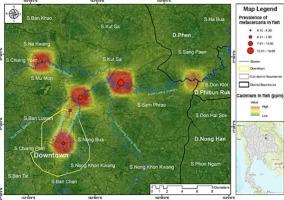
In Southeast Asia, consumption of raw or undercooked cyprinoid fish poses dual health concerns: transmission of zoonotic fish-borne trematodes (FBTs) and exposure to heavy metals that have bioaccumulated in fish. We investigated the association between heavy-metal contamination and FBT metacercarial infections in cyprinoid fish from canals connected to the Huay Luang River, Udon Thani Province, Thailand, during the 2024 rainy season. In total, 1377 fish were examined for metacercariae using the pepsin digestion method. Concentrations of five heavy-metals (Cd, Zn, Cu, Ni, and Pb) were quantified by atomic absorption spectrometry (AAS) in infected fish, uninfected fish, water, sediment, and Bithynia snails. The overall prevalence of infection was 8.5%, with mean intensities of 1.6–3.6 metacercariae/infected fish. Infected fish contained significantly higher Cd (1.63 ppm), Cu (11.06 ppm), and Zn (68.51 ppm) than uninfected fish (P ≤ 0.001). Pearson correlation revealed positive associations between metacercarial prevalence and all metal concentrations, except Pb (P < 0.05). Multivariable regression identified Cd as the strongest predictor of infection intensity, with each 1-ppm increase associated with 5.36 additional metacercariae/infected fish (P < 0.001). Bioaccumulation factors were higher in infected fish for Cd (ratio 1.3), Zn (ratio 1.6), and Cu (ratio 1.4) compare to uninfected fish, while Pb was lower. Spatial analysis identified three sites where elevated Cd overlapped with high parasite intensity. These findings establish FBT metacercariae as site-specific bioindicators of heavy-metal accumulation, highlighting the public-health risk from co-exposure and their potential use in food safety and ecosystem monitoring.
泰国东北部鲤科鱼类中吸虫蚴感染作为重金属污染的生物指标。
在东南亚,食用生的或未煮熟的鲤类鱼会带来双重健康问题:人畜共患的鱼源性吸虫的传播和接触鱼类体内生物积累的重金属。我们调查了重金属污染与2024年雨季期间泰国乌隆他尼省Huay Luang河运河中鲤类鱼类FBT metccarial感染之间的关系。用胃蛋白酶消化法对1377条鱼进行了囊蚴检测。采用原子吸收光谱法(AAS)测定了5种重金属(Cd、Zn、Cu、Ni、Pb)在感染鱼、未感染鱼、水、沉积物和双螺中的浓度。总感染率为8.5%,平均感染强度为1.6 ~ 3.6个囊蚴/条感染鱼。感染鱼的Cd (1.63 ppm)、Cu (11.06 ppm)和Zn (68.51 ppm)含量显著高于未感染鱼(P≤0.001)。Pearson相关性显示,除Pb (P P P)外,所有金属浓度与包虫病患病率呈正相关
本文章由计算机程序翻译,如有差异,请以英文原文为准。
求助全文
约1分钟内获得全文
求助全文
来源期刊

Food and Waterborne Parasitology
Immunology and Microbiology-Parasitology
CiteScore
5.10
自引率
4.00%
发文量
38
审稿时长
13 weeks
期刊介绍:
Food and Waterborne Parasitology publishes high quality papers containing original research findings, investigative reports, and scientific proceedings on parasites which are transmitted to humans via the consumption of food or water. The relevant parasites include protozoa, nematodes, cestodes and trematodes which are transmitted by food or water and capable of infecting humans. Pertinent food includes products of animal or plant origin which are domestic or wild, and consumed by humans. Animals and plants from both terrestrial and aquatic sources are included, as well as studies related to potable and other types of water which serve to harbor, perpetuate or disseminate food and waterborne parasites. Studies dealing with prevalence, transmission, epidemiology, risk assessment and mitigation, including control measures and test methodologies for parasites in food and water are of particular interest. Evidence of the emergence of such parasites and interactions among domestic animals, wildlife and humans are of interest. The impact of parasites on the health and welfare of humans is viewed as very important and within scope of the journal. Manuscripts with scientifically generated information on associations between food and waterborne parasitic diseases and lifestyle, culture and economies are also welcome. Studies involving animal experiments must meet the International Guiding Principles for Biomedical Research Involving Animals as issued by the Council for International Organizations of Medical Sciences.
 求助内容:
求助内容: 应助结果提醒方式:

 京公网安备 11010802042870号


