Imaging-based prognostic factors in patients undergoing thermal ablation for colorectal liver metastases. A retrospective study on the role of sarcopenia parameters and tumor burden score.
Maximilian Moos, Lena Maria Jacobi, Fabian Stoehr, Paul Steiner, Tobias Bäuerle, Roman Kloeckner, Constantin Scholz, Hauke Lang, Lukas Müller, Felix Hahn
{"title":"Imaging-based prognostic factors in patients undergoing thermal ablation for colorectal liver metastases. A retrospective study on the role of sarcopenia parameters and tumor burden score.","authors":"Maximilian Moos, Lena Maria Jacobi, Fabian Stoehr, Paul Steiner, Tobias Bäuerle, Roman Kloeckner, Constantin Scholz, Hauke Lang, Lukas Müller, Felix Hahn","doi":"10.2478/raon-2026-0011","DOIUrl":null,"url":null,"abstract":"<p><strong>Background: </strong>To investigate imaging-based prognostic factors in patients who underwent thermal ablation for colorectal liver metastases (CRLM), with a focus on sarcopenia-related body composition parameters and L1-bone-density in comparison to tumor burden score (TBS).</p><p><strong>Patients and methods: </strong>A retrospective analysis was conducted on patients who received thermal ablation for CRLM at our tertiary care center between 2009 and 2023. CT-derived body composition metrics included the psoas muscle volume index (PMVI), the psoas muscle index (PMI), and L1-bone-density. PMVI was automatically extracted using the open-source deep learning tool TotalSegmentator. Comparisons between 1-year survivors and non-survivors were performed using unpaired t-tests.</p><p><strong>Results: </strong>A total of 88 patients were included, most had previously undergone hepatic resection (n = 72, 82%). Among sarcopenia-related imaging markers, PMVI showed a significant association with 1-year survival (p = 0.048), with higher PMVI values observed in survivors (mean 113.3 cm<sup>3</sup>/m<sup>3</sup>) compared to non-survivors (mean 101.3 cm<sup>3</sup>/m<sup>3</sup>). No significant differences were observed for L1-density (p = 0.925) or PMI (p = 0.137). Similarly, the TBS was not significantly associated with 1-year survival (p = 0.182).</p><p><strong>Conclusions: </strong>In our cohort of patients treated with thermal ablation for CRLM, PMVI showed significant association with 1-year survival, which was not observed for conventional tumor burden score or other sarcopenia-related imaging parameters.</p>","PeriodicalId":21034,"journal":{"name":"Radiology and Oncology","volume":" ","pages":"32-39"},"PeriodicalIF":2.3000,"publicationDate":"2026-02-04","publicationTypes":"Journal Article","fieldsOfStudy":null,"isOpenAccess":false,"openAccessPdf":"https://www.ncbi.nlm.nih.gov/pmc/articles/PMC13012389/pdf/","citationCount":"0","resultStr":null,"platform":"Semanticscholar","paperid":null,"PeriodicalName":"Radiology and Oncology","FirstCategoryId":"3","ListUrlMain":"https://doi.org/10.2478/raon-2026-0011","RegionNum":4,"RegionCategory":"医学","ArticlePicture":[],"TitleCN":null,"AbstractTextCN":null,"PMCID":null,"EPubDate":"2026/3/1 0:00:00","PubModel":"eCollection","JCR":"Q3","JCRName":"ONCOLOGY","Score":null,"Total":0}
引用次数: 0
Abstract
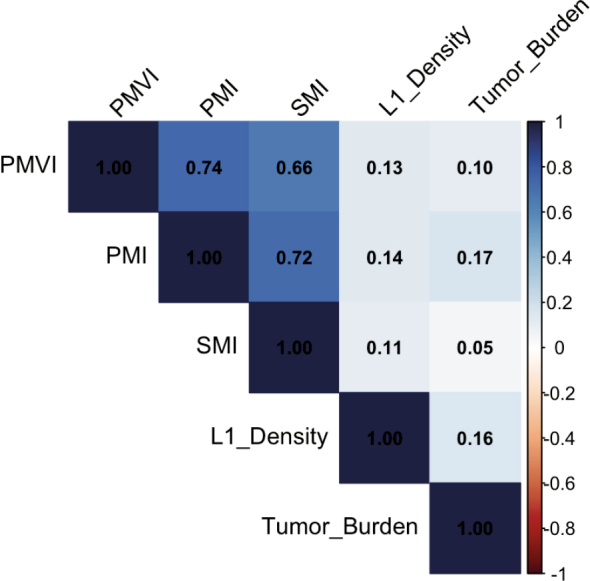
Background: To investigate imaging-based prognostic factors in patients who underwent thermal ablation for colorectal liver metastases (CRLM), with a focus on sarcopenia-related body composition parameters and L1-bone-density in comparison to tumor burden score (TBS).
Patients and methods: A retrospective analysis was conducted on patients who received thermal ablation for CRLM at our tertiary care center between 2009 and 2023. CT-derived body composition metrics included the psoas muscle volume index (PMVI), the psoas muscle index (PMI), and L1-bone-density. PMVI was automatically extracted using the open-source deep learning tool TotalSegmentator. Comparisons between 1-year survivors and non-survivors were performed using unpaired t-tests.
Results: A total of 88 patients were included, most had previously undergone hepatic resection (n = 72, 82%). Among sarcopenia-related imaging markers, PMVI showed a significant association with 1-year survival (p = 0.048), with higher PMVI values observed in survivors (mean 113.3 cm3/m3) compared to non-survivors (mean 101.3 cm3/m3). No significant differences were observed for L1-density (p = 0.925) or PMI (p = 0.137). Similarly, the TBS was not significantly associated with 1-year survival (p = 0.182).
Conclusions: In our cohort of patients treated with thermal ablation for CRLM, PMVI showed significant association with 1-year survival, which was not observed for conventional tumor burden score or other sarcopenia-related imaging parameters.
期刊介绍:
Radiology and Oncology is a multidisciplinary journal devoted to the publishing original and high quality scientific papers and review articles, pertinent to diagnostic and interventional radiology, computerized tomography, magnetic resonance, ultrasound, nuclear medicine, radiotherapy, clinical and experimental oncology, radiobiology, medical physics and radiation protection. Therefore, the scope of the journal is to cover beside radiology the diagnostic and therapeutic aspects in oncology, which distinguishes it from other journals in the field.



 求助内容:
求助内容: 应助结果提醒方式:

 京公网安备 11010802042870号


