Heewon Bae, Dae Won Seo, Seung Bong Hong, Hea Ree Park, Young-Min Shon
{"title":"Divergent Propagation Networks Define Two Pathophysiologically Distinct Electroclinical Phenotypes in Mesial Temporal Lobe Epilepsy.","authors":"Heewon Bae, Dae Won Seo, Seung Bong Hong, Hea Ree Park, Young-Min Shon","doi":"10.3988/jcn.2025.0473","DOIUrl":null,"url":null,"abstract":"<p><strong>Background and purpose: </strong>Temporal dissociation between electrographic and clinical seizure onset in mesial temporal lobe epilepsy (MTLE) implies network heterogeneity. We hypothesized that MTLE consists of distinct electroclinical phenotypes defined by divergent seizure propagation dynamics.</p><p><strong>Methods: </strong>We retrospectively analyzed 167 seizures from 13 patients with drug-resistant MTLE who achieved Engel Class I surgical outcomes. Based on the predominant relationship between scalp electroencephalography (EEG) and clinical onset, patients were classified as EEG-first (<i>n</i>=7) or Clinical-first (<i>n</i>=6). Seizure onset patterns, propagation pathways, and temporal dynamics were assessed using scalp and stereoelectroencephalography (SEEG).</p><p><strong>Results: </strong>The cohort included 83 scalp and 84 SEEG seizures. By definition, onset order differed: in EEG-first seizures, scalp changes preceded clinical signs in 70.5%, whereas the reverse occurred in 65.8% of Clinical-first seizures (<i>p</i><0.001). EEG-first seizures demonstrated longer SEEG-to-clinical latency (28.8±7.7 s vs. 13.0±7.7 s; <i>p</i>=0.004) and rhythmic theta onset on scalp EEG with focal SEEG low-voltage fast activity or preictal spikes. In contrast, Clinical-first seizures showed heterogeneous scalp patterns (theta, delta-theta, or delta slowing). Propagation tended to differ, with anterior pathways more common in EEG-first (69.6%) and posterior pathways in Clinical-first (26.3%), though with partial overlap (<i>p</i>=0.138).</p><p><strong>Conclusions: </strong>MTLE comprises two pathophysiologically distinct phenotypes: EEG-first, reflecting a slowly propagating anterior mesial network, and Clinical-first, involving a rapidly spreading posterior network. This classification offers a mechanistic framework for understanding electroclinical dissociation and may refine presurgical evaluation.</p>","PeriodicalId":15432,"journal":{"name":"Journal of Clinical Neurology","volume":"22 2","pages":"203-211"},"PeriodicalIF":3.1000,"publicationDate":"2026-03-01","publicationTypes":"Journal Article","fieldsOfStudy":null,"isOpenAccess":false,"openAccessPdf":"https://www.ncbi.nlm.nih.gov/pmc/articles/PMC12956459/pdf/","citationCount":"0","resultStr":null,"platform":"Semanticscholar","paperid":null,"PeriodicalName":"Journal of Clinical Neurology","FirstCategoryId":"3","ListUrlMain":"https://doi.org/10.3988/jcn.2025.0473","RegionNum":3,"RegionCategory":"医学","ArticlePicture":[],"TitleCN":null,"AbstractTextCN":null,"PMCID":null,"EPubDate":"","PubModel":"","JCR":"Q2","JCRName":"CLINICAL NEUROLOGY","Score":null,"Total":0}
引用次数: 0
Abstract
Background and purpose: Temporal dissociation between electrographic and clinical seizure onset in mesial temporal lobe epilepsy (MTLE) implies network heterogeneity. We hypothesized that MTLE consists of distinct electroclinical phenotypes defined by divergent seizure propagation dynamics.
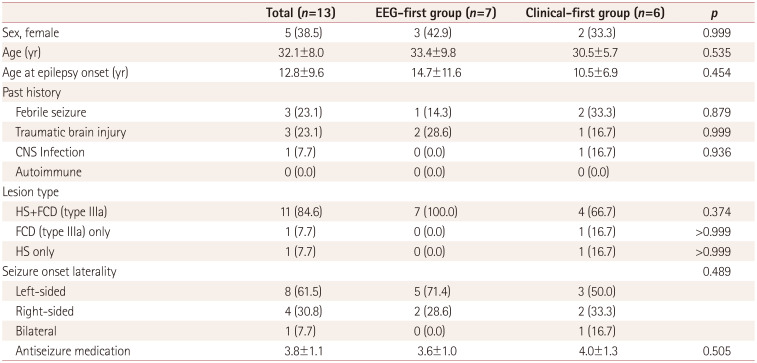
Methods: We retrospectively analyzed 167 seizures from 13 patients with drug-resistant MTLE who achieved Engel Class I surgical outcomes. Based on the predominant relationship between scalp electroencephalography (EEG) and clinical onset, patients were classified as EEG-first (n=7) or Clinical-first (n=6). Seizure onset patterns, propagation pathways, and temporal dynamics were assessed using scalp and stereoelectroencephalography (SEEG).
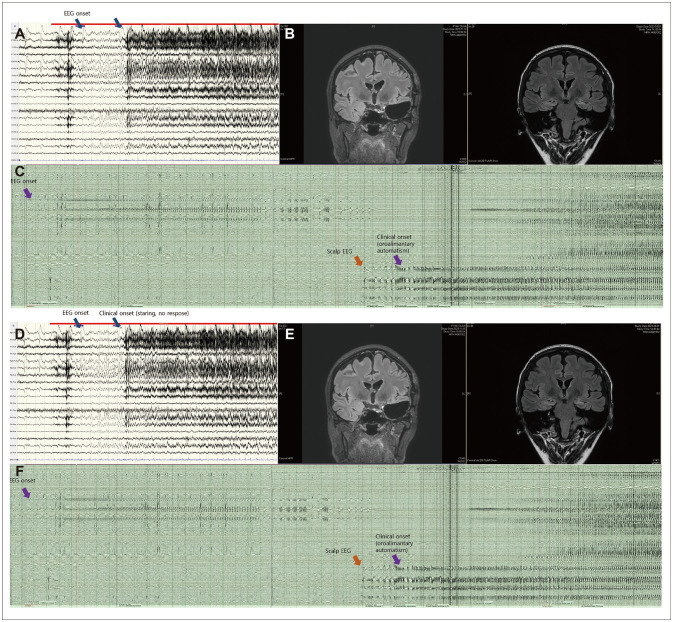
Results: The cohort included 83 scalp and 84 SEEG seizures. By definition, onset order differed: in EEG-first seizures, scalp changes preceded clinical signs in 70.5%, whereas the reverse occurred in 65.8% of Clinical-first seizures (p<0.001). EEG-first seizures demonstrated longer SEEG-to-clinical latency (28.8±7.7 s vs. 13.0±7.7 s; p=0.004) and rhythmic theta onset on scalp EEG with focal SEEG low-voltage fast activity or preictal spikes. In contrast, Clinical-first seizures showed heterogeneous scalp patterns (theta, delta-theta, or delta slowing). Propagation tended to differ, with anterior pathways more common in EEG-first (69.6%) and posterior pathways in Clinical-first (26.3%), though with partial overlap (p=0.138).
Conclusions: MTLE comprises two pathophysiologically distinct phenotypes: EEG-first, reflecting a slowly propagating anterior mesial network, and Clinical-first, involving a rapidly spreading posterior network. This classification offers a mechanistic framework for understanding electroclinical dissociation and may refine presurgical evaluation.
期刊介绍:
The JCN aims to publish the cutting-edge research from around the world. The JCN covers clinical and translational research for physicians and researchers in the field of neurology. Encompassing the entire neurological diseases, our main focus is on the common disorders including stroke, epilepsy, Parkinson''s disease, dementia, multiple sclerosis, headache, and peripheral neuropathy. Any authors affiliated with an accredited biomedical institution may submit manuscripts of original articles, review articles, and letters to the editor. The JCN will allow clinical neurologists to enrich their knowledge of patient management, education, and clinical or experimental research, and hence their professionalism.



 求助内容:
求助内容: 应助结果提醒方式:

 京公网安备 11010802042870号


