Andrei S. Steindorff, Feng M. Cai, Mingyue Ding, Siqi Jiang, Lea Atanasova, Scott E. Baker, Jomal Rodrigues Barbosa-Filho, Gunseli Bayram Akcapinar, Daren W. Brown, Priscila Chaverri, Peijie Chen, Komal Chenthamara, Chris Daum, Elodie Drula, Mukesh Dubey, Mikael Brandström Durling, Daniel Flatschacher, Thomas Ebner, Tamás Emri, Renwei Gao, Raphaela Castro Georg, Bernard Henrissat, Rosa Hermosa, Alfredo Herrera-Estrella, Wolfgang Hinterdobler, Philipp Kainz, Magnus Karlsson, László Kredics, Christian P. Kubicek, Alan Kuo, Kurt LaButti, Anna Lipzen, Matteo Lorito, Robert L. Mach, Gelsomina Manganiello, Tamás Marik, Natalia Martinez-Reyes, Michael Mayrhofer-Reinhartshuber, Márton Miskei, Marie-Claude Moisan, Stephen Mondo, Enrique Monte, Vivian Ng, Guan Pang, Jasmyn Pangilinan, Mao Peng, Edoardo Piombo, István Pócsi, Mohammad Javad Rahimi, Sumitha K. Reddy, Robert Riley, Sabrina Sarrocco, Matthias Schmal, Monika Schmoll, Attila Szűcs, Sheridan L. Woo, Oded Yarden, Susanne Zeilinger, Christian Zimmermann, Ekaterina Shelest, Adrian Tsang, Randy Berka, Ronald P. de Vries, Igor V. Grigoriev, Irina S. Druzhinina
{"title":"Phenogenomics reveals the ecology and evolution of Trichoderma fungi for sustainable agriculture","authors":"Andrei S. Steindorff, Feng M. Cai, Mingyue Ding, Siqi Jiang, Lea Atanasova, Scott E. Baker, Jomal Rodrigues Barbosa-Filho, Gunseli Bayram Akcapinar, Daren W. Brown, Priscila Chaverri, Peijie Chen, Komal Chenthamara, Chris Daum, Elodie Drula, Mukesh Dubey, Mikael Brandström Durling, Daniel Flatschacher, Thomas Ebner, Tamás Emri, Renwei Gao, Raphaela Castro Georg, Bernard Henrissat, Rosa Hermosa, Alfredo Herrera-Estrella, Wolfgang Hinterdobler, Philipp Kainz, Magnus Karlsson, László Kredics, Christian P. Kubicek, Alan Kuo, Kurt LaButti, Anna Lipzen, Matteo Lorito, Robert L. Mach, Gelsomina Manganiello, Tamás Marik, Natalia Martinez-Reyes, Michael Mayrhofer-Reinhartshuber, Márton Miskei, Marie-Claude Moisan, Stephen Mondo, Enrique Monte, Vivian Ng, Guan Pang, Jasmyn Pangilinan, Mao Peng, Edoardo Piombo, István Pócsi, Mohammad Javad Rahimi, Sumitha K. Reddy, Robert Riley, Sabrina Sarrocco, Matthias Schmal, Monika Schmoll, Attila Szűcs, Sheridan L. Woo, Oded Yarden, Susanne Zeilinger, Christian Zimmermann, Ekaterina Shelest, Adrian Tsang, Randy Berka, Ronald P. de Vries, Igor V. Grigoriev, Irina S. Druzhinina","doi":"10.1038/s41564-026-02260-3","DOIUrl":null,"url":null,"abstract":"Trichoderma fungi support sustainable agriculture by suppressing plant diseases and improving crop performance. However, emerging pathogenicity of Trichoderma warrants further ecological and genetic characterization. Here we used machine learning to correlate genomic data from 37 Trichoderma strains with over 140 phenotypic traits, spanning metabolic versatility, biotic interactions, stress tolerance and reproductive strategies. We determined Trichoderma to be an ancient, genetically cohesive and physiologically diverse genus with spores capable of germination in water and dispersal via air and water droplets. Metabolic preferences indicate universal adaptation to mycoparasitism and to niches like arboreal microbial mats, alongside broader saprotrophic versatility. Our analyses are consistent with character displacement among close relatives and convergent evolution in distant lineages, with both processes shaping ecological plasticity and traits including dispersal modes, terrestrialization or endophytism. Our findings reveal that while some Trichoderma species show traits of biosafety concern, its vast ecophysiological diversity enables the development of safe, targeted bioeffectors. Analysis of 37 genomes together with more than 140 phenotypic traits links genomic features to ecological fitness and lifestyle diversity in Trichoderma fungi.","PeriodicalId":18992,"journal":{"name":"Nature Microbiology","volume":"11 3","pages":"815-831"},"PeriodicalIF":19.4000,"publicationDate":"2026-03-03","publicationTypes":"Journal Article","fieldsOfStudy":null,"isOpenAccess":false,"openAccessPdf":"https://www.nature.comhttps://www.nature.com/articles/s41564-026-02260-3.pdf","citationCount":"0","resultStr":null,"platform":"Semanticscholar","paperid":null,"PeriodicalName":"Nature Microbiology","FirstCategoryId":"99","ListUrlMain":"https://www.nature.com/articles/s41564-026-02260-3","RegionNum":1,"RegionCategory":"生物学","ArticlePicture":[],"TitleCN":null,"AbstractTextCN":null,"PMCID":null,"EPubDate":"","PubModel":"","JCR":"Q1","JCRName":"MICROBIOLOGY","Score":null,"Total":0}
引用次数: 0
Abstract
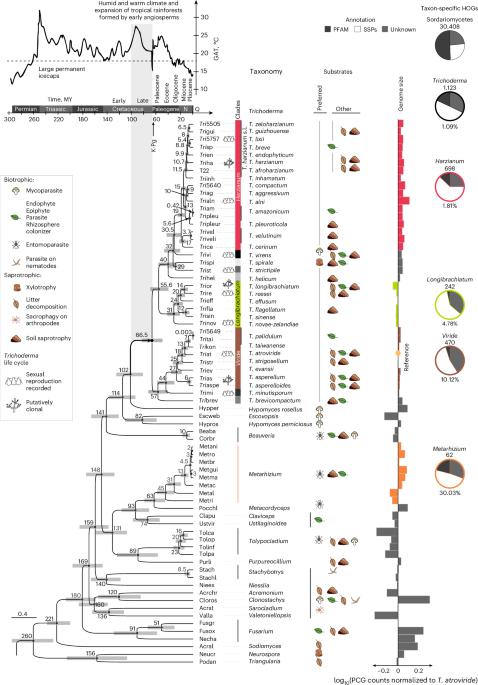
Trichoderma fungi support sustainable agriculture by suppressing plant diseases and improving crop performance. However, emerging pathogenicity of Trichoderma warrants further ecological and genetic characterization. Here we used machine learning to correlate genomic data from 37 Trichoderma strains with over 140 phenotypic traits, spanning metabolic versatility, biotic interactions, stress tolerance and reproductive strategies. We determined Trichoderma to be an ancient, genetically cohesive and physiologically diverse genus with spores capable of germination in water and dispersal via air and water droplets. Metabolic preferences indicate universal adaptation to mycoparasitism and to niches like arboreal microbial mats, alongside broader saprotrophic versatility. Our analyses are consistent with character displacement among close relatives and convergent evolution in distant lineages, with both processes shaping ecological plasticity and traits including dispersal modes, terrestrialization or endophytism. Our findings reveal that while some Trichoderma species show traits of biosafety concern, its vast ecophysiological diversity enables the development of safe, targeted bioeffectors. Analysis of 37 genomes together with more than 140 phenotypic traits links genomic features to ecological fitness and lifestyle diversity in Trichoderma fungi.
期刊介绍:
Nature Microbiology aims to cover a comprehensive range of topics related to microorganisms. This includes:
Evolution: The journal is interested in exploring the evolutionary aspects of microorganisms. This may include research on their genetic diversity, adaptation, and speciation over time.
Physiology and cell biology: Nature Microbiology seeks to understand the functions and characteristics of microorganisms at the cellular and physiological levels. This may involve studying their metabolism, growth patterns, and cellular processes.
Interactions: The journal focuses on the interactions microorganisms have with each other, as well as their interactions with hosts or the environment. This encompasses investigations into microbial communities, symbiotic relationships, and microbial responses to different environments.
Societal significance: Nature Microbiology recognizes the societal impact of microorganisms and welcomes studies that explore their practical applications. This may include research on microbial diseases, biotechnology, or environmental remediation.
In summary, Nature Microbiology is interested in research related to the evolution, physiology and cell biology of microorganisms, their interactions, and their societal relevance.