{"title":"Motion Artifact Correction in MRI with a Gibbs Sampling Residual Diffusion Model","authors":"Jingwen Yue, Rui Chen, Zijian Jia, Le Liu","doi":"10.1007/s00723-026-01831-1","DOIUrl":null,"url":null,"abstract":"<div><p>Motion artifacts in magnetic resonance imaging (MRI) substantially degrade image quality and compromise subsequent image analysis and clinical interpretation. To address this challenge, we propose Gibbs Sampling Residual Diffusion Motion Correction (GRDMoCo), a novel retrospective motion correction framework based on a deep generative diffusion model. GRDMoCo decouples the conventional diffusion process into two sub-processes—residual diffusion and noise diffusion—enhancing the model’s capacity to capture the underlying mechanisms of motion artifact generation. Furthermore, it integrates a Gibbs sampling strategy to effectively tackle the non-convex optimization problem inherent in motion parameter estimation, enabling progressive artifact suppression through a residual-guided diffusion process. Extensive experiments demonstrate that GRDMoCo consistently outperforms state-of-the-art methods in both qualitative and quantitative evaluations, achieving superior anatomical boundary preservation and accurate morphological restoration, particularly in abnormal brain tissues. On real motion-corrupted datasets, GRDMoCo achieves an average structural similarity index (SSIM) of 0.9734 and a peak signal-to-noise ratio (PSNR) of 36.7 dB, significantly exceeding all benchmark approaches. In conclusion, GRDMoCo offers an effective deep learning-based solution for MRI motion artifact correction with strong clinical potential, especially for motion-prone populations such as infants and patients with Alzheimer’s disease, and also holds promise for extension to other motion-sensitive imaging modalities, including functional MRI (fMRI) and diffusion-weighted imaging (DWI).</p></div>","PeriodicalId":469,"journal":{"name":"Applied Magnetic Resonance","volume":"57 2","pages":""},"PeriodicalIF":1.3000,"publicationDate":"2026-02-24","publicationTypes":"Journal Article","fieldsOfStudy":null,"isOpenAccess":false,"openAccessPdf":"","citationCount":"0","resultStr":null,"platform":"Semanticscholar","paperid":null,"PeriodicalName":"Applied Magnetic Resonance","FirstCategoryId":"101","ListUrlMain":"https://link.springer.com/article/10.1007/s00723-026-01831-1","RegionNum":4,"RegionCategory":"物理与天体物理","ArticlePicture":[],"TitleCN":null,"AbstractTextCN":null,"PMCID":null,"EPubDate":"","PubModel":"","JCR":"Q4","JCRName":"PHYSICS, ATOMIC, MOLECULAR & CHEMICAL","Score":null,"Total":0}
引用次数: 0
Abstract
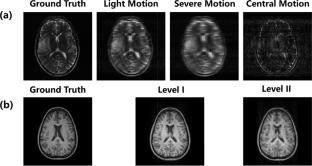
Motion artifacts in magnetic resonance imaging (MRI) substantially degrade image quality and compromise subsequent image analysis and clinical interpretation. To address this challenge, we propose Gibbs Sampling Residual Diffusion Motion Correction (GRDMoCo), a novel retrospective motion correction framework based on a deep generative diffusion model. GRDMoCo decouples the conventional diffusion process into two sub-processes—residual diffusion and noise diffusion—enhancing the model’s capacity to capture the underlying mechanisms of motion artifact generation. Furthermore, it integrates a Gibbs sampling strategy to effectively tackle the non-convex optimization problem inherent in motion parameter estimation, enabling progressive artifact suppression through a residual-guided diffusion process. Extensive experiments demonstrate that GRDMoCo consistently outperforms state-of-the-art methods in both qualitative and quantitative evaluations, achieving superior anatomical boundary preservation and accurate morphological restoration, particularly in abnormal brain tissues. On real motion-corrupted datasets, GRDMoCo achieves an average structural similarity index (SSIM) of 0.9734 and a peak signal-to-noise ratio (PSNR) of 36.7 dB, significantly exceeding all benchmark approaches. In conclusion, GRDMoCo offers an effective deep learning-based solution for MRI motion artifact correction with strong clinical potential, especially for motion-prone populations such as infants and patients with Alzheimer’s disease, and also holds promise for extension to other motion-sensitive imaging modalities, including functional MRI (fMRI) and diffusion-weighted imaging (DWI).
期刊介绍:
Applied Magnetic Resonance provides an international forum for the application of magnetic resonance in physics, chemistry, biology, medicine, geochemistry, ecology, engineering, and related fields.
The contents include articles with a strong emphasis on new applications, and on new experimental methods. Additional features include book reviews and Letters to the Editor.

 求助内容:
求助内容: 应助结果提醒方式:

 京公网安备 11010802042870号


