{"title":"Dependence of the Elastic Modulus of a Diamond–Silicon Carbide Composite Material on Its Phase Composition","authors":"M. M. Sychev, A. S. Dolgin, S. P. Bogdanov","doi":"10.1134/S1087659625600875","DOIUrl":null,"url":null,"abstract":"<p>Young’s modulus (elastic modulus) of ceramics is a fundamental property that influences the mechanical characteristics of the material. When designing a ceramic material, a large number of experiments are required to determine the influence of phase composition on the elastic modulus. To quickly select the composition of a composite, it would be optimal to calculate its properties; however, today, there is no consensus on the dependence of Young’s modulus of composite materials consisting of brittle components on their composition. This paper proposes an equation for calculating the elastic modulus of a diamond–silicon carbide composite, which includes its phase composition, elastic moduli of the phases, composite porosity, and pore shape factor, which allows for a fairly accurate prediction of the material’s properties.</p>","PeriodicalId":580,"journal":{"name":"Glass Physics and Chemistry","volume":"51 6","pages":"743 - 749"},"PeriodicalIF":0.7000,"publicationDate":"2026-02-24","publicationTypes":"Journal Article","fieldsOfStudy":null,"isOpenAccess":false,"openAccessPdf":"","citationCount":"0","resultStr":null,"platform":"Semanticscholar","paperid":null,"PeriodicalName":"Glass Physics and Chemistry","FirstCategoryId":"88","ListUrlMain":"https://link.springer.com/article/10.1134/S1087659625600875","RegionNum":4,"RegionCategory":"材料科学","ArticlePicture":[],"TitleCN":null,"AbstractTextCN":null,"PMCID":null,"EPubDate":"","PubModel":"","JCR":"Q4","JCRName":"MATERIALS SCIENCE, CERAMICS","Score":null,"Total":0}
引用次数: 0
Abstract
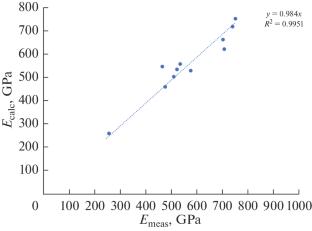
Young’s modulus (elastic modulus) of ceramics is a fundamental property that influences the mechanical characteristics of the material. When designing a ceramic material, a large number of experiments are required to determine the influence of phase composition on the elastic modulus. To quickly select the composition of a composite, it would be optimal to calculate its properties; however, today, there is no consensus on the dependence of Young’s modulus of composite materials consisting of brittle components on their composition. This paper proposes an equation for calculating the elastic modulus of a diamond–silicon carbide composite, which includes its phase composition, elastic moduli of the phases, composite porosity, and pore shape factor, which allows for a fairly accurate prediction of the material’s properties.
期刊介绍:
Glass Physics and Chemistry presents results of research on the inorganic and physical chemistry of glass, ceramics, nanoparticles, nanocomposites, and high-temperature oxides and coatings. The journal welcomes manuscripts from all countries in the English or Russian language.

 求助内容:
求助内容: 应助结果提醒方式:

 京公网安备 11010802042870号


