Yamina Ghillal, Hammou Gherras, Ahmed Yahiaoui, Aicha Hachemaoui, Abdelkader Belfedal, Ali Alsalme, Abdelkader Dehbi, Massimo Messori
{"title":"Highly Soluble Aromatic Oligoazomethine Synthesized Using Maghnite-H+ for Organic Electronics","authors":"Yamina Ghillal, Hammou Gherras, Ahmed Yahiaoui, Aicha Hachemaoui, Abdelkader Belfedal, Ali Alsalme, Abdelkader Dehbi, Massimo Messori","doi":"10.1134/S1560090425601268","DOIUrl":null,"url":null,"abstract":"<p>In this study, a conjugated oligoazomethine was synthesized via polycondensation of terephthaldehyde and <i>p</i>-phenylenediamine, aiming to develop a thermally stable, solution-processable, and semiconductive oligomer with potential applications in optoelectronic devices. The resulting oligomer exhibited a π‑conjugated backbone with azomethine (C=N) linkages, confirmed by FTIR spectroscopy. UV–visible spectroscopy revealed a red-shift in absorption, with an optical band gap of 2.69 eV, indicating semiconductive behavior. Structural analysis using XRD showed semicrystalline characteristics, while TGA demonstrated good thermal stability with decomposition onset at 455°C. SEM images revealed a rough, globular surface morphology with porous features. Oligomer yield was optimized by varying reaction parameters, with a maximum yield of 95.1% achieved at room temperature using 5% Maghnite-H<sup>+</sup> as a catalyst over 24 hours. Solubility tests confirmed good compatibility with organic solvents. Electrical conductivity measurements indicated a room temperature conductivity of 2.1 × 10<sup>−6</sup> S/cm and an activation energy of 0.24 eV, placing oligoazomethine in the category of organic semiconductors. These properties suggest the synthesized oligo-azomethine is a promising candidate for use in optoelectronic and photovoltaic applications.</p>","PeriodicalId":739,"journal":{"name":"Polymer Science, Series B","volume":"67 3","pages":""},"PeriodicalIF":1.0000,"publicationDate":"2026-02-18","publicationTypes":"Journal Article","fieldsOfStudy":null,"isOpenAccess":false,"openAccessPdf":"","citationCount":"0","resultStr":null,"platform":"Semanticscholar","paperid":null,"PeriodicalName":"Polymer Science, Series B","FirstCategoryId":"1","ListUrlMain":"https://link.springer.com/article/10.1134/S1560090425601268","RegionNum":4,"RegionCategory":"化学","ArticlePicture":[],"TitleCN":null,"AbstractTextCN":null,"PMCID":null,"EPubDate":"","PubModel":"","JCR":"Q4","JCRName":"POLYMER SCIENCE","Score":null,"Total":0}
引用次数: 0
Abstract
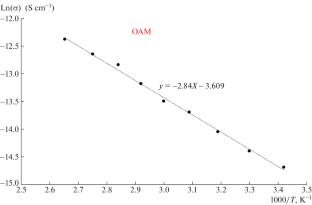
In this study, a conjugated oligoazomethine was synthesized via polycondensation of terephthaldehyde and p-phenylenediamine, aiming to develop a thermally stable, solution-processable, and semiconductive oligomer with potential applications in optoelectronic devices. The resulting oligomer exhibited a π‑conjugated backbone with azomethine (C=N) linkages, confirmed by FTIR spectroscopy. UV–visible spectroscopy revealed a red-shift in absorption, with an optical band gap of 2.69 eV, indicating semiconductive behavior. Structural analysis using XRD showed semicrystalline characteristics, while TGA demonstrated good thermal stability with decomposition onset at 455°C. SEM images revealed a rough, globular surface morphology with porous features. Oligomer yield was optimized by varying reaction parameters, with a maximum yield of 95.1% achieved at room temperature using 5% Maghnite-H+ as a catalyst over 24 hours. Solubility tests confirmed good compatibility with organic solvents. Electrical conductivity measurements indicated a room temperature conductivity of 2.1 × 10⁻⁶ S/cm and an activation energy of 0.24 eV, placing oligoazomethine in the category of organic semiconductors. These properties suggest the synthesized oligo-azomethine is a promising candidate for use in optoelectronic and photovoltaic applications.
期刊介绍:
Polymer Science, Series B is a journal published in collaboration with the Russian Academy of Sciences. Series B experimental and theoretical papers and reviews dealing with the synthesis, kinetics, catalysis, and chemical transformations of macromolecules, supramolecular structures, and polymer matrix-based composites (6 issues a year). All journal series present original papers and reviews covering all fundamental aspects of macromolecular science. Contributions should be of marked novelty and interest for a broad readership. Articles may be written in English or Russian regardless of country and nationality of authors. All manuscripts are peer reviewed

 求助内容:
求助内容: 应助结果提醒方式:

 京公网安备 11010802042870号


