V. A. Bykov, D. A. Yagodin, T. V. Kulikova, K. Yu. Shunayev
{"title":"Electrical Resistivity of Equiatomic High-Entropy CoCrFeNi Alloy at High Temperatures","authors":"V. A. Bykov, D. A. Yagodin, T. V. Kulikova, K. Yu. Shunayev","doi":"10.1134/S003602952570291X","DOIUrl":null,"url":null,"abstract":"<p>The temperature dependence of the specific electrical resistivity of the high-entropy equiatomic CoCrFeNi alloy was studied in the range of 1100–1900 K using the contactless rotating magnetic field method, including the solid and liquid states. It was found that the electrical resistivity increases linearly with temperature, and at the melting point, there is an abrupt change toward an increase in its value. High absolute electrical resistivity values and a low temperature coefficient of about 10<sup>–4</sup> K<sup>–1</sup> are retained in the condensed state. The temperature dependence of electrical resistivity obeys the Bloch–Grüneisen law, and the main scattering mechanism at high temperatures is associated with the defect crystal lattice and, to a lesser extent, with phonons. The behavior of the electrical resistivity of the disordered solid solution CoCrFeNi at high temperatures confirmed that the conductivity was metallic type.</p>","PeriodicalId":769,"journal":{"name":"Russian Metallurgy (Metally)","volume":"2025 10","pages":"1902 - 1905"},"PeriodicalIF":0.3000,"publicationDate":"2026-02-09","publicationTypes":"Journal Article","fieldsOfStudy":null,"isOpenAccess":false,"openAccessPdf":"","citationCount":"0","resultStr":null,"platform":"Semanticscholar","paperid":null,"PeriodicalName":"Russian Metallurgy (Metally)","FirstCategoryId":"5","ListUrlMain":"https://link.springer.com/article/10.1134/S003602952570291X","RegionNum":0,"RegionCategory":null,"ArticlePicture":[],"TitleCN":null,"AbstractTextCN":null,"PMCID":null,"EPubDate":"","PubModel":"","JCR":"Q4","JCRName":"METALLURGY & METALLURGICAL ENGINEERING","Score":null,"Total":0}
引用次数: 0
Abstract
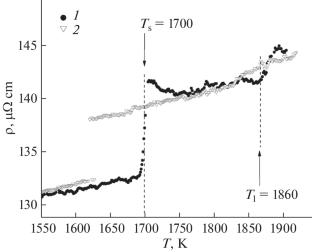
The temperature dependence of the specific electrical resistivity of the high-entropy equiatomic CoCrFeNi alloy was studied in the range of 1100–1900 K using the contactless rotating magnetic field method, including the solid and liquid states. It was found that the electrical resistivity increases linearly with temperature, and at the melting point, there is an abrupt change toward an increase in its value. High absolute electrical resistivity values and a low temperature coefficient of about 10–4 K–1 are retained in the condensed state. The temperature dependence of electrical resistivity obeys the Bloch–Grüneisen law, and the main scattering mechanism at high temperatures is associated with the defect crystal lattice and, to a lesser extent, with phonons. The behavior of the electrical resistivity of the disordered solid solution CoCrFeNi at high temperatures confirmed that the conductivity was metallic type.
期刊介绍:
Russian Metallurgy (Metally) publishes results of original experimental and theoretical research in the form of reviews and regular articles devoted to topical problems of metallurgy, physical metallurgy, and treatment of ferrous, nonferrous, rare, and other metals and alloys, intermetallic compounds, and metallic composite materials. The journal focuses on physicochemical properties of metallurgical materials (ores, slags, matters, and melts of metals and alloys); physicochemical processes (thermodynamics and kinetics of pyrometallurgical, hydrometallurgical, electrochemical, and other processes); theoretical metallurgy; metal forming; thermoplastic and thermochemical treatment; computation and experimental determination of phase diagrams and thermokinetic diagrams; mechanisms and kinetics of phase transitions in metallic materials; relations between the chemical composition, phase and structural states of materials and their physicochemical and service properties; interaction between metallic materials and external media; and effects of radiation on these materials.

 求助内容:
求助内容: 应助结果提醒方式:

 京公网安备 11010802042870号


